



























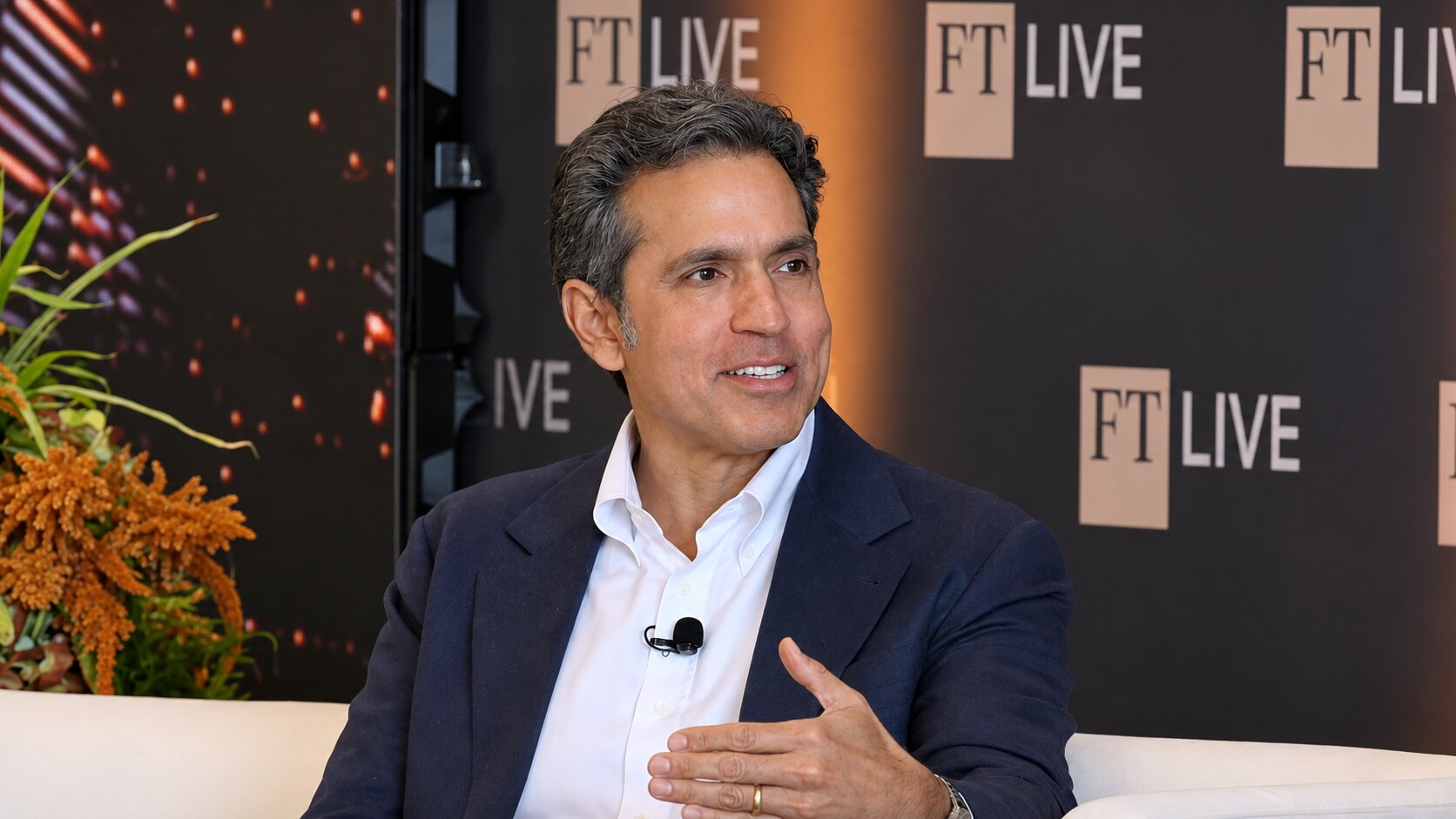
Ravi Ahuja ‘s Sony Pictures strategy: skip mega-mergers, license to streamers, build franchises across platforms. Here’s what he said and where it’s weak.
Sony Pictures’ CEO explains why he’d rather license to streamers, buy IP and build franchises than merge, and where that plan is exposed.
Sony Pictures Entertainment CEO Ravi Ahuja told the Financial Times Business of Entertainment Summit on September 24, 2026, at the 1 Hotel West Hollywood, that he has no interest in getting bigger. He was speaking with Daniel Thomas, the FT’s global media editor. He said it three days after Paramount settled the state and Writers Guild lawsuits blocking its roughly $110 billion takeover of Warner Bros. Discovery. That settlement commits the combined company to release at least 30 theatrical films a year for two years, then 32 a year for the next three.
Ahuja’s answer is not modesty. It is a thesis: scale helps you distribute content, not make it. A record-setting Spider-Man and a franchise-best Resident Evil opening are his evidence. Here is what he said, where it holds up and where it is exposed.
Scale helps streamers, not studios
Ahuja was specific about where size pays. “I think in streaming and distribution, there is value to scale,” he said, pointing to Netflix, which can outspend rivals because it spreads costs across more subscribers. Making hits is a different job. “We don’t need to become even bigger,” he said, before adding a hedge: “I’m not saying this strategy is for everyone. But for us, I think it’s a really good strategy.”
The scoreboard is real. Spider-Man: Brand New Day passed The Force Awakens’ $936 million to become the highest-grossing North American release on an unadjusted basis. Resident Evil opened to $60 million domestically, a franchise best, and $108.3 million worldwide, on a reported $75 million budget. That was the weekend before the summit.
Half supplier, half direct
Ahuja’s summary of Sony’s model: “kind of half and half. Half a supplier, but half direct.” Sony’s film and television studios supply outside buyers, while Crunchyroll and Alamo Drafthouse sell to consumers directly.
The Netflix pay-one deal is the supplier half. Announced in January 2026, it gives Netflix the first streaming window for Sony’s films worldwide, after the theatrical and home entertainment windows. It is the first time one streamer has held exclusive first-window rights to a major studio’s films worldwide. The U.S. portion begins in early 2027, with full global availability in early 2029. Terms weren’t disclosed, though sources put the value above $7 billion.
Licensing, not selling
The fine print matters. “We’re not selling them the show. We’re licensing them the show,” Ahuja said. In practice, a licensed show stays Sony’s asset and can be licensed again.
Where it’s exposed: fewer buyers, one big one
Ahuja said he thinks less about how many companies buy from suppliers and more about their health. His wish for the merging companies is that they “pay down the debt really quickly, they make a lot of money, and then they can buy a lot of content.” Then he added, “Obviously, that’s what I’m after.” A supplier’s wish, in other words: get healthy, then send checks.
It is a fair answer and an incomplete one, for three reasons.
Sony has already narrowed its own buyer pool. The first films headed to Netflix under the global deal include The Legend of Zelda and Spider-Man: Beyond the Spider-Verse, two of Sony’s biggest 2027 releases. That is concentration by design.
“No interest in getting bigger” has a footnote. TheWrap reports Sony teamed with Apollo on a 2024 bid for Paramount that lost to Skydance’s David Ellison, and that Ahuja has said the bid fit Sony’s focus on IP and capabilities.
The proof points had partners. Brand New Day is a Sony and Marvel Studios release, and Resident Evil’s budget was shared among Sony’s TriStar label, Constantin Films and Davis Films. Sony Pictures also sits inside Sony Group, and Ahuja has described the studio as integral to the conglomerate. “Agile” is relative when a conglomerate stands behind you.
Ahuja thinks theaters can handle Paramount-Warner’s slate: “I always thought this year would be the test of whether young people will go to movies, or will just keep watching their phones. But it’s pretty clear they want to go to movies.” One strong year proves less than it feels like, and he knows it. “Things go up and down,” he said.
Buy IP and capabilities, skip the mega deal
Sony’s recent purchases show the pattern. In December 2025, Sony Pictures and Sony Music Entertainment (Japan) announced a deal for WildBrain’s 41% stake in Peanuts, taking Sony to 80%. The Japanese music arm leads management of the property. Sony Pictures also put $100 million into Cosm for a minority stake. It bought Alamo Drafthouse in 2024 and has taken a long-term lease on the Cinerama Dome, slated to reopen in early 2028. “We’re primarily interested in IP and capabilities,” Ahuja said.
Big mergers fail that test. “I’m definitely not interested in big mega M&A,” he said, calling them costly and “a very difficult thing to combine in.” His preferred position: “we’re agile, we’re differentiated, we’re able to move very quickly.”
Ahuja also pointed to PlayStation game IP. Sony’s slate includes a Helldivers film dated for November 2027, alongside The Last of Us on television.
Jeopardy! and the open franchise
Ahuja’s clearest example is Jeopardy!. Pop Culture Jeopardy! moved from Prime Video to Netflix, where its second season premiered in May 2026, and Jeopardy! Masters aired in primetime on ABC in August. “We’re taking advantage of media fragmentation across platforms to build franchises,” he said.
That breaks with the old idea of a franchise kept in a closed system. Sony, in his words, is “very content-focused and untethered or unconstrained by having to go to one particular platform.”
What to watch next
Ahuja’s plan has a clear test ahead. In 2027, Sony has The Legend of Zelda in May and Beyond the Spider-Verse in June. Crunchyroll passed 21 million paid subscribers in March 2026, up from 17 million a year earlier. “For sure, there will be another Spider-Man,” he said. The question is whether buyers stay flush and numerous enough to keep paying for hits. If they do, staying agile and everywhere will look smart. If they don’t, Sony will have staked its biggest 2027 films on a market with fewer, shakier buyers.
FAQ
Why won’t Sony pursue a big studio merger?
Ahuja said mega-M&A is costly and hard to combine, and he prefers Sony’s position as agile and differentiated. Sony buys IP and capabilities instead, such as Peanuts, Cosm and Alamo Drafthouse. It did team with Apollo on a 2024 Paramount bid, according to TheWrap, which Ahuja has said fit that same focus.
How does Sony’s Netflix deal work?
Sony’s films go to theaters, then home entertainment, then to Netflix as the first streaming window, called pay-one. The deal was announced in January 2026 and rolls out gradually: the U.S. portion begins in early 2027 and global availability arrives in early 2029. Terms weren’t disclosed, though sources put the value above $7 billion.
Can theaters handle 30 films a year from Paramount-Warner?
Under Paramount’s settlement with California and 11 other states, the combined company must release at least 30 films a year for two years, then 32 a year for three more. Ahuja thinks the market can absorb that, citing younger audiences returning to theaters this year. He also said the business goes up and down, so one good year does not settle the question.