



























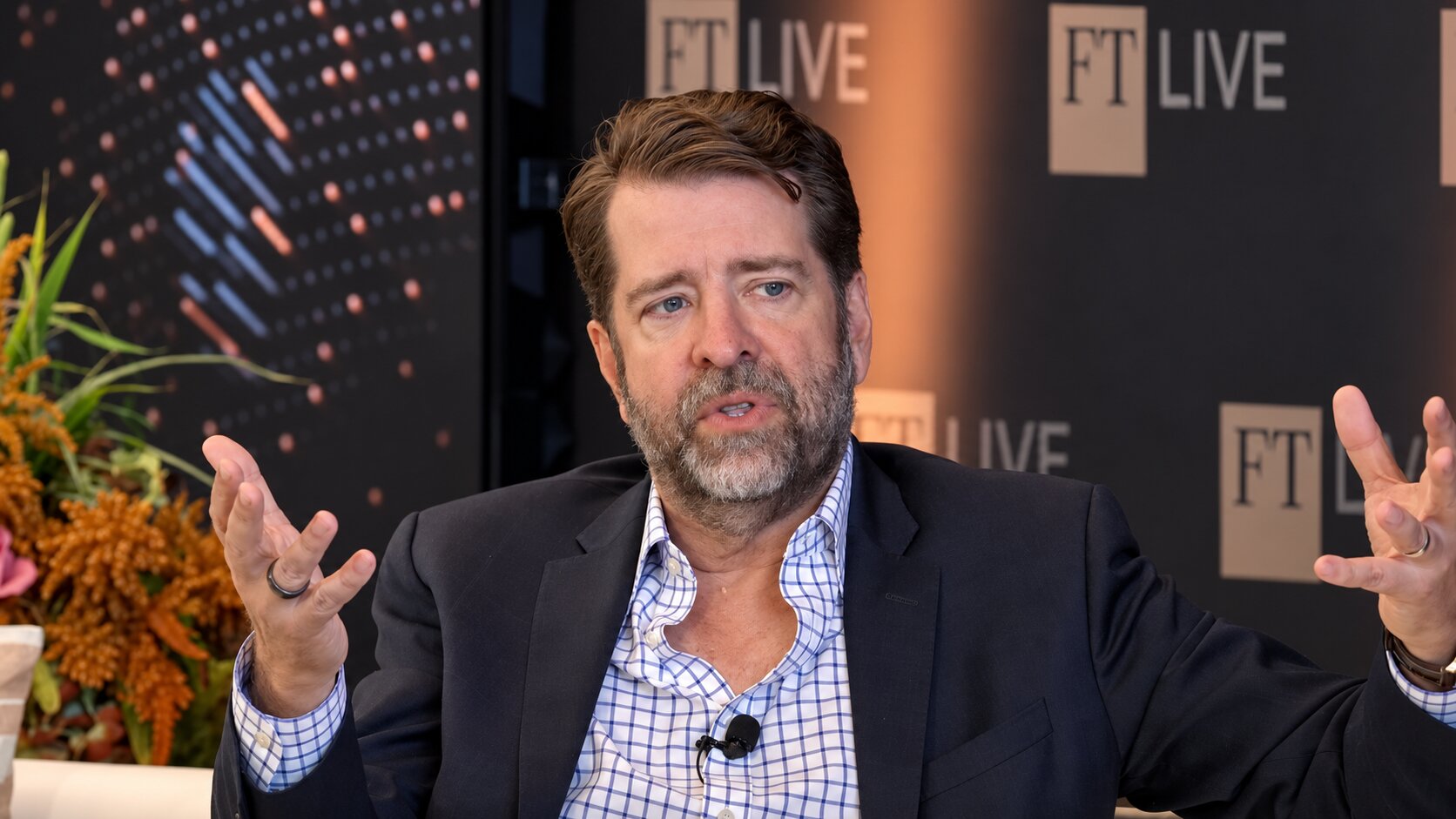
Bob Valentine explains the BMG Concord merger, why BMG licenses Suno while Concord fights Anthropic, and his car lease warning on catalogs.
The CEO of the newly merged BMG explains the AI strategy, why he won’t call it a fourth major, and why he hates seeing songs priced like car leases.
BMG has a license with Suno. Concord, now part of the same company, is suing Anthropic over, in Valentine’s words, “a lot of the same kind of issues.” Bob Valentine, CEO of the combined company, defended holding both positions at the Financial Times Business of Entertainment Summit on September 24, 2026, at the 1 Hotel West Hollywood, in conversation with the FT’s Anna Nicolaou.
His defense holds up on the dates and thins out on the logic.
How the deal came together
The merger was announced April 28, 2026 and closed September 1, with Valentine as CEO and BMG’s Thomas Coesfeld as chairman. Valentine, a longtime Concord CFO who became CEO on July 1, 2023, said both companies had hit a ceiling, each “capped at the level of our ability to grow even further.”
What each side brings
By Valentine’s account, Concord was heavily US-centric in personnel and leaned on Universal’s infrastructure outside the United States. Concord’s recorded music has been distributed by Universal under a global deal renewed in 2020. BMG is the mirror image, with many offices in Europe and Australia. Concord has a theatricals division that BMG lacks, and BMG has many more songwriting clients.
My read: two cash-generating catalog businesses now share one fixed-cost base, which should free cash for marketing and signings. Valentine did not put it that way.
Not a fourth major, but “by far” the biggest independent
Nicolaou put the combined valuation at roughly $14 billion, close to Warner Music, which she called the third-biggest major. The companies never disclosed a valuation. The $14 billion figure traces to FT reporting, while MBW’s sources put it nearer $15 billion. For scale, Warner’s market value was about $14.9 billion when the deal was announced. Valentine declined the “fourth major” label: “I’m still struggling with how to define what that new thing is.” He did say the company is “by far” bigger than any other independent on capital, personnel and capabilities.
His pitch to artists is patience. Universal and Warner are public companies, and Sony is part of one. At BMG, he said, “what you get here that you don’t get there is patience,” because “we’re not driven by quarterly results, we’re not driven by public shareholder pressure.”
That pitch deserves a footnote. The company is owned roughly 67% by Bertelsmann and 33% by Great Mountain Partners affiliates, and it has publicly targeted $1.2 billion in EBITDA in the mid-term, up from a pro forma $730 million-plus in 2026. Private capital is not capital without targets. Valentine did not address this in the session.
Licensing Suno, suing Anthropic
BMG signed its Suno deal on August 12, before the merger closed. Warner settled with Suno in November 2025, and Suno launched its v6 model on September 9 with Warner, BMG and Believe as partners. Universal and Sony are still fighting Suno in federal court in Boston and filed a second suit on September 18 covering 60,202 recordings. Suno has called that complaint “fundamentally flawed.”
On the other side, Concord, Universal Music Publishing and ABKCO sued Anthropic in 2023, alleging it used lyrics to at least 500 songs to train Claude. A judge denied the publishers’ request for a preliminary injunction, and the publishers have since filed an amended complaint.
Valentine’s explanation is that BMG signed before the merger closed, when the two companies could not yet operate as one. The dates support him. But the merger had been public since April 28, and the publishers were still amending their Anthropic complaint in July. The timing explains how the two positions arose. It does not explain why the combined company should keep both.
His logic starts with Napster. The industry ignored the threat or sued its own users, “which was a terrible strategy,” and streaming eventually came out of it. He wants the same outcome with Suno, Udio and ElevenLabs, and he thinks being “part of a solution” beats a court fight with no guaranteed end.
He did not let the AI companies off the hook. On training with copyrighted material, he said “it’s not okay for you to have acted in this way.” On the law: “there’s still the fundamental question of whether this is or isn’t fair use, and that question hasn’t been resolved yet, and it’s not going to be resolved anytime soon.”
My view: a license is only worth signing if the alternative costs the AI company something, and litigation supplies that cost. Suing one company while licensing another keeps pressure on the sector while BMG collects revenue from the willing. That is a negotiating posture, not hypocrisy. But it holds only if the license terms are fair, and with fair use unresolved, those terms are being set without knowing what the unlicensed alternative is worth.
Asked whether Suno has enough subscribers to justify its valuation, Valentine said, “I don’t know.” He compared the opportunity to Instagram and imagined teenagers remixing lyrics or turning a bluegrass song into a hip-hop track. He does not see AI replacing professional music or concerts. If it works, “it is an incremental revenue stream,” and “the consumer will drive whether this works or not.”
Artists and politics
Nine days before the panel, Macklemore was removed from Ed Sheeran’s US tour after pro-Palestinian remarks on stage. Sheeran said the promoter made the call after venues threatened to pull shows, and that he keeps politics off his stage.
Asked how a music company handles artists who speak on politics, Valentine pointed to John Fogerty and the political moment Creedence Clearwater Revival’s music came to represent. Concord owns Creedence recordings. His position: “We are not here to arbitrate someone’s political view versus another political view.” He called both Macklemore’s and Sheeran’s choices acceptable.
“Like a car lease”
An audience member asked whether the industry is too focused on buying catalogs and too little on building the infrastructure to monetize them. Valentine defended the catalog market first: it gives artists more choice and has created value that did not exist ten years ago.
Then the warning. “I hate thinking about music in a way that makes it like a car lease,” he said. Catalogs are financial assets with projectable cash flows, and that is how Concord was built. But “there is an organic component to buying a catalog,” and funds that trade songs purely as cash flows miss it. For the seller, “this is their life’s work.”
Film library owners know this problem. The model prices the asset, but it doesn’t run it.
What to watch
The test is not the headline valuation. It is whether the patience Valentine is selling shows up in artist development budgets, and whether one company can hold a Suno license and an Anthropic lawsuit once courts start ruling. Valentine expects no quick answer on fair use. Watch for rulings in the Suno cases (fact discovery in the first one closes September 30) and for how BMG describes its AI revenue in future announcements.
FAQ
Is the BMG Concord merger creating a fourth major music label?
Valentine would not use that label. He said he is “still struggling with how to define what that new thing is,” though he described the company as “by far” bigger than any other independent. His pitch to artists is patient capital that is not tied to quarterly results.
Why does BMG license Suno while Concord is suing Anthropic?
BMG signed the Suno license on August 12, before the merger closed, when the two companies could not yet operate as one. Valentine argues that being “part of a solution” beats an open-ended court fight, citing the industry’s experience with Napster. He also said “it’s not okay” for AI companies to have trained on copyrighted material, and that whether it counts as fair use remains unresolved.
What is Valentine’s concern about catalog acquisitions?
He said he hates thinking about music “in a way that makes it like a car lease.” Catalogs are financial assets with projectable cash flows, he acknowledged, but “there is an organic component to buying a catalog,” and for the seller, “this is their life’s work.”