
























Don Melchor winemaker Enrique Tirado pours five vintages in LA and explains why 30–40% of his best Cabernet fruit never makes the final blend.
A room full of Los Angeles sommeliers and beverage directors watched a Chilean winemaker explain why the best-tasting barrel in his cellar sometimes doesn’t make the cut. That’s the real story inside Don Melchor’s 2024 Wine Spectator Wine of the Year — not the trophy, the discipline behind it.
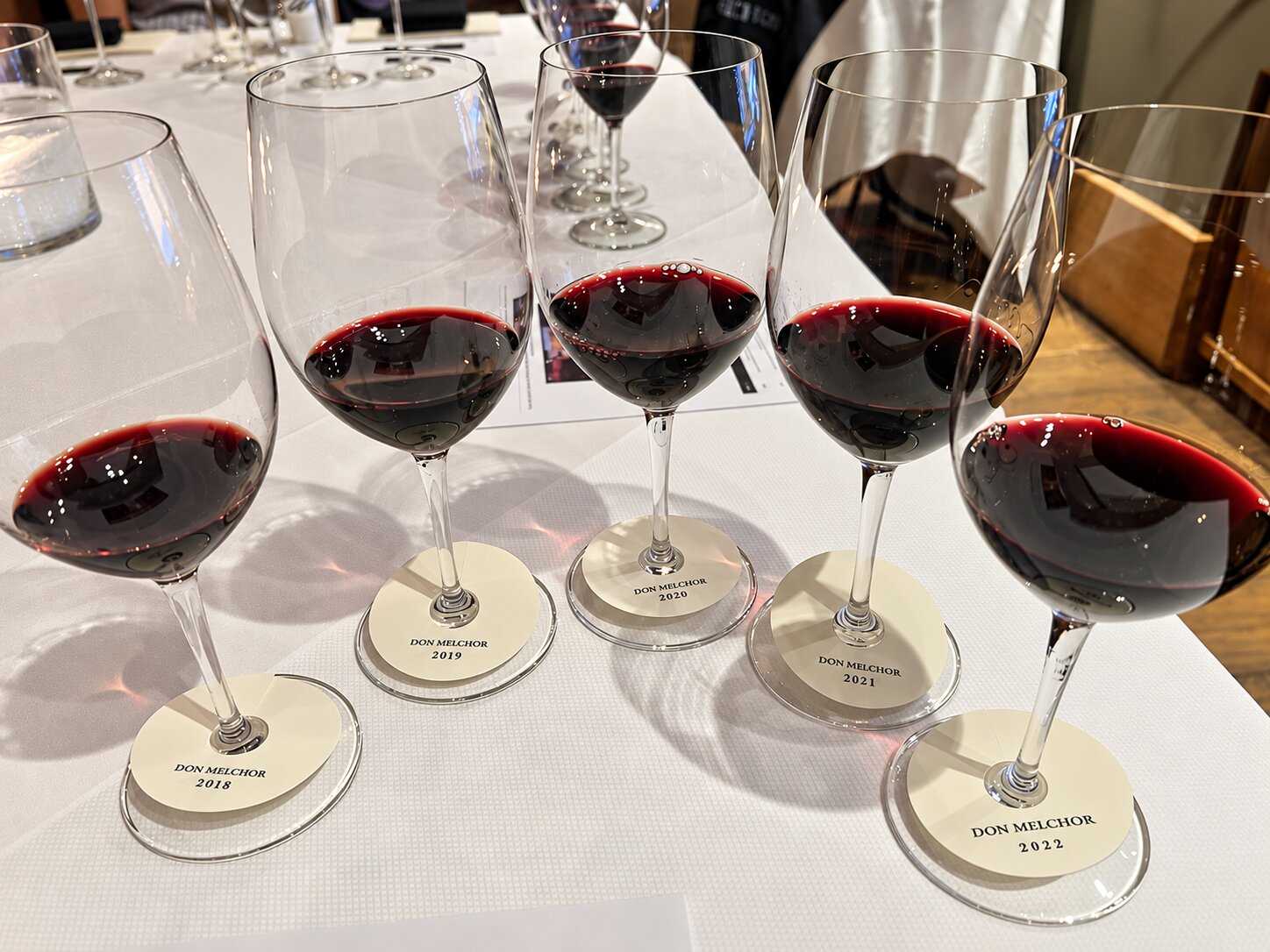
Enrique Tirado has run Don Melchor since 1997. Twenty-nine years on one wine, from one 309-acre vineyard on the north bank of the Maipo River, at the foot of the Andes in Puente Alto, Chile. This month he poured five vintages, 2018 through 2022, for a small Los Angeles tasting, and walked through exactly how a single-vineyard Cabernet gets built parcel by parcel, then gets cut down to size.
The vineyard isn’t one vineyard. It’s 151.
Tirado subdivided Don Melchor from roughly 30 blocks into 151 individual parcels after years of soil study — enough granularity that no two are vinified the same way. Harvest is 100% hand-picked, one parcel at a time, over six weeks from mid-March into early May. Each parcel ferments separately for 20 to 25 days. By the time vinification wraps, there are 150 to 250 distinct lots on the tasting table, all Cabernet Sauvignon, all from the same 309 acres — and all tasting like slightly different wines.
Tirado grouped the parcels into seven working profiles: red fruit and violet with real finesse, spice, mineral concentration with grip, a “balance” profile that links the others together, pure energy, structure, and tension. Same soil, same clone family, seven different personalities.
The part that should bother every other winery chasing consistency
Here’s the detail that reframes the whole tasting: Don Melchor uses only 60 to 70 percent of what that vineyard produces in the final blend. Every year, some genuinely excellent parcel gets left out.
Tirado didn’t dress this up. Asked directly about it, he confirmed a parcel can taste “fantastic” on its own and still not make the final wine — because the final wine, not any single lot, is the actual product. Most producers that size would find a way to bottle that fruit under a second label and call it a value line. Don Melchor just doesn’t use it.
That decision runs through a French consulting team, the Boissenot family, involved in the blend since Don Melchor’s first vintage in 1987. They also work with roughly 200 Bordeaux châteaux, including Latour, Margaux, Lafite, and Mouton — but at Don Melchor it’s two people from that family, plus Tirado, in the room. No larger committee. Tirado said flatly he doesn’t lean on lab metrics like pH for the final call. It’s tasting, and judgment.
2020 was a warm vintage that should have been ordinary. It wasn’t.
The 2020 harvest — later named Best Wine by Robb Report — is a case study in reading conditions instead of a calendar. Tirado picked three to four weeks early, starting in the first days of March instead of the usual late-March start, and finished by the first week of April. Smaller berries. Cooler nights despite the warm days. The result, by his account, opened dominated by red fruit and has since built into real complexity — pencil lead, coal ash, freshness that a warm year doesn’t usually deliver.
He was on vacation in southern Chile that January, watching ripeness data from a distance, when he decided the numbers meant he needed to be back at the vineyard. He retested maturity with the team over two days in mid-February and told them: forget the date on the calendar, pick when the fruit says pick. It’s his stated favorite of the five vintages poured.
The vintage that won, and the one that argued for itself anyway
2021 — 93% Cabernet Sauvignon, 4% Cabernet Franc, 3% Merlot, no Petit Verdot that year — is the Wine Spectator Wine of the Year. It’s also the fourth time a Don Melchor vintage has landed in that publication’s Top 10, a mark matched among Cabernet Sauvignon only by Caymus, at five.
But the room didn’t just nod along. One taster pushed back in real time, saying flatly that 2020 still drank better to them — denser, smoother, less obviously tannic. Tirado’s answer wasn’t defensive: quality isn’t a function of a warm year or a cool one, he said, it’s whether the vineyard management and the blend land on balance. That argument is easier to make with a trophy already on the shelf than without one, but it’s also the same thing he says about every vintage, award or not.
2022 shows its work
95% Cabernet Sauvignon, 99 points from James Suckling, and — by Tirado’s own read — a wine that doesn’t blend its parcels into one voice the way 2021 does. It shows its seams: red fruit, mineral drive, structure, each still legible on its own inside the final wine. Guests compared it to 2018 for that same layered, still-separating quality, and predicted it will only integrate with more bottle age.
No Petit Verdot in 2022, either. Not because the Petit Verdot was bad — Tirado said it just didn’t belong in that year’s blend. Same logic as the parcels: good on its own isn’t the bar.
How many vintages of Don Melchor have made Wine Spectator’s Top 10? Four — 2001, 2003, 2010, and 2021, the last of which was also named 2024 Wine of the Year. Among Cabernet Sauvignon specifically, only Caymus has more Top 10 finishes, with five.
What percentage of the Don Melchor vineyard goes into the final wine each year? Roughly 60 to 70 percent. The vineyard is farmed as 151 individual parcels, and winemaker Enrique Tirado excludes any parcel that doesn’t serve the final blend, even when it tastes strong on its own.
Why did Don Melchor pick the 2020 vintage three to four weeks early? Warmer conditions moved ripeness up the calendar. Tirado picked earlier and worked with smaller berries to preserve freshness, and cooler overnight temperatures during that stretch helped the fruit hold acidity despite the warm days.
Which taste is Tirado’s favorite
If you’re tasting these vintages side by side, do it in order — 2019 before 2020, 2021 before 2022 — because the through-line isn’t a single “best” year, it’s watching the same 309 acres get read differently five years running. Pour the 2020 last if you want to understand why Tirado calls it his favorite, and don’t skip the 2022 just because it hasn’t won anything yet; give it three more years in the cellar first.