



























Extended hold periods, a bifurcated AI exposure story, and why continuation vehicles are not necessarily a clean payday for sponsors. A private markets pulse check for 2026 at SuperReturn US West.
Eight months into 2026, three private markets investors sat for a conversation at SuperReturn US West and landed on something more revealing than most of the macro framing around it: the tool increasingly being used to solve private equity’s liquidity problem also creates a new set of alignment questions.
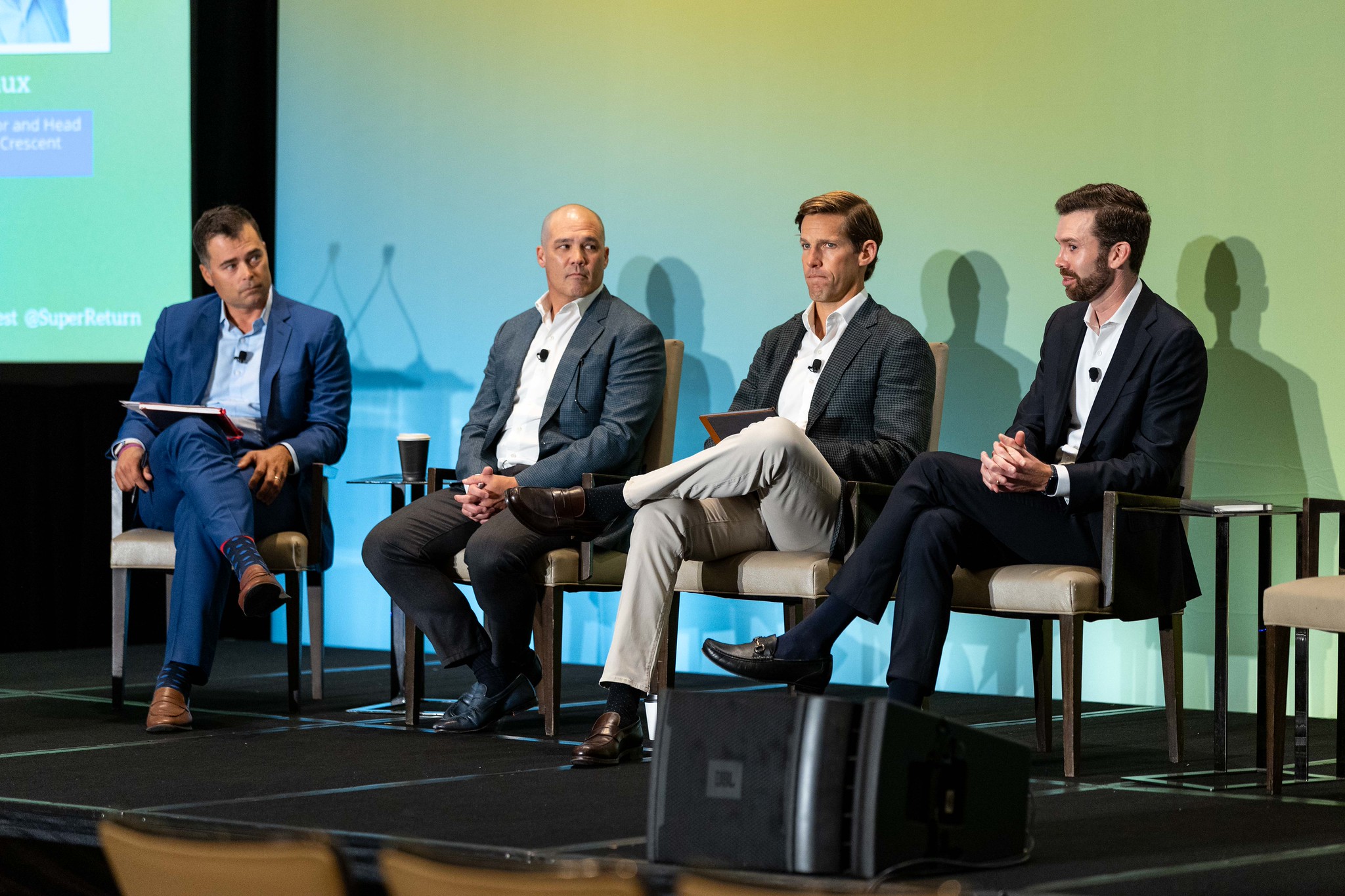
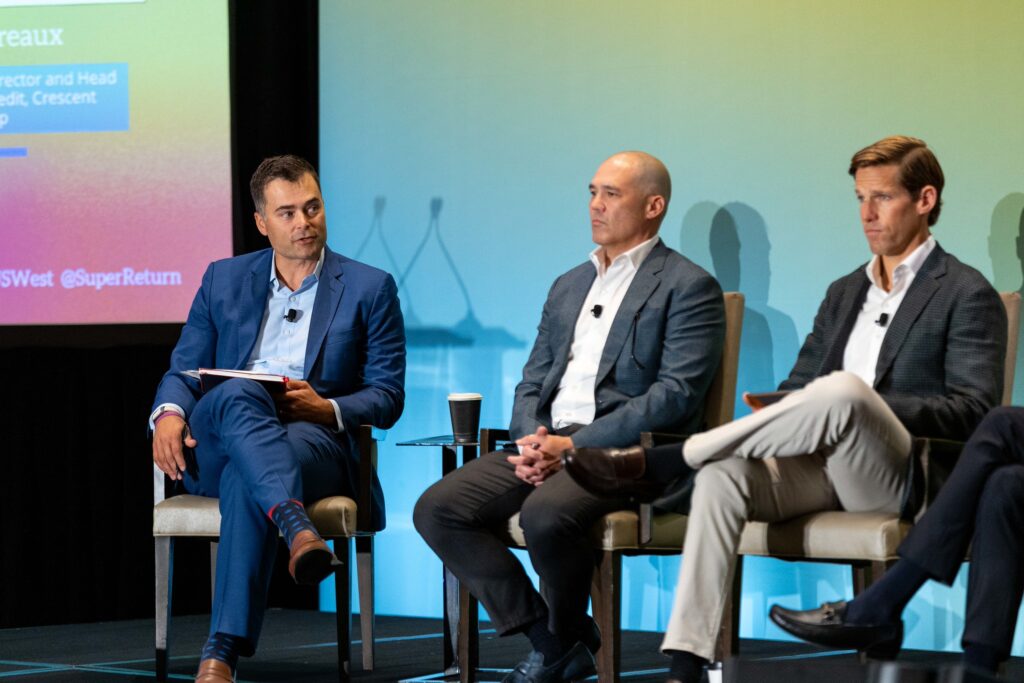
The panel was moderated by Chris Webber, Partner at Monument Group, and featured three panelists with a combined six decades in private markets: Jeff Suer, Partner at Leonard Green & Partners; Nicholas Janneck, Partner at Vance Street Capital; and Jason Breaux, Managing Director and Head of Private Credit at Crescent Capital Group.
A continuation vehicle lets a firm hold onto a high-conviction asset longer while giving existing limited partners the option to exit. It can also crystallize carried interest in the legacy fund. But that does not necessarily mean the sponsor simply cashes out. In many transactions, some or all of that carry is rolled into the new vehicle, keeping the GP economically exposed to the asset.
That distinction matters.
The continuation vehicle solves one liquidity problem, but it also creates another question: when the same sponsor is extending ownership, influencing valuation, and potentially creating a new fee-and-carry structure around the same company, how should LPs think about alignment?
That kind of detail tells you more about where private markets actually are than much of the macro framing offered at the top of the panel.
The panelists broadly agreed that capital remains available. What remains less clear is what investors should do with the uncertainty sitting next to it.
Two Portfolios, Two Realities
The most useful tension of the session was structural, not directional.
One large-cap buyout investor described a year spent digging out from under what has been called the “SaaSpocalypse,” the public-market software selloff that has spilled into private holdings and forced investors to reassess which software businesses are durable in an AI-driven market.
He estimated that software represented roughly a quarter of large-cap private equity exposure.
Nobody wanted to be the first seller of a software business into a market still sorting AI winners from losers, so deal flow in that segment slowed dramatically.
A lower middle market specialist on the same stage described a nearly opposite year. His portfolio sits largely in mission-critical, non-software services, businesses where AI has so far looked more like a productivity tool than an existential threat.
He described relatively little exposure to the disruption dominating software headlines.
Two firms, same eight months, two entirely different operating realities.
That is not noise.
The discussion suggested that the AI story in private markets is not one story. It is increasingly a filter. Where a portfolio sits on either side of that divide may now matter as much as some of the macro variables dominating the industry conversation.
The Number That Actually Matters: Duration
Buried in a question about credit underwriting was one of the most concrete data points of the panel.
One lender said average loan duration on his book ran roughly three to four years a decade ago.
Today, it runs closer to five to seven.
That is not a doubling, but it is a major structural change.
It reflects a market in which the traditional exit environment no longer clears quickly enough to make short holding periods realistic. IPO activity remains selective. M&A has improved unevenly. And the bid-ask spread between buyers and sellers has remained stubbornly difficult to close.
The same panelist flagged another notable development on the wealth management side.
Retail and RIA appetite for private credit through semi-liquid and registered vehicles weakened sharply in late 2025 amid broader concerns over credit quality, valuations, and liquidity.
By 2026, those concerns had become increasingly tied to software exposure and the potential impact of AI on certain borrowers.
His view was that the pullback would prove temporary.
More interesting than that prediction was what he said comes next: greater manager selectivity.
Instead of buying private credit as a category, investors increasingly want proof that a manager has performed across multiple credit cycles.
That is a very different market than the one that rewarded simple exposure to the asset class.
Growth Replaced Financial Engineering, and Everyone Knows It
With rate tailwinds gone and multiple expansion no longer a dependable lever, the panel repeatedly came back to the same idea: operating growth matters more.
One buyout executive said roughly 90 percent of his firm’s realized value creation now comes from EBITDA growth rather than leverage or multiple expansion.
That is a firm-specific number, not an industry statistic.
But it is still revealing.
It shows how far the buyout playbook has shifted from the easy-money years, when cheaper debt and rising multiples could do more of the work.
The lower middle market view sharpened the point further.
The strategy described on stage was deliberately conservative: take less leverage than the market allows, then reinvest the difference into people, processes, technology, and infrastructure.
It is slower and less flashy than financial engineering.
It is also much closer to what appears to be working in the current environment.
Continuation Vehicles Have Grown Up
Continuation vehicles are no longer a fringe solution.
They represented roughly 14 percent of private equity exits in 2025, with industry estimates suggesting their share could eventually approach 20 percent.
The panel treated them as a permanent part of the exit toolkit rather than merely a symptom of a broken market.
The stated discipline was straightforward: use them selectively and only when the rationale is compelling.
That might mean funding a transformational follow-on acquisition.
It might mean holding a crown-jewel asset that the sponsor believes still has significant upside.
It should not simply mean that a traditional sale is unavailable this quarter.
But the real structural issue is not that sponsors go unpaid.
It is that a continuation vehicle can simultaneously crystallize existing economics, extend the sponsor’s control of the asset, and create a new fee-and-carry structure around the same company.
That does not make the transaction improper.
It does mean LPs have good reason to scrutinize valuation, process, and alignment when the sponsor is effectively sitting on both sides of the table.
That may be the more important continuation-vehicle debate.
Not whether CVs are legitimate.
But whether the economic incentives remain properly aligned when they are used.
The Belief Most Likely to Age Badly
Asked what conventional wisdom may not survive the next twelve months, the panel landed on the same theme from different angles: the assumption that lower rates are required before M&A can meaningfully recover.
The argument on stage was that dealmakers may need to adjust permanently to a higher-for-longer environment rather than wait for cheap capital to return.
The IPO window was characterized as open but selective.
Companies with sufficient growth and realistic valuation expectations can still access public markets. That is very different from saying the IPO market is fully open, but it is also different from the idea that it is shut.
If you are still underwriting against a 2021 comparison set, that is the uncomfortable part.
Several people on the stage were explicit about the lesson.
2021 was an unusual alignment of low rates, abundant liquidity, strong growth expectations, and aggressive valuations.
There is no guarantee that combination returns.
Waiting for it is a strategy built on a coincidence, not a cycle.
Where This Actually Goes
Nobody on the panel promised a flood of deal activity.
What they described instead was closer to a trickle gradually becoming a stream.
That improvement depends on multiple variables: geopolitical stability, greater valuation certainty, narrowing bid-ask spreads, and buyers and sellers gradually resetting expectations.
It does not depend exclusively on rate cuts riding to the rescue.
That is a less satisfying story than “the floodgates are about to open.”
It may also be the more realistic one.
Private markets are not frozen.
They are repricing.
They are extending duration.
They are becoming more selective about managers.
And they are increasingly separating assets that benefit from AI from those that may be impaired by it.
That is a slower story than a recovery narrative.
It is also a more useful one.
FAQ
Why are private equity holding periods getting longer?
A narrower traditional exit market, selective IPO activity, persistent valuation gaps, and slower M&A have pushed sponsors toward longer holding periods. One lender on the panel said average duration on his credit book had increased from roughly three-to-four years a decade ago to five-to-seven years today.
Are continuation vehicles a sign of a weak exit market?
Partially, but not exclusively. They can be used defensively when a traditional sale is unattractive, but they are also used to extend ownership of high-conviction assets and fund additional growth. A CV may crystallize carried interest in the legacy fund, but sponsors are often expected to roll some or all of that carry into the new vehicle to maintain alignment.
Is private credit overexposed to AI disruption risk?
The panel suggested that AI-related credit risk is unevenly distributed rather than systemic. Software-heavy portfolios are facing greater scrutiny, while lenders concentrated in traditional, mission-critical businesses may have substantially less direct exposure.