


























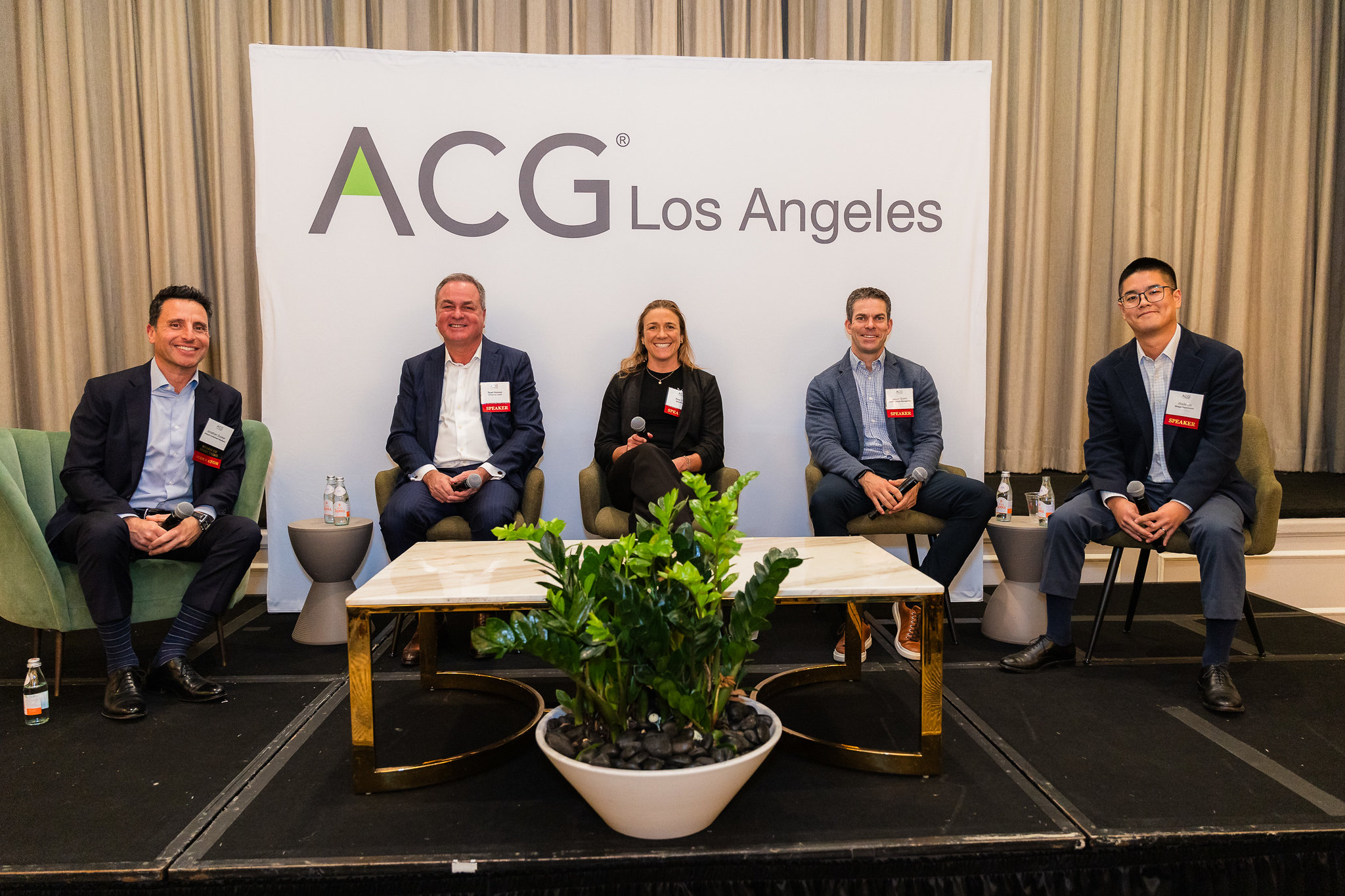
At ACG Los Angeles’ State of Private Credit, senior executives examined rising defaults, AI disruption, changing valuations, and emerging investment opportunities.
Private credit has become a major force in American finance. After years of rapid growth, lenders now face a tougher market, with more capital competing for quality borrowers.
Rising debt costs, shifting software valuations, and competition from traditional lenders are changing how private credit firms evaluate opportunities.

These challenges took center stage at ACG Los Angeles’ State of Private Credit, held November 12 at The Beverly Hilton in Beverly Hills.
The panel featured Stuart Aronson, CEO of WhiteHorse Capital Direct Lending and Executive Managing Director at H.I.G. Capital; Alex Doll, Executive Director and Private Credit Product Strategist at BlackRock; Jason Quinn, Managing Director of Origination at Churchill Asset Management; and Wade Lin, Managing Director at Bregal Sagemount.
Jonathan Zucker, Managing Director and Head of Capital Advisory at Intrepid Investment Bankers and President of ACG Los Angeles, moderated the discussion.
Their outlook for 2027 combined caution about credit quality with optimism about new financing opportunities.
Inside ACG Los Angeles’ Investment Community
The event brought together business owners, investors, lenders, and financial advisors from across Southern California.

Longtime ACG members reconnected with colleagues, while first-time attendees met professionals involved in buying, selling, financing, and growing businesses.
The gathering reflected Los Angeles’ varied business community, with professionals from different generations, backgrounds, and career stages sharing insights and building relationships.
Those connections are particularly valuable in middle-market finance, where transactions often require cooperation among investment bankers, private equity firms, lenders, attorneys, and accountants.
The evening paired that networking opportunity with a timely examination of an industry that has grown significantly.
According to the Federal Reserve’s November 2026 Financial Stability Report, private-credit lenders held approximately $1.5 trillion in loans to U.S. businesses at the end of 2025. More recent figures show that corporate private-credit loans reached $1.12 trillion in the second quarter of 2026, highlighting the industry’s growing role in financing American businesses.
Why Companies Pay More for Private Credit
Banks often offer lower interest rates, but private lenders can provide greater flexibility.
One technology transaction discussed during the panel illustrated the difference.

The borrower initially considered bank financing at approximately 350 basis points above SOFR, a benchmark interest rate commonly used in corporate lending.
However, restrictions attached to the bank loan threatened to limit the company’s growth plans.
The business ultimately chose more expensive private financing that allowed greater operating flexibility.
For companies pursuing acquisitions or expansion, fewer restrictions can justify higher borrowing costs. The decision depends on whether the strategic benefits outweigh the additional interest expense.
Rising Defaults Could Test Private Credit in 2027
Some borrowers are entering 2027 after years of elevated financing costs, while others carry debt originated when valuations and earnings expectations were more optimistic.
A particular concern is payment-in-kind interest, commonly called PIK.
Instead of paying interest entirely in cash, borrowers add some or all of it to their outstanding debt.

Consider a $10 million loan charging 12% annual PIK interest.
After one year, the balance reaches approximately $11.2 million. After five years, it exceeds $17.6 million, assuming annual compounding and no repayments.
PIK provides short-term cash-flow relief but increases the amount eventually owed. Lenders may also recognize accrued interest income without receiving the corresponding cash.
Financial stress does not always produce an immediate default. Lenders may defer interest, amend agreements, or provide additional financing to keep businesses operating.
Those arrangements can preserve viable companies, but they can also delay the recognition of underlying credit problems.
When Lenders Must Take Control
More serious situations may require debt restructuring, management changes, asset sales, or lender ownership.
The panel described one company that moved from approximately negative $1 million in EBITDA to more than $13 million in positive EBITDA over three years.

Another company experienced serious financial misreporting before restructuring and operational improvements helped stabilize the business.
These cases show why lenders need restructuring and operational expertise alongside financial analysis.
For private-credit investors, a manager’s ability to handle troubled loans can be just as important as its ability to originate new ones.
How AI Is Changing Software Valuations
Software companies have traditionally attracted private equity investment because of recurring subscription revenue, attractive margins, and growth potential.

Artificial intelligence is now challenging some of those assumptions.
The panel described software transactions previously valued at approximately 20 to 25 times EBITDA, a measure of operating earnings. More recent transactions have seen valuations closer to 12 to 16 times EBITDA.
Consider a company generating $20 million in annual EBITDA.
At 25 times EBITDA, its estimated enterprise value is $500 million.
At 15 times EBITDA, that value falls to $300 million.
That’s a $200 million decline in estimated value, even though earnings remain unchanged.
For lenders, lower valuations reduce the equity cushion protecting outstanding loans.
AI also raises questions about whether established software companies can maintain their customer bases when newer technologies offer comparable services at lower prices.
Lenders are responding with closer scrutiny of cash flow, leverage, financial covenants, and the durability of recurring revenue.
Lower valuations may also provide opportunities to finance strong software businesses on more favorable terms.
Where Private Lenders See New Opportunities
Beyond traditional private equity-backed loans, the panel identified several expanding markets for private capital.
Founder-Owned Businesses
Non-sponsored lending provides financing directly to businesses without institutional private equity ownership.

These companies may be founder-led, family-owned, or independently operated.
Certain transactions discussed during the panel offered interest-rate spreads of 600 to 800 basis points above benchmark rates, with leverage commonly ranging from three to four-and-a-half times EBITDA.
That can compare favorably with some private equity-sponsored loans carrying higher leverage and lower interest-rate spreads.
However, finding these borrowers requires extensive relationship-building. Their financial statements and operations may also need additional verification.
Independent-business transactions can take months to complete rather than weeks.
For lenders willing to perform that work, the combination of attractive pricing, moderate leverage, and meaningful owner involvement can create compelling opportunities.
Music Royalties and Sports
Private lending is expanding into assets supported by recurring contractual revenue.
Music catalogs, for example, generate income through streaming, licensing, and broadcasting.
The panel discussed a music-related transaction initially structured as a $450 million first-lien loan with an approximately 10% all-in yield.

The borrower later refinanced through the securitized market at a borrowing cost roughly two percentage points lower.
Securitization can connect income-producing assets with additional sources of investment capital, sometimes reducing financing costs.
Professional sports offer opportunities involving franchise ownership, media rights, licensing, stadiums, and related businesses.
The Infrastructure Behind AI
Lenders are also financing businesses that support artificial intelligence without developing AI software.
Examples include data-center construction contractors, excavation specialists, and industrial cooling providers.
Their growth depends on the continued expansion of computing infrastructure, though electricity availability, equipment costs, construction capacity, and customer demand remain important risks.
Competition Could Reshape Returns in 2027
Private credit has attracted substantial institutional capital, while merger-and-acquisition activity has generated fewer financing opportunities than some lenders anticipated.
As more funds compete for quality borrowers, lenders face pressure to reduce pricing or loosen loan protections.
Panelists expressed differing expectations for 2027, ranging from relatively stable lending spreads to additional pricing pressure.
Recent market concerns may also encourage stronger underwriting on new loans.
For investors, evaluating private credit means looking beyond advertised yields to the borrower’s leverage, actual cash flow, loan protections, and potential recovery if a business fails.
ACG Los Angeles: Connecting the People Behind Business Growth
Founded in 1954, the Association for Corporate Growth has developed an international network of more than 100,000 professionals across 61 local markets.

Its Los Angeles chapter represents more than 600 members, including private equity investors, investment bankers, corporate executives, lenders, and transaction advisors.
Through educational panels, networking receptions, conferences, and professional programs, ACG connects people involved in financing, acquiring, advising, and growing middle-market businesses.
For a business owner considering a sale, an investor evaluating acquisitions, or a professional expanding their network, those relationships can create opportunities that extend well beyond a single event.
The November 12 gathering demonstrated that combination of financial insight and personal connection, bringing experienced industry leaders together with professionals at different stages of their careers.
Interested in joining the ACG Los Angeles community?
Explore ACG Los Angeles membership opportunities, upcoming events, and professional programs.
As private credit enters a more demanding phase, the central lesson from the evening remains clear:
The real measure of a private-credit investment is not how much interest it promises when everything goes right. It’s how much capital investors can recover when everything goes wrong.