


























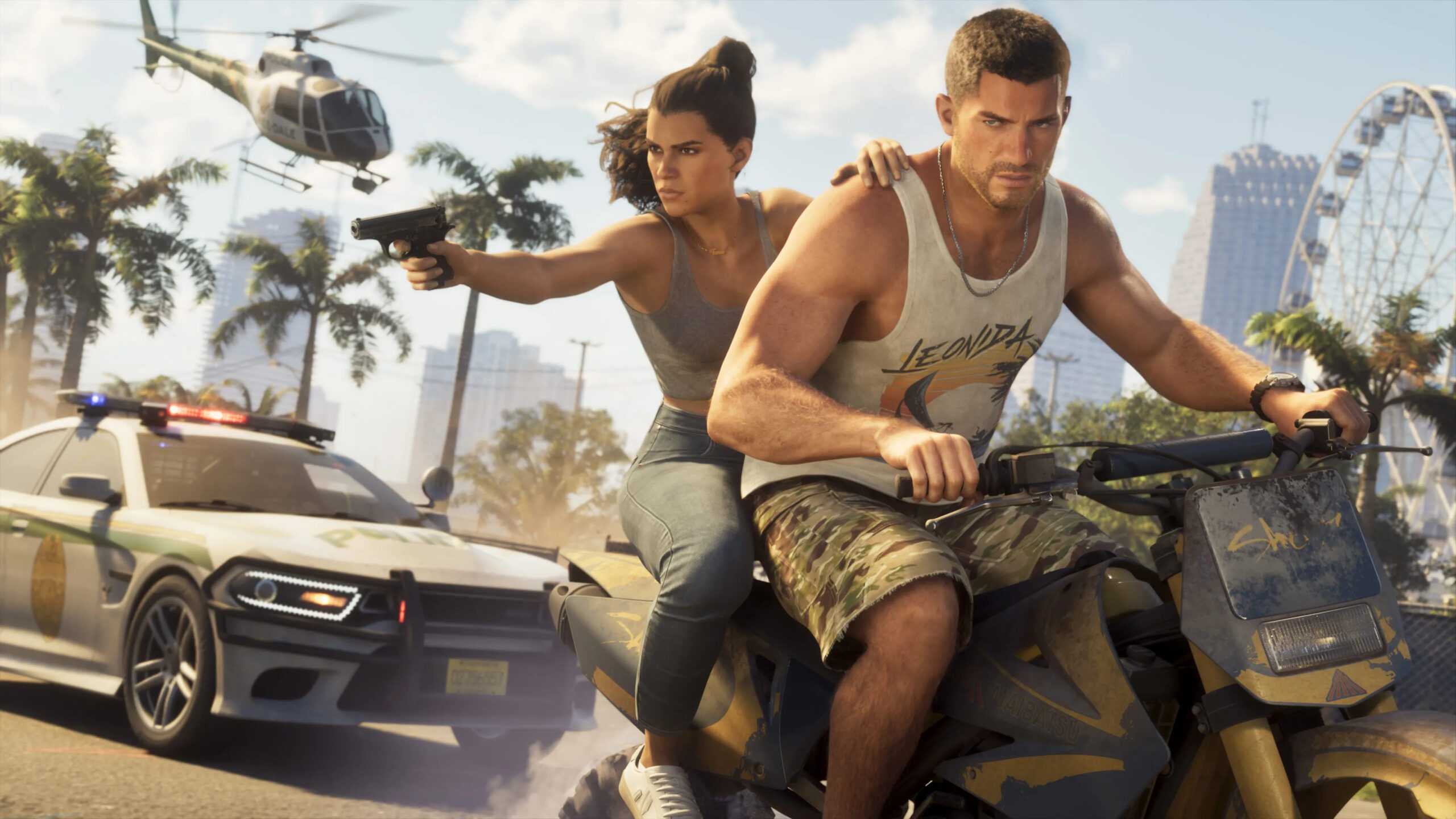
Grand Theft Auto VI has arrived with extraordinary sales estimates and an audience millions strong. As Rockstar Games takes over the entertainment conversation, Hollywood faces a question bigger than opening weekend box office: Who controls how we spend our free time?
Hollywood has spent decades chasing the next billion-dollar blockbuster.
Today, one of the biggest entertainment stories in the world isn’t happening in a movie theater.
It’s happening on a gaming console.
On November 19, 2026, Rockstar Games officially launched Grand Theft Auto VI (GTA 6), bringing one of entertainment’s most anticipated franchises back after 13 years.
And the early numbers are remarkable.
According to Sensor Tower estimates reported by Reuters, GTA 6 had sold approximately 19.1 million copies as of Thursday morning, representing an estimated $1.84 billion in sales.
For perspective, its predecessor, Grand Theft Auto V, generated approximately $800 million in its first 24 hours in 2013.
These latest figures are independent estimates, not yet official sales results from Rockstar or parent company Take-Two Interactive.
But the larger story isn’t simply how much money GTA 6 could make.
It’s what happens when millions of consumers choose an interactive world over movies, television, and streaming.
And whether Hollywood is prepared for that competition.
GTA 6 Is Already an Entertainment Juggernaut
The commercial history of Grand Theft Auto helps explain the excitement.
Take-Two reports that Grand Theft Auto V has sold-in nearly 235 million units worldwide since 2013. Across the franchise, total sales have approached 480 million units.
Those numbers establish GTA as one of the biggest commercial properties in modern entertainment.
Unlike a movie sequel that arrives every few years, GTA 6 follows a prolonged absence.
An entire generation of consumers has grown up between installments.
Someone who played GTA V as a teenager may now be approaching 30, with more disposable income and a deeper relationship with the franchise.
Rockstar isn’t simply introducing another entertainment product.
It is delivering a cultural event to an audience that has been waiting more than a decade.
Hollywood Has a New Problem: The Competition Isn’t Another Movie
Think about how consumers spend a typical Friday night.
Dinner and a movie. A streaming series. A concert. A sporting event. Or several hours playing a video game.
Every option competes for the same limited resources.
Time, money, and attention.
This is where video games have a particular advantage.
A theatrical movie generally offers a two-hour experience. An expansive game like GTA 6 can occupy dozens or hundreds of hours, depending on how an individual chooses to play.
A consumer who buys the game may return to it night after night.
That doesn’t automatically mean fewer movie tickets will be sold.
But it creates competition that didn’t exist at the same scale when Hollywood’s business model was built around theaters, television, and home video.
For a film studio, the most dangerous competitor might not be another studio’s blockbuster.
It might be a game people already own.
Netflix and Streaming Services Could Feel the Impact First
Movie theaters have one advantage that streaming services cannot fully replicate.
They offer a reason to leave the house.
Streaming and gaming, however, frequently compete for the same television in the same living room.
That distinction matters.
In a November analysis, PwC identified the living-room television as potentially GTA 6’s most significant competitive battleground.
The firm suggested that the game’s arrival could draw some consumers away from their normal streaming habits during November and December.
That includes a valuable period when families gather during Thanksgiving and the year-end holidays.
For Netflix, Disney+, Hulu, and other services, the challenge isn’t necessarily subscription cancellations.
It’s engagement.
A person who spends four hours exploring Vice City may have four fewer hours available for a streaming series.
That shift may be temporary. It may also vary considerably by age, gaming habits, and household.
But streaming services depend on keeping subscribers engaged.
Lower engagement can influence advertising opportunities, programming decisions, and potentially long-term customer retention.
The key question is whether GTA 6 simply creates a short-lived disruption or produces a longer change in viewing habits.
It’s too early to know.
Can GTA 6 Actually Hurt Movie Theater Attendance?
Theatrical exhibitors are watching the GTA 6 launch for an obvious reason.
A blockbuster game arriving just before Thanksgiving creates another major entertainment option during one of Hollywood’s important holiday periods.
But there are reasons not to exaggerate the risk.
Moviegoing offers experiences gaming cannot fully duplicate.
A date night. A family outing. A special screening. Watching a film with hundreds of people on a giant screen.
And not every audience overlaps.
An adult interested in Grand Theft Auto may not have the same viewing preferences as a family attending an animated movie.
A major test arrives November 20 with Lionsgate’s The Hunger Games: Sunrise on the Reaping.
The film opens one day after GTA 6.
According to TheWrap’s November 18 box-office preview, industry sources expected a strong opening, with some projections reaching $100 million or more domestically.
The publication also noted that The Hunger Games has a different core audience from GTA 6, which could help protect its theatrical performance.
The comparison will be interesting.
But even a disappointing opening weekend would not prove that GTA 6 caused the decline.
Ticket sales depend on marketing, reviews, release timing, audience demand, and many other factors.
Hollywood should be concerned about the competition for attention without assuming that every lost ticket belongs to Rockstar.
Why Playing a Story Can Be More Powerful Than Watching One
There’s another reason GTA 6 deserves Hollywood’s attention.
The game isn’t simply competing with movies for revenue.
It’s competing with how audiences experience storytelling.
Traditional films provide a carefully constructed narrative.
The director controls the camera. The editor controls the rhythm. The writer shapes the story.
The audience watches it unfold.
A video game adds a different element.
Participation.
Players can explore environments, make choices within the game’s rules, and experience events at their own pace.
That freedom can create an unusually personal connection to an entertainment property.
A movie character may become someone audiences admire.
A game character may become someone they spend weeks inhabiting.
That difference helps explain why gaming franchises can remain relevant for years between major releases.
It also raises an uncomfortable question for Hollywood.
Are studios producing the entertainment consumers want most, or are they relying on traditional formats while audience expectations evolve?
The Entertainment Business Is Bigger Than Hollywood
Rockstar’s financial potential extends beyond the purchase price of GTA 6.
Music, merchandise, social media, and brand collaborations all create opportunities surrounding the franchise.
On launch day, Rockstar announced Grand Theft Auto VI: The Album, an official Atlantic Records soundtrack featuring 34 original tracks.
The soundtrack adds another commercial dimension to the game’s fictional world.
The potential influence reaches fashion and tourism as well.
GTA 6 takes place in the fictional state of Leonida, including Vice City, a location inspired by Miami.
That setting gives the franchise a recognizable visual identity built around South Florida’s beaches, nightlife, architecture, and culture.
PwC has suggested that the game’s popularity could create opportunities for retailers, food delivery services, music companies, and even tourism-related businesses.
Miami has already embraced the connection, including Vice City-themed activities associated with its NBA franchise.
Of course, these are potential economic effects, not guaranteed results.
But they illustrate an important point.
A video game can influence consumers even when they aren’t actively playing it.
They may encounter the soundtrack, watch gameplay clips, purchase merchandise, or share content inspired by the game.
The product becomes part of a wider cultural conversation.
And the more attention it generates, the more valuable that ecosystem may become.
What GTA 6 Means for Entertainment Investors
For investors, the most interesting question may not be how many copies GTA 6 sells during its opening week.
It’s how much money the franchise can generate over its lifetime.
Traditional films have several revenue opportunities, including theatrical distribution, digital rentals, licensing, and streaming deals.
Gaming franchises have their own models.
Initial purchases can be followed by downloadable content, subscriptions, and online experiences.
Grand Theft Auto V demonstrated the power of long-term consumer engagement through GTA Online.
Whether GTA 6 achieves the same success will depend partly on Rockstar’s future plans.
As of November 19, investors are still awaiting details about the game’s online component and potential PC release.
Reuters reported that analysts consider recurring consumer spending a major factor in Take-Two’s longer-term outlook.
This distinction matters because strong sales don’t necessarily tell investors everything about profitability.
Development costs, marketing expenses, platform commissions, and ongoing operations all affect the economics.
The exact development cost of GTA 6 has not been publicly confirmed.
Although estimates have reached $1 billion or more, neither Rockstar nor Take-Two has disclosed a definitive title-specific production budget.
Investors should therefore avoid treating widely repeated budget estimates as established facts.
Still, the fundamental attraction is clear.
An entertainment property that sustains audience engagement for years may produce a very different economic profile from one that depends heavily on opening-weekend demand.
Hollywood understands franchise value.
Gaming is demonstrating how far that value can extend.
Hollywood Doesn’t Need to Defeat GTA 6
It would be a mistake to interpret GTA 6’s extraordinary launch as evidence that Hollywood is becoming irrelevant.
Movies continue to create experiences gaming cannot replace.
Theater attendance remains an important social and cultural activity.
Streaming provides entertainment that consumers can enjoy without learning how to play an interactive game.
And successful franchises increasingly move between film, television, and gaming.
The more important lesson is that entertainment companies can no longer assume audiences will spend their free time according to old habits.
Consumers have more choices than ever.
They can watch a story, play a story, or follow a creator who tells an entirely different kind of story.
The companies that succeed will be the ones that recognize how those preferences are changing.
GTA 6 is not necessarily Hollywood’s enemy.
It may be one of its clearest warnings.
The Bigger Question: Who Wins the Battle for Our Attention?
Rockstar Games has achieved something remarkable.
It has turned a 13-year wait into a global entertainment event, with early independent sales estimates already approaching $2 billion.
But the most consequential number may not be sales revenue.
It may be the hours millions of consumers spend immersed in the world Rockstar has created.
Those hours are valuable.
Every studio, streaming platform, advertiser, and entertainment company wants a share of them.
For Hollywood, the challenge is no longer simply creating the biggest opening weekend.
It’s creating entertainment that audiences consider worth their limited time.
GTA 6 doesn’t have to destroy the box office to change Hollywood. It only has to prove that audiences have compelling alternatives.
Frequently Asked Questions About GTA 6 and Hollywood
How much money has GTA 6 made?
As of the morning of November 19, 2026, analytics firm Sensor Tower estimated approximately $1.84 billion in sales from 19.1 million units. The figures were reported by Reuters and remain independent estimates rather than final company-reported totals.
Is GTA 6 the biggest video game launch in history?
Its early estimated sales suggest a record-setting debut. However, definitive rankings should await confirmed financial data and consistent comparisons across game launches.
Will GTA 6 hurt Hollywood movie theaters?
It may compete for the attention of some moviegoers, particularly younger gaming audiences. There is not yet sufficient evidence to conclude that GTA 6 has caused an industry-wide decline in theatrical attendance.
Will GTA 6 affect Netflix and other streaming services?
Potentially. PwC identifies streaming as a significant competitor for the time consumers spend playing GTA 6. Any measurable long-term impact on viewing hours or subscriptions remains uncertain.
How much did GTA 6 cost to develop?
No official, definitive development budget has been published by Rockstar Games or Take-Two Interactive. Reported billion-dollar figures are estimates.
Is GTA 6 available on PC?
As of November 19, 2026, GTA 6 is officially available on PlayStation 5 and Xbox Series X|S. A PC release date has not been confirmed.