

























Vincent van Gogh’s Blossoming Chestnut Trees has set a new auction record at Sotheby’s. Discover the extraordinary history, the last-minute ownership dispute, and why collectors place such enormous value on rare masterpieces.
What makes a painting worth $190 million?
Is it the artist’s reputation? The beauty of the work? Its fascinating history? Or the chance to own something that may never appear on the market again?
For one extraordinary Vincent van Gogh painting, the answer involves all four.
On November 18, 2026, Van Gogh’s 1890 masterpiece Châtaigniers en fleurs, known in English as Blossoming Chestnut Trees, sold for $190.4 million at Sotheby’s in New York, setting a new auction record for the legendary Dutch painter.
The painting had spent more than 50 years in a private Argentine collection, largely unseen by the public until its recent exhibition previews.
Its return to the market was already a major event in the international art world.
But a last-minute dispute involving the descendants of a Jewish family who owned the painting during the Nazi era added another remarkable chapter to its history.
The result is a story about extraordinary wealth, artistic genius, historical responsibility, and the power of owning something truly irreplaceable.
Van Gogh’s $190 Million Painting Was Created During His Final Months
In May 1890, Vincent van Gogh arrived in Auvers-sur-Oise, a small village northwest of Paris.
He had recently left the psychiatric hospital in Saint-Rémy-de-Provence, where he had spent much of the previous year.
Despite his personal struggles, Van Gogh entered an intensely productive period.
He painted landscapes, village streets, gardens, and portraits with remarkable energy.
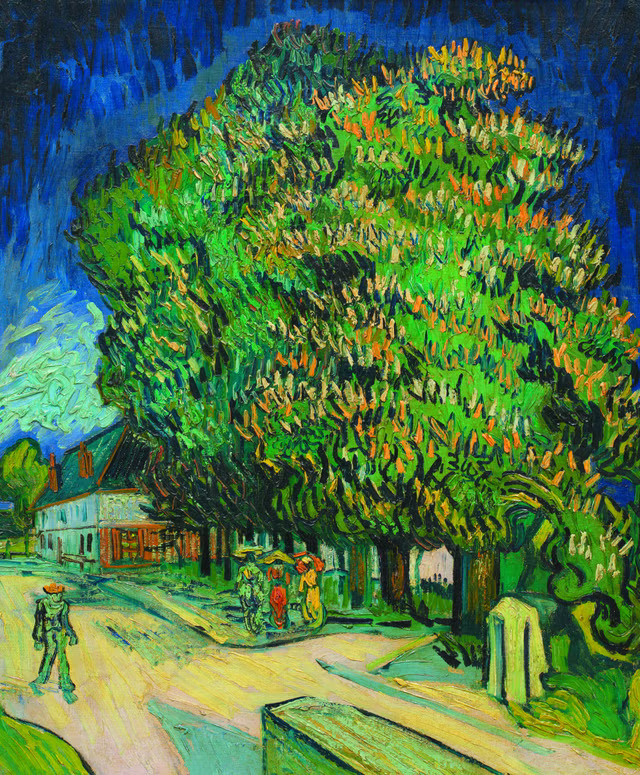
On May 24, 1890, he created Blossoming Chestnut Trees.
The painting shows a quiet village road shaded by flowering chestnut trees. Deep greens, vivid blues, and bright touches of yellow and orange bring the landscape to life.
Its thick brushstrokes create movement across the canvas, transforming an ordinary spring scene into something emotional and memorable.
Measuring approximately 28 by 23 inches, the artwork is relatively modest in size.
Yet its impact is extraordinary.
Van Gogh died on July 29, 1890, just over two months after completing the painting.
Today, works from this final period are among the most admired creations of his career.
Why This Rare Van Gogh Painting Disappeared From Public View
The story of Blossoming Chestnut Trees did not end with the artist’s death.
Over the following decades, the painting passed through the hands of respected galleries and prominent collectors.
Its documented ownership history includes Van Gogh’s brother Theo, Theo’s widow Johanna van Gogh-Bonger, European art dealers, and several distinguished private collectors.
In 1975, Argentine collectors Nelly Arrieta de Blaquier and Carlos Pedro Blaquier acquired the painting.
It remained with their family for more than half a century.
During that time, the artwork was largely absent from public exhibitions.
For collectors, such extended private ownership can make a major painting especially appealing when it returns to auction.
Unlike works that repeatedly change hands, an artwork held privately for decades offers buyers a rare opportunity.
Collectors may have followed its history for years without ever having the chance to purchase it.
And when that opportunity finally arrives, some may be willing to spend extraordinary sums.
However, scarcity alone cannot explain a $190 million price. The painting’s artistic importance, condition, ownership history, and the strength of the market also play essential roles.
A Last-Minute Nazi-Era Ownership Dispute Complicated the Auction
Behind the painting’s beautiful spring landscape lies a complicated history.
In 1909, German Jewish publisher Samuel Fischer acquired the work.
After his death in 1934, the painting remained within his family before being sold in 1936, during the rise of Nazi persecution.
Decades later, Fischer’s descendants questioned the circumstances surrounding that sale.
They argued that the family had faced pressure caused by Nazi persecution and sought to have the Sotheby’s auction postponed.
The challenge raised an important issue for today’s art market: whether an artwork sold during the Nazi era may have changed ownership under coercive circumstances.
On November 17, 2026, Sotheby’s announced that an agreement had been reached between the Blaquier-Arrieta family and the legal descendants of Hedwig and Samuel Fischer.
The financial terms were not disclosed.
The agreement allowed the auction to proceed as scheduled the following evening.
The dispute illustrates why provenance, the documented history of an artwork’s ownership, is such an important consideration for serious collectors.
Even a masterpiece by one of the world’s most celebrated artists can carry legal and ethical questions that must be addressed before a major transaction.
The $190.4 Million Sale Shattered Van Gogh’s Previous Auction Record
Before November 2026, the highest publicly reported auction price for a Van Gogh painting was $117.2 million.
That record was established in November 2022 when Orchard with Cypresses, painted in 1888, sold at Christie’s in New York.
The painting had belonged to the collection of Microsoft co-founder Paul Allen.
Four years later, Blossoming Chestnut Trees surpassed that result by approximately $73.2 million.
That represents an increase of more than 62% over the previous artist record.
There is an important distinction in the new sale price.
The bidding concluded at a hammer price of $165 million. After buyer’s fees, the final reported total reached approximately $190.4 million.
The hammer price was actually below the painting’s reported $180 million presale valuation.
So although the final price established a historic record, it does not mean bidding dramatically exceeded the auction house’s expectations.
Nevertheless, the transaction secured Van Gogh’s place among the artists commanding some of the highest prices in auction history.
How Van Gogh Compares With the World’s Most Expensive Paintings
A $190 million painting belongs to an extremely exclusive category.
In 2017, Leonardo da Vinci’s Salvator Mundi sold at Christie’s for approximately $450.3 million, establishing the record for a painting sold at public auction.
Andy Warhol’s Shot Sage Blue Marilyn brought approximately $195 million in 2022.
In November 2025, Gustav Klimt’s Portrait of Elisabeth Lederer sold at Sotheby’s for $236.4 million.
Van Gogh’s Blossoming Chestnut Trees now joins these extraordinary works among the highest-priced paintings ever sold at auction.
But these headline sales represent a tiny portion of the global art market.
Most paintings, including works by respected and established artists, trade for dramatically smaller sums.
At the highest level, buyers are competing for cultural objects with a combination of artistic significance, reputation, rarity, and historical importance that cannot easily be duplicated.
Can Fine Art Be a Smart Luxury Investment?
The extraordinary Van Gogh sale raises an intriguing question.
Can owning great art be as financially rewarding as owning real estate, stocks, or other investments?
For some collectors, the answer has been yes.
Major works by celebrated artists have achieved substantial price increases over long periods.
But buying fine art is not the same as investing in a diversified financial portfolio.
Art does not generate dividends or regular income. Its value depends heavily on collector demand, authenticity, condition, historical importance, and market trends.
Owners may also face significant insurance, conservation, transportation, storage, and transaction costs.
And unlike publicly traded stocks, valuable paintings cannot always be sold quickly at a predictable price.
There is another limitation: record-breaking auctions generate enormous publicity, while disappointing sales receive far less attention.
That can create a misleading picture of the overall art market.
A $190 million Van Gogh is proof of extraordinary demand for one painting, not proof that art always appreciates.
For experienced collectors, financial value may be only part of the appeal.
Owning an important painting can also offer cultural prestige, personal satisfaction, and the opportunity to preserve an artwork for future generations.
Why Provenance Matters as Much as Prestige
One of the most interesting aspects of the Van Gogh sale is the painting’s extensive ownership history.
Before entering the Argentine collection, Blossoming Chestnut Trees passed through some remarkable hands.
Its former owners included prominent European collectors, respected galleries, and Hollywood producer and songwriter George “Buddy” DeSylva.
Each documented transfer adds another chapter to the painting’s story.
That history can help establish authenticity and give prospective buyers greater confidence.
But the Fischer family dispute also demonstrates that a celebrated provenance requires careful examination.
Collectors purchasing important artwork must consider more than its beauty or potential resale value.
Questions about ownership, restitution, export rules, and historical transactions can become financially and legally significant.
At this level of collecting, expert due diligence is not an optional luxury.
It is an essential part of the acquisition process.
The Extraordinary Value of Owning Something Irreplaceable
There is something fascinating about the contrast between Van Gogh’s lifetime and the enormous sums his paintings command today.
During his career, the artist struggled financially and received little commercial recognition.
More than 130 years after his death, a single painting has sold for a figure approaching $200 million.
The difference reveals how dramatically cultural and financial perceptions can change.
But the appeal of Blossoming Chestnut Trees extends beyond its staggering price.
It captures a brief moment in the final spring of Van Gogh’s life.
It survived more than a century of changing ownership, political upheaval, and shifting artistic tastes.
And after decades in a private collection, it returned to the public marketplace with a history as compelling as the artwork itself.
For the world’s most ambitious art collectors, that combination is difficult to resist.
The finest artworks offer something that money alone cannot manufacture: a direct connection to a singular moment in human creativity.
And on November 18, 2026, one collector was prepared to pay approximately $190.4 million for that privilege.
Frequently Asked Questions About the Record-Breaking Van Gogh Sale
What is the most expensive Van Gogh painting ever sold?
Blossoming Chestnut Trees, also known as Châtaigniers en fleurs, set the public auction record for Vincent van Gogh when it sold for approximately $190.4 million at Sotheby’s in New York on November 18, 2026.
Who owned Blossoming Chestnut Trees before the auction?
The painting belonged to the Blaquier-Arrieta family of Argentina. Nelly Arrieta de Blaquier and Carlos Pedro Blaquier acquired it in 1975.
Why is Blossoming Chestnut Trees so valuable?
Its value reflects Van Gogh’s international reputation, the painting’s artistic significance, its creation during the final months of his life, its documented history, and its rarity on the public market.
What was the previous Van Gogh auction record?
The previous record was approximately $117.2 million for Orchard with Cypresses, sold at Christie’s in November 2022 from the Paul Allen collection.
Why was there a legal dispute over the painting?
The descendants of German Jewish publisher Samuel Fischer challenged the circumstances of the painting’s sale in 1936, arguing that Nazi persecution had pressured the family. An agreement with the current sellers allowed the 2026 auction to proceed.
Who purchased the $190 million Van Gogh painting?
The buyer’s identity was not publicly confirmed in the reporting available on November 19, 2026.
Is investing in fine art profitable?
Some artworks appreciate significantly, but returns are uncertain. Collectors should consider market demand, fees, provenance, authenticity, insurance, maintenance, and how difficult an artwork may be to resell.