

























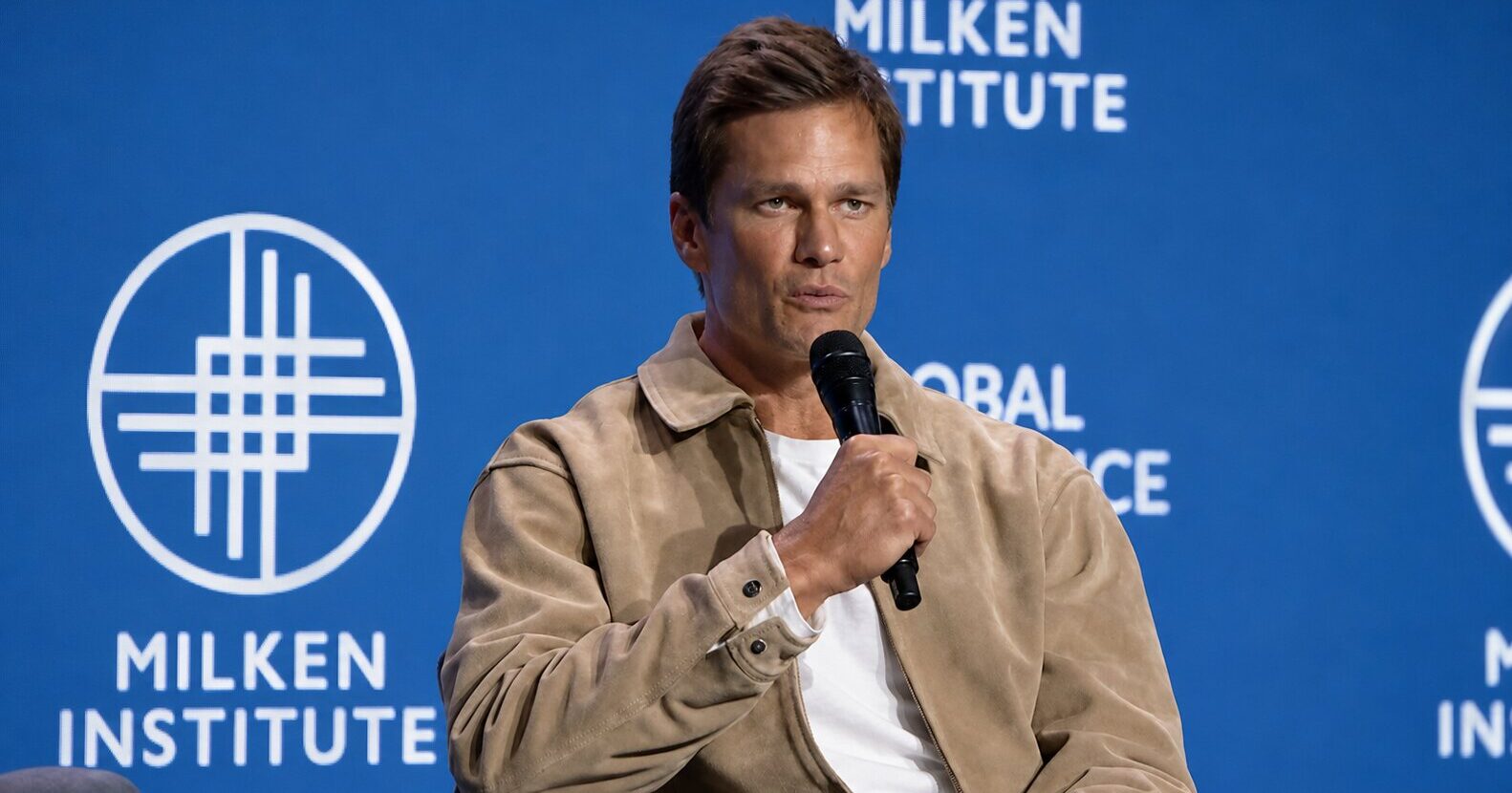
Tom Brady and Shaquille O’Neal at Milken 2026 revealed how the athlete brand licensing model turns celebrity IP into perpetual royalty income. Here’s the business logic.
The Milken Institute Global Conference has hosted central bankers, sovereign wealth fund managers, and biotech founders. Monday’s session brought Tom Brady and Shaquille O’Neal, which means the room was full, the energy was loud, and the actual business content required some excavation.
Worth excavating, though.
Because beneath the highlight-reel nostalgia and the Jim Gray charm offensive was a clear structural argument about how elite athletic brands generate long-term enterprise value — and what the capital markets are beginning to understand about that asset class.
The four-person panel — Brady, O’Neal, Authentic Brands Group Chairman and CEO Jamie Salter, and Merrick Ventures Chairman and CEO Michael Ferro — gave the audience something more interesting than a victory lap. They gave a working thesis on why the athlete brand licensing model, done correctly, behaves less like endorsement revenue and more like perpetual royalty income.
The ABG Structure Is Not an Endorsement Deal
That distinction matters. Salter was direct about the mechanics. ABG doesn’t hire athletes to pitch products. They acquire equity in the athlete’s name, image, and likeness — permanently. A panelist described the arrangement plainly: you’re not buying ten minutes of someone’s attention, you’re buying a percentage of their identity forever.
That framing should interest anyone tracking the post-NIL landscape in college athletics, where the conversation about athlete brand value has been almost entirely short-term. The ABG model is the opposite. It treats the athlete’s cultural capital as a depreciating-but-renewable asset — one that requires active management, brand protection, and content infrastructure. Salter noted that Shaquille O’Neal has been a partner for eleven years, long past the point where the NBA career was generating attention. The Shaqalicious gummy bear line at Hershey isn’t an endorsement. It’s a licensed product from a jointly-held brand entity.
That’s a different business. And it’s one the institutional capital markets are still figuring out how to price.
“I’m Rich. You’re Wealthy.”
The most quoted line of the session — Shaq’s famous distinction between being rich and being wealthy, the one that reportedly upset the O’Neal family when he said it publicly — surfaced again here. He walked his youngest son through the conference in a suit, partly as a teaching moment, partly as a flex, and mostly as both. The parenting-as-brand-management subplot ran underneath the entire conversation.
But there was a real point inside the anecdote. O’Neal’s pivot to business wasn’t driven by vision. It was driven by a statistic that bothered him: roughly 70% of NBA players, by his account, had no income five years after retirement. His father’s directive — don’t lose your mother’s house — became the motivating constraint. He started reading, came across a quote attributed to Eisenhower about hiring people smarter than yourself, and eventually found Salter through what he described as jealousy-fueled competitive research into how Elvis Presley’s estate continued generating revenue decades after his death.
That’s not an unusual origin story for athlete-entrepreneurs. What made it structurally interesting was the equity flip Shaq described: his business went from 100% endorsement-based to 50% endorsement, 50% licensing and ownership. That ratio shift — from being paid to appear to being paid because you own a piece of the product — is the transition that separates the athletes who build durable wealth from the ones who didn’t.
Brady’s Control Problem — and What It Taught Him
Tom Brady’s portion of the session was more introspective than commercial, but it contained the most transferable insight of the afternoon.
Ferro described watching Brady study game notes obsessively — copious, organized, prepared for every contingency including overtime scenarios — and drawing a direct line between that preparation discipline and Brady’s behavior as a business partner. Brady, he said, coaches the people around him rather than waiting to be coached. He seeks feedback from CEOs, sits in on pitches, asks to understand peptides and clinical nuance in Ferro’s health-tech work. The toughest person on Tom Brady, Ferro said, is Tom Brady.
Brady himself described the post-retirement adjustment with more candor than most athletes allow themselves in public. For 23 years, he had a defined rhythm — preparation, game, result, repeat. Retirement removed the structure. The loss of control was genuinely disorienting. His framing: patience equals peace. The ability to sit in uncertainty rather than force outcomes.
That’s a useful framework for anyone managing a portfolio through a rate cycle.
The ABG Model and What It Implies
For a room full of investors and executives, the most actionable thread of the session was the one about brand-as-asset-class. ABG’s approach to acquiring and managing athlete and celebrity IP — their portfolio includes Sports Illustrated, Graceland, and dozens of athlete partnerships — is essentially an alternative asset management operation dressed in a lifestyle brand.
Salter described the criteria simply: global reach, demonstrable family values, and the expectation of long-term reputation stability. That last one is the underwriting risk. You are buying perpetual rights. Any reputational event is permanent exposure.
Brady, by that logic, is a nearly perfect asset: seven Super Bowl rings, a television broadcasting career, a health and wellness brand with clinical infrastructure. He described himself as a “tough date” — not yet committed to ABG despite the long courtship. In a different room, that’s called a cap rate negotiation.
For more on how Authentic Brands Group structures its athlete partnerships, see the Authentic Brands Group overview.
FAQ
Isn’t this just a more elaborate version of a celebrity endorsement?
No, and the distinction is financially significant. A traditional endorsement is a services contract — the athlete is paid to associate their image with a product for a defined term. The ABG model involves acquiring equity in the athlete’s name, image, and likeness in perpetuity, then building licensed product categories around that asset. The revenue stream is royalty-based and doesn’t expire when the campaign does.
Why does this matter to institutional investors?
Because it represents a new category of alternative asset: branded IP with celebrity-anchored scarcity. The returns are tied to cultural relevance rather than traditional financial metrics, which creates both opportunity and underwriting complexity. A handful of family offices and brand-holding companies have begun treating this category seriously. Most of the market hasn’t caught up.
What’s the biggest risk in the athlete brand licensing model?
Reputational exposure. When you acquire perpetual rights to a name, image, and likeness, you’re underwriting that person’s public behavior indefinitely. There’s no exit clause for a scandal that happens in year twelve. Salter acknowledged this directly — the relationship is structured like a marriage, and the diligence process reflects that.
Athletic celebrity is being repackaged
The Brady-O’Neal session was framed as inspiration for a Milken audience. The more interesting read is structural: athletic celebrity is being repackaged as perpetual IP, licensed rather than rented, and valued accordingly. The capital logic is sound. The market is early. The athletes who understood this earliest — and found partners who could operationalize it — built something that outlasts the career that started it.
The ones who didn’t lost their mother’s house.