



























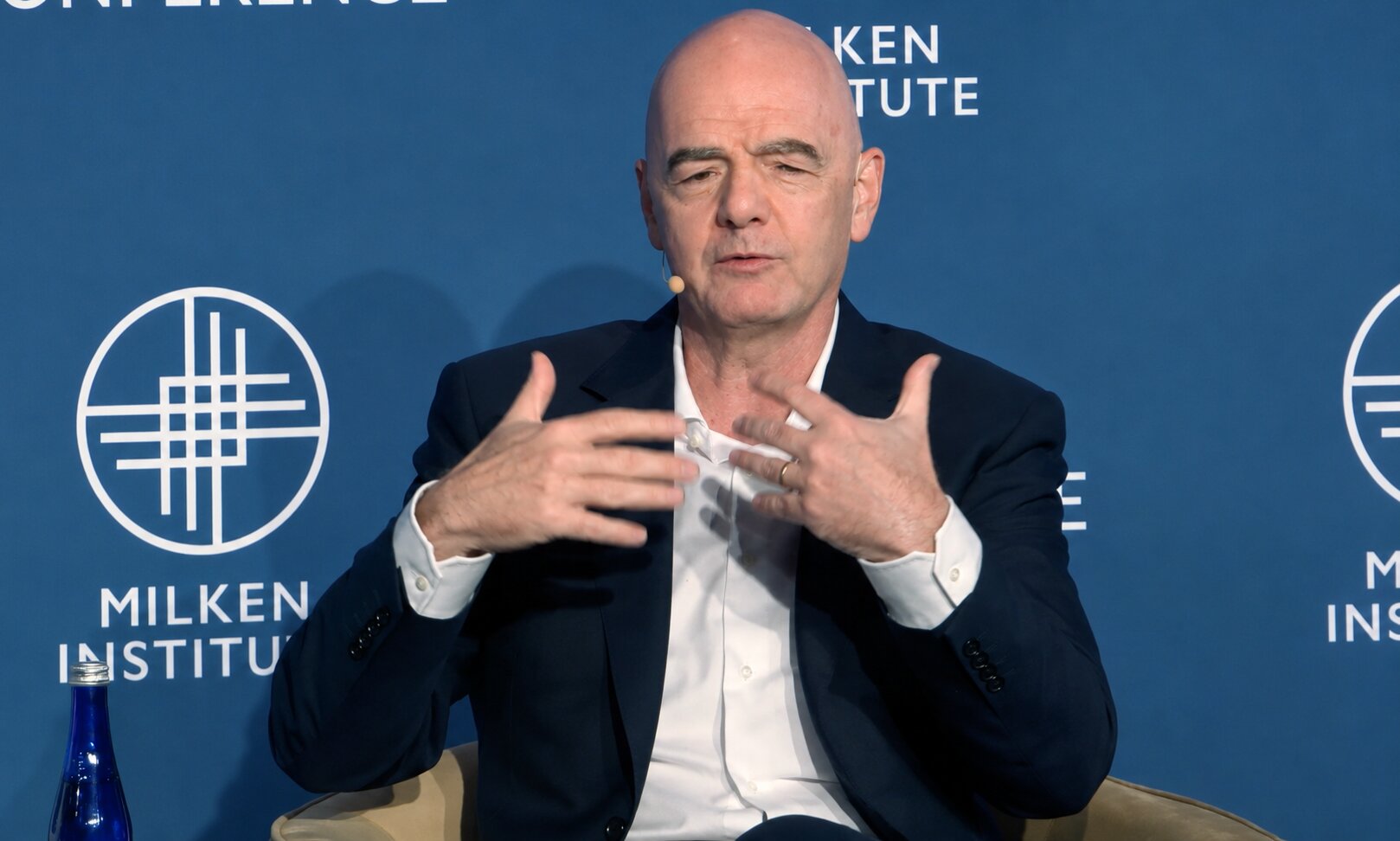
FIFA President Infantino made the FIFA World Cup 2026 case at Milken 2026: the US generates 3% of global soccer GDP. Here’s what the $100B opportunity actually requires.
Here is the single sharpest fact from the Milken Institute Global Conference on Tuesday: the global soccer economy generates approximately $300 billion a year. The United States accounts for around 3% of that. If American investors could push that share to even 30% of what Europe generates, the soccer GDP impact in the US alone would approach $100 billion annually. That is not a growth thesis. That is a gap large enough to drive a league through.
FIFA President Gianni Infantino made that case at the conference’s Beverly Hilton main stage, in conversation with Bloomberg’s Jason Kelly. Infantino was direct about what he called one of the most surprising facts in sports business: that a country which leads the world in financial markets, military power, and entertainment infrastructure does not believe in its own capacity to compete at the top of the planet’s dominant sport.
“Americans don’t believe in America,”
Infantino said
“This is something that I cannot understand.”
48 Teams. Three Countries. One Market Moment.
The structural argument begins with the tournament itself. The 2026 World Cup — the first with 48 national teams — spans Canada, Mexico, and the United States across 16 host cities, 104 matches in 39 days. Infantino cited 500 million ticket requests during the January sales phase. In the two prior World Cups combined — 2018 and 2022 — that number was under 50 million. Demand is not the problem.
The economic impact figure Infantino cited is $80 billion for the tournament itself, creating an estimated 800,000 jobs. That is not the long-term investment thesis — it is the opening condition. The tournament creates a sustained commercial window that, handled correctly, could restructure the domestic professional league’s relationship to global capital. The last time this happened here was 1994, when MLS launched on the back of the Cup. The league has since grown from 10 teams to 30. But the growth has been incremental; the next phase needs to be structural.
Where the Money Is Going — and Where It Isn’t
American sports investors currently treat soccer as a European asset class. They buy into EPL clubs, La Liga franchises, and Series A stakes. Domestic MLS investments are treated separately — a market within a market, not a gateway to the global game. Infantino’s pitch is that the math on that approach is increasingly backward.
Of the $300 billion global soccer GDP, 70% is generated in Europe. The United States contributes roughly 3%. What Infantino is arguing — carefully, at a room full of allocators — is that the distribution is not an inevitability. Europe built its dominance through infrastructure investment, elite player development, and long-term club ownership that tied local identity to commercial outcomes. All of those are replicable. None of them happen without capital believing the thesis first.
Infantino did not shy away from the ambassador-for-his-sport theatrics. He arrived holding a soccer ball, which he held out to the crowd and described, with full conviction, as “a magic tool that transforms people into happy people.” He is not wrong, technically. He is also the president of a $300 billion industry that needs American LPs.
The Talent Pipeline Is the Real Problem
The investment conversation kept returning to one structural friction point: youth access. In the United States, playing organized soccer as a child costs money. It is a pay-to-play system. Basketball, football, and baseball have high school and college infrastructure that identifies and develops talent for free — or close to it. Soccer does not. An athletically talented 12-year-old choosing between sports does the math on which path has a visible ceiling, and soccer rarely wins that calculation.
This is the core infrastructure gap that separates the US from countries that consistently produce world-class soccer players. The pipeline problem is not genetic or cultural — it is economic. It suppresses the talent pool and, as a consequence, suppresses the ceiling of the domestic league. Infantino’s stated goal is to see MLS competing with top European leagues within his tenure. That requires not just bringing elite players in at the top, but building the grassroots system that stops the talent from leaving the sport entirely before it matures.
He was unambiguous that the Women’s National Team represents the clearest evidence that US soccer infrastructure, when it does develop properly, produces world-class results. The women’s game is where America is already a dominant force. The men’s game is a decade-long infrastructure build, at minimum.
The Ticket Price Problem Is Real — but Misread
The conversation turned briefly to ticket pricing, which has generated genuine public anger.
Infantino offered to personally deliver a hot dog and a Coke to anyone who paid $2 million for a World Cup final ticket on the secondary market — a joke, but also a useful calibration device. FIFA’s actual pricing includes 25% of group stage tickets under $300. For comparison, he noted, you cannot get into most domestic professional games of any sport at that price point.
The structural reality is simpler: 500 million ticket requests for a tournament with roughly 6 million available seats creates a secondary market regardless of face value. The pricing debate is a symptom of demand, not a cause.
The Commercial Argument, Plainly Stated
The World Cup final is watched by approximately 20 times more people globally than the Super Bowl. That is not hyperbole — it is the viewership asymmetry that makes Infantino’s argument about investor misallocation legible. If you are building a sports media or sponsorship business and you are structuring around US domestic viewership alone, you are leaving the larger market on the table.
The commercial case for US soccer investment rests on that asymmetry. MLS is the domestic delivery vehicle. The World Cup is the proof-of-market event. What comes between them — player development, academy investment, broadcast rights, youth infrastructure — is where the actual capital is needed.
For more on FIFA’s commercial structure and governance reforms, see FIFA’s official site.
FAQ
Q: Is the 2026 World Cup actually a good investment signal for US soccer, or just a one-time event?
It is both, and the distinction matters. The tournament generates roughly $80 billion in economic impact by FIFA’s figures. But its investment signal function is longer-lived: it establishes domestic audience scale, creates broadcast rights leverage, and demonstrates to international capital that the US soccer market is real. 1994 launched MLS. 2026 is the next structural inflection point — but only if the capital follows.
Q: Why is MLS valued below top European leagues despite the US being a larger economy?
Revenue infrastructure. European clubs generate income from global broadcast rights, massive stadium attendance, UEFA competition prize money, and merchandising reach that touches every continent. MLS clubs are largely domestic revenue stories. The gap is not audience size — it is monetization depth. Building that requires the same infrastructure investment Europe made over decades: academies, elite player recruitment, broadcast deal expansion, and sponsorship tied to global brands rather than regional ones.
Q: What would it actually take for a US-developed player to reach the level of a Champions League starter?
Primarily youth access at the grassroots level. The pay-to-play system in US youth soccer filters out a significant percentage of talented athletes before they ever develop seriously. Countries that produce Champions League-level talent — Brazil, France, Germany, Spain — have subsidized or fully public youth development systems. Fixing that pipeline is a decade-long process that requires investment at the club and federation level, not just at the elite end.
Can the country compete at the top
The $100 billion projection Infantino put on the table at Milken is not a guarantee — it is a market size estimate that assumes US investors actually show up. The structural conditions are real: a 500-million-ticket-request tournament, an underbuilt youth pipeline, a domestic league at a critical scale inflection, and a global audience twenty times larger than the Super Bowl. What is missing is not the market. It is the conviction that this country can compete at the top of the one sport the rest of the world already organizes its life around.