



























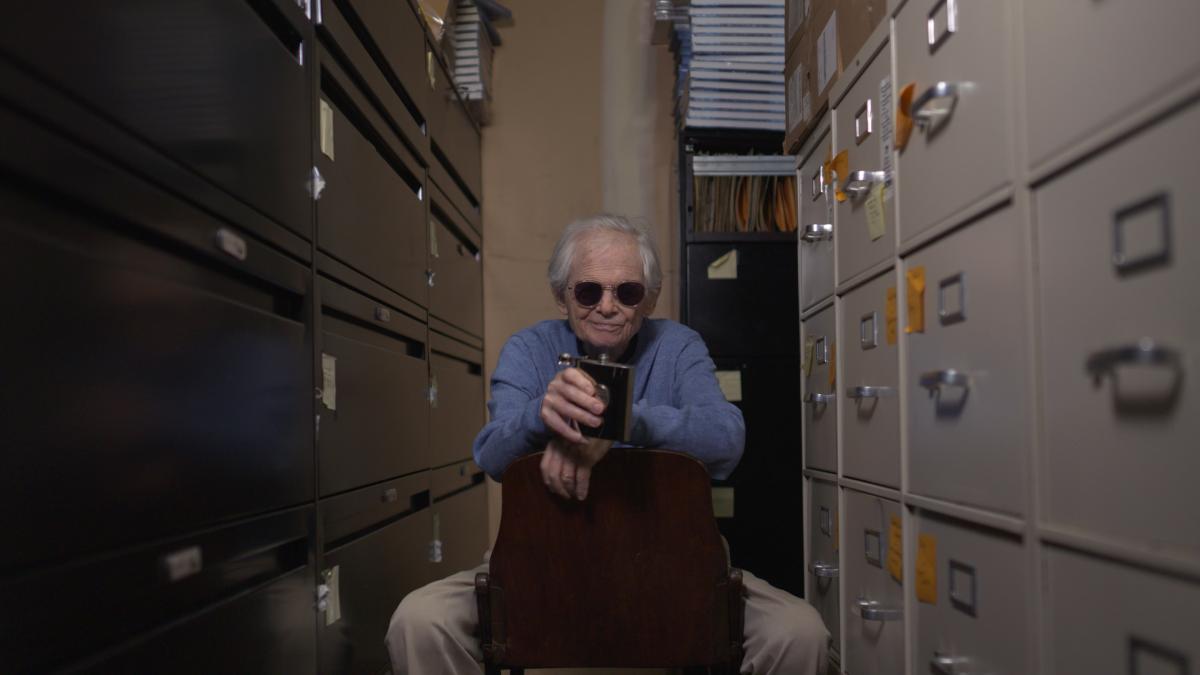
Steve Schapiro: Being Everywhere is streaming now on Amazon, Apple TV, YouTube, and Google Play. Here we interview Director Maura Smith on the archive, the access, and the future of photography and entertainment.
A new documentary captures the man who photographed Bowie, the Kennedys, Warhol, and the soul of American life — and asks whether that kind of vision still has a future.
There is a moment early in Steve Schapiro: Being Everywhere — available now on Amazon, Apple TV, YouTube, and Google Play — where the photographer apologizes for wearing sunglasses on camera. He does not want anyone to think he is “a big shot.”
The man has 798,000 negatives in his archive. He photographed Robert Kennedy on Christmas morning in a bathrobe. He was in the motel room after Martin Luther King Jr. was shot. He captured David Bowie, Andy Warhol, The Velvet Underground, Barbra Streisand, James Baldwin, Samuel Beckett, and the Selma march. He shot the stills for The Godfather and Ferris Bueller’s Day Off.
He did not want you to think he was a big shot.
Here’s an interview between Joe Wehinger and filmmaker Maura Smith on FlavRReport’s YouTube channel.
That tension, between the magnitude of what Steve Schapiro witnessed and the almost stubborn modesty with which he moved through the world, is exactly what makes Being Everywhere one of the most quietly devastating documentaries to hit streaming in 2026.
And it is exactly why director Maura Smith, his wife, knew she had to make it.
The Archive No One Fully Knows
Sit with the number for a moment: 798,000 negatives. And that, Smith told me during a recent conversation for FlavRReport and Daily Ovation, does not count a single color slide.
“The color slides,”
she said,
“have got to be at least two or three times over.”
So we are talking, conservatively, somewhere north of two million images. A half-century of American life — its glamour, its grief, its politics, its pop culture — shot by one man who traveled light, stayed quiet, and had a gift for making powerful people forget he was in the room.
The most commercially sought images from that archive are what you might expect: Warhol, Bowie, The Velvet Underground, James Baldwin, the Selma March, the Godfather stills, Streisand. But Smith mentioned something her son Theophilus Donoghue, who manages Schapiro’s archives, noticed that caught her off guard. Samuel Beckett, when posted, routinely outperforms expectations. Forty thousand likes, easy. Nobody saw that coming.
That is the thing about an archive this size. It keeps surprising you.
How He Got in the Room
The obvious question, watching the documentary, is how a photographer earns the kind of access Schapiro had. Robert Kennedy. Christmas morning. A robe. Hairy legs. Twice.
“How well did Robert Kennedy like Steve?” Smith said, laughing softly. “If you see those pictures, that’s your answer.”
The answer, she believes, was not charisma or credential. It was something simpler and rarer. He was not physically imposing. He did not shove for position or blow up an eyeline. He was, by every account, genuinely polite. He gave people room.
“He’s not getting in my way,” she said, describing how subjects must have experienced him. “He’s not disturbing. He’s not trying to grab that picture.”
And he never thought he was the best in the room. Smith told a story about Schapiro traveling to New York and visiting the Irving Penn studio — not to meet Penn, but to leave a book at the front desk and ask if Penn might possibly sign it someday. The secretary asked him to wait. Penn walked out personally. “I have always admired your work,” Penn told him.
Smith teetered on becoming emotional telling it. Schapiro, she said, genuinely never thought about people admiring his work. He knew some people recognized his pictures. Admiration had not occurred to him.
The Film Maura Smith Had to Make
The documentary had a slow origin. A French TV crew came to Chicago around 2013 or 2015 to film Schapiro, and Smith was thrilled — until she saw the finished cut screened in Paris. The gallery owner standing next to her said it simply: too much archival news footage of the events, not enough of Steve’s actual photographs.
Mental note taken.
“If I make a film about Steve,” Smith decided, “it’s going to be about his pictures.”
She also made a deliberate choice against the conventional documentary format of celebrity endorsements and expert talking heads. She had the access. She could have gotten names. She chose not to.
“I didn’t want other people’s opinion of Steve’s work,” she said. “If I’m going to pay to make the movie, I’m just going to make it about Steve telling his stories.”
That is a genuine risk. One person on camera for seventy minutes is a structural gamble. Smith knew it. “I absolutely know that watching one person tell stories for 70 minutes could be a drag,” she said. “But that’s the story I was going to tell.”
It works. The film runs 71 minutes and structured not chronologically; which Smith called the easy, thoughtless choice, but emotionally. “Have the fun stuff, the key stuff, the charming stuff,” she explained, “and then we can get to some of the other stuff.” The Martin Luther King motel room sequence arrives like a weight you did not see coming. The Robert Kennedy plane sequence — where Schapiro leans over and re-enacts Ethel Kennedy holding her husband’s hand — lands as one of the more quietly shattering moments in recent documentary filmmaking.
“As soon as that picture comes up,” Smith said, “I’m clear sailing. I know from here on, no one’s going to get bored.”
She was right.
Steve’s Three Rules
Schapiro learned photography the way he learned everything: methodically, from first principles. He attended Stuyvesant High School in New York, one of the city’s elite public schools, where he was not a photographer but a journalist. He learned to tell a story before he learned to shoot one.
His photography philosophy, as he articulates it in the documentary, comes down to three elements: design, information, and emotion. Get all three in a single frame, he says, and you are doing good. You have it.
It sounds simple. It is not. Most photographers spend careers chasing one or two of those. Schapiro built 798,000 negatives chasing all three.
Valentine or Eulogy? The Future of Photojournalism
Walking out of the theater after seeing Being Everywhere, I found myself caught between two readings of what I had just watched. Was this a valentine to what photojournalism can be — or a eulogy for what it used to be?
The magazines that gave Schapiro his platform largely no longer exist. The access infrastructure that put a quiet, polite photographer in Robert Kennedy’s living room on Christmas morning is gone. The economics that sustained long-form photo essays have collapsed.
I brought the question to Smith directly: is there a Steve Schapiro in the future?
She did not hesitate: “I think it’s going to work out.”
Her reasoning was grounded. She pointed to the resurgence of analog film among young photographers — a trend that started in Europe roughly eight years ago and has been accelerating. She pointed to the international gallery system actively incorporating new talent. She pointed to the fact that Schapiro himself is represented by eight international photo galleries, and that she pays close attention to what those galleries are showing and prioritizing.
“I agree that everybody can take a picture,” she said. “Everyone’s a camera person. But I think that happened for a while in America and it didn’t interfere.”
She drew a parallel to independent film — a subject she knows with equal intimacy. She walked into her Columbia College Chicago classroom the morning after the 2025 Academy Awards and told her students: we won. Anora, a low-budget film without major stars, had just taken the top prize. The door, she said, is opening.
“They need those independent filmmakers to tell those real stories. Now they need us more than ever.”
71 Minutes. Watch It Tonight.
Steve Schapiro: Being Everywhere is available now on Amazon Prime Video, Apple TV, YouTube, and Google Play.
At 71 minutes, it is the rare documentary that leaves you wanting to press rewind immediately. The pacing earns that. So does Schapiro himself — a man who spent six decades being the least obtrusive person in the most consequential rooms in American life, and whose final message to the camera is exactly what you would expect from someone like that.
Go out there, he says. Take pictures that mean something. Change the world by your images.
The world, as Smith noted when I mentioned that line to her, is a little discombobulated right now.
“If you can change the world with a little more kindness,” she said, “let’s do it.”
FAQ
Q: What is Steve Schapiro: Being Everywhere about? A: Steve Schapiro: Being Everywhere is a feature-length documentary about legendary American photographer Steve Schapiro, told entirely in his own words. The film spans his six-decade career capturing David Bowie, Robert Kennedy, Martin Luther King Jr., Andy Warhol, Barbra Streisand, the Selma March, and the set of The Godfather. Directed by filmmaker and Schapiro’s wife, Maura Smith.
Q: Where can I watch Steve Schapiro: Being Everywhere? A: The documentary is available to rent or buy on Amazon, Apple TV, YouTube, and Google Play. Visit steveschapirobeingeverywhere.com for more information.
Q: Who directed Steve Schapiro: Being Everywhere? A: The film was directed by Maura Smith, a graduate of USC Cinema with an MFA in screenwriting from Columbia University. She has directed for Sony Music, BBC, and Paramount.
Q: How many photographs are in Steve Schapiro’s archive? A: Steve Schapiro’s archive contains approximately 798,000 negatives — not counting color slides, which Maura Smith estimates could be two to three times that number.
Q: What are Steve Schapiro’s three rules of photography? A: Schapiro’s three principles were design, information, and emotion. He believed that if a photograph achieved all three, it succeeded.
Q: Why does the documentary feature only Steve Schapiro’s voice — no celebrity interviews? A: Director Maura Smith made a deliberate choice to let Schapiro tell his own stories without outside commentary. She wanted the film to be about his pictures and his perspective — not other people’s opinions of his work.
Q: Did Steve Schapiro: Being Everywhere have a theatrical release? A: Yes. The documentary screened theatrically in Los Angeles, Chicago, New York, San Francisco, Berkeley, Boston, Washington D.C., Cincinnati, Santa Fe, Sedona, Tulsa, and additional cities, with director Q&As at many screenings.









The Godfather stills. He shot THE GODFATHER STILLS. And he was “modest” about it. LEGEND!!
Ferris Bueller AND The Godfather. He photographed two of the most iconic films of the 20th century
Change the world by your images. Understatement Hall of Fame.
71 minutes and she didn’t need a single celebrity talking head. That’s a confident filmmaker
Every film school should show this alongside their first week of storytelling lectures. Design, information, emotion.
Someone needs to do this doc for the chefs who photographed the food world before everything became a flat lay on Instagram.
No celebrity interviews was the right call and also a massive risk. It paid off because the subject was strong enough to carry it.
Everyone’s a camera person now. Truly. I have 12 photos from last Tuesday that are just slightly blurry versions of my pasta
He photographed RFK in a bathrobe on Christmas morning. Twice. That could be its own movie
A man who photographed the defining moments of American history for six decades, didn’t think he was a big shot, and apologized for his sunglasses on camera. What a character
40,000 likes on a Samuel Beckett post. Nobody saw that coming. I’d say the internet surprises you but mostly it just disappoints you