



























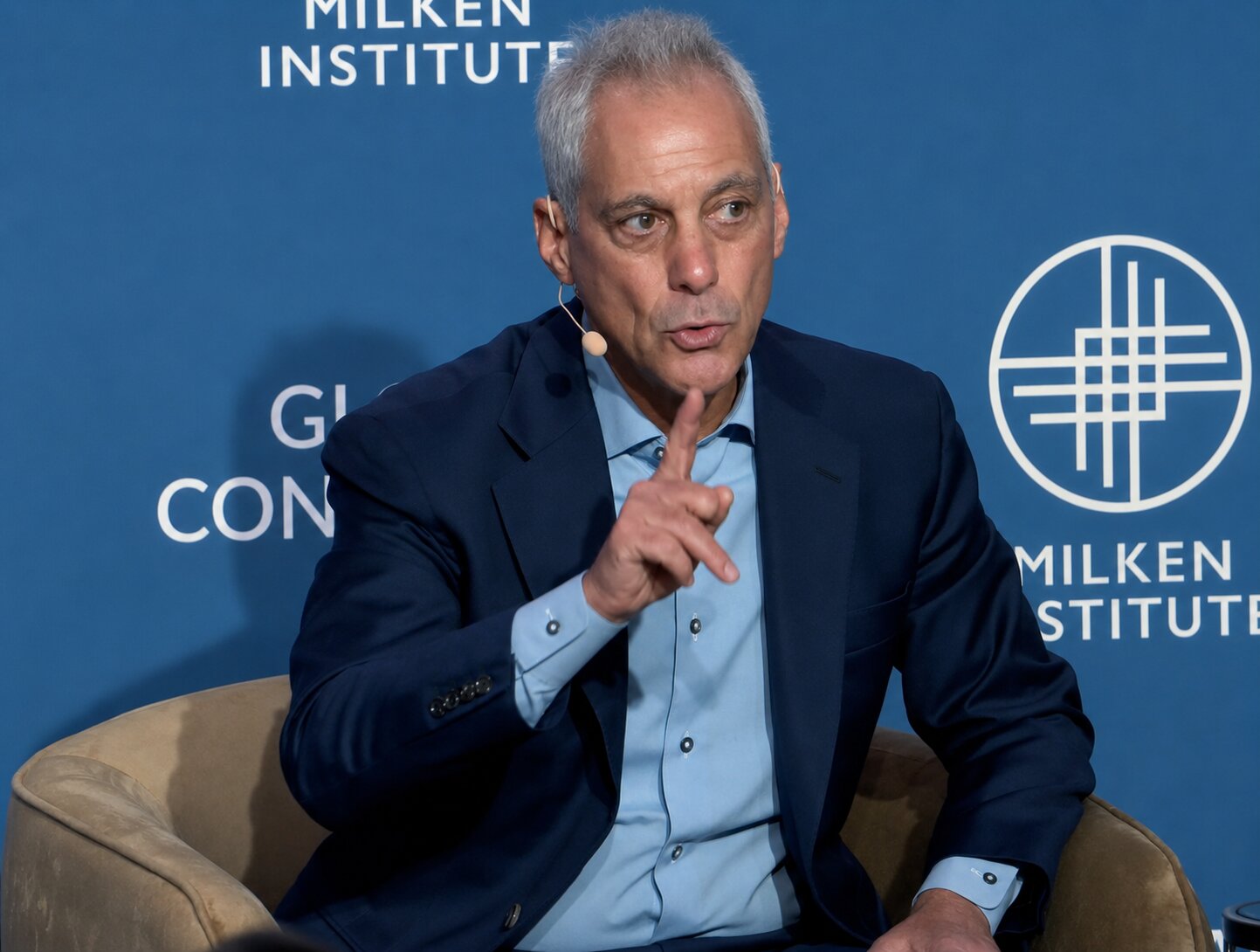
At Milken 2026, Rahm Emanuel made the structural case for a Democratic wave, with 14 wins, hard data, and the self-awareness his party has been missing.
There’s a particular kind of silence that follows a diagnosis nobody wants to argue with.
That’s what happened Tuesday morning at the Milken Institute Global Conference when Rahm Emanuel — former White House Chief of Staff, former Mayor of Chicago, former U.S. Ambassador to Japan, said, with the precision of a man who has lost elections he should have won:
“Democrats worked really hard to get into this position.”
The room laughed. Then it sat with it.
Emanuel hadn’t come to Beverly Hills to spin. He came with data, a structural theory, and a willingness to say, on record, that his own party spent 2024 “in a cultural cul-de-sac on a set of issues that had not anything primary to do with where the American people were.” Stop talking about bathroom access. Start talking about classroom excellence.
“That’s the smallest room in the house, and we occupied it stupidly.”
If more Democratic strategists had said that out loud two years ago, the morning’s panel might not have been necessary.
What the Numbers Actually Say
The session opened with polling that should have been the whole conversation: Democratic Party approval at 34%, Republican Party at 42%, and a sitting Republican president flirting with some of the lowest approval ratings in recent memory. Both parties underwater. Both parties failing the kitchen table.
Glenn Youngkin — the former Co-CEO of The Carlyle Group who served as Virginia’s 74th Governor — offered the GOP’s version of reassurance: the administration is delivering, the communication has lagged, the narrative will catch up.
“We just got to make sure we help people understand what has happened.”
It was a boardroom answer. Competent. Polished. And structured around the assumption that voters are waiting to be informed rather than waiting to be heard.
Emanuel’s read was more honest, and more politically useful. Since November 2024, he said, Democrats have gone 14-for-14 in statewide elections. Of 25 state legislative seats that changed hands, Democrats took all 25. That’s not a blip. That’s a pattern with the same structural physics as 1994, 2006, and 2010: independents break 2-to-1 for the party out of power, base turnout inverts, and wave elections don’t ask permission.
The man has done this before. He knows what a wave looks like from the inside.
The Iran Detour (And What It Cost the Room)
Youngkin himself flagged it: “We have for the last 23 minutes talked about this issue.” The issue was Iran. The irony was complete.
Two men who had just agreed that voters can’t pay their bills proceeded to spend the majority of a 35-minute session debating a foreign policy question that doesn’t appear anywhere near the top of a working family’s worry list.
Emanuel’s foreign policy argument was the most analytically interesting thing said all morning, and it got buried in the format. His thesis: Iran had already been cornered before the U.S. intervention — five internal uprisings in twelve years, an aging supreme leader with no succession plan, a broken economy, Hezbollah knocked back, Syria lost. His broader military observation — that the U.S. still operates on a conventional naval dominance model while adversaries have learned to control strategic waterways with no navy at all — landed as the session’s sharpest unreported insight.
It deserved a separate panel.
Instead, it became a debate neither side could close.
The Distinction That Decides 2026
Emanuel arrived with a piece of data Youngkin didn’t dispute: Manhattan Institute polling showing 50% of Democratic primary voters self-identify as moderate.
“I know where the noise is,”
he said,
“and I also know where the voters are, and it’s not the same.”
That sentence is the whole midterm in one line. The noise is louder, more quotable, and more present in media coverage. The voters are quieter, more numerous, and showing up in every special election since November. Emanuel’s argument isn’t that Democrats have figured it out — it’s that the structural environment is already doing the work, and the party’s job is to not get in its own way again.
Youngkin countered with Virginia’s current governor as evidence of moderate-presenting candidates governing left. It was a fair hit on a specific case. What it didn’t address was the aggregate data Emanuel had just put on the table — 14 states, 25 legislative seats, a consistent pattern that predates any individual governor’s policy choices.
One of them was arguing from a data set. The other was arguing from an anecdote.
What Sophisticated Observers Take From Tuesday Morning
Emanuel’s self-awareness is his competitive advantage; and it’s genuinely rare in a room full of people who have spent decades being told they’re right. The ability to say “we did this to ourselves” on a Milken stage, with specificity and without hedging, is a political skill that doesn’t show up on a résumé but shows up in results.
The structural midterm case he laid out is consistent with every historical analogue he cited. Whether Democrats use the next six months to build something durable on that foundation — or whether they drift back toward the smallest room in the house — is the only question that matters between now and November 2026.
Youngkin’s final answer was honest: “We’ve got work to do.”
Emanuel’s answer, unspoken, was already on the scoreboard.
Frequently Asked Questions
Why are Democratic approval ratings rising in special elections despite low overall party approval? Emanuel’s Milken argument points to structural midterm physics: independent voters consistently break 2-to-1 for the party out of power, and base turnout differentials compound the effect. The 14-for-14 pattern in statewide elections since November 2024 mirrors the same dynamics that produced wave elections in 1994, 2006, and 2010 — regardless of which party held the White House.
What is Rahm Emanuel’s argument about Democratic primary voters? Emanuel cited Manhattan Institute polling showing 50% of Democratic primary voters self-identify as moderate, pushing back against the narrative that the party’s base has moved irrevocably left. His distinction — between where the noise is and where the voters are — is the core of his 2026 midterm theory.
What did the Milken panel reveal about the GOP’s political risk heading into 2026? Youngkin framed the Republican challenge as a communications gap rather than a performance gap — the administration is delivering, the narrative hasn’t caught up. But Emanuel’s structural midterm data, which Youngkin did not dispute, suggests the political environment may be moving faster than any communications strategy can correct.