























Most film pitch deck mistakes aren’t about design — they’re structural. Learn the page order and financial clarity that makes investors engage instead of pass.
The problem with most pitch decks isn’t design or writing — it’s that they answer the wrong questions first
Your pitch deck took three months to build. The designer charged real money. Every frame is considered. The mood boards reference directors you genuinely admire. Your synopsis is sharp.
Investors looked at it for under a minute and passed.
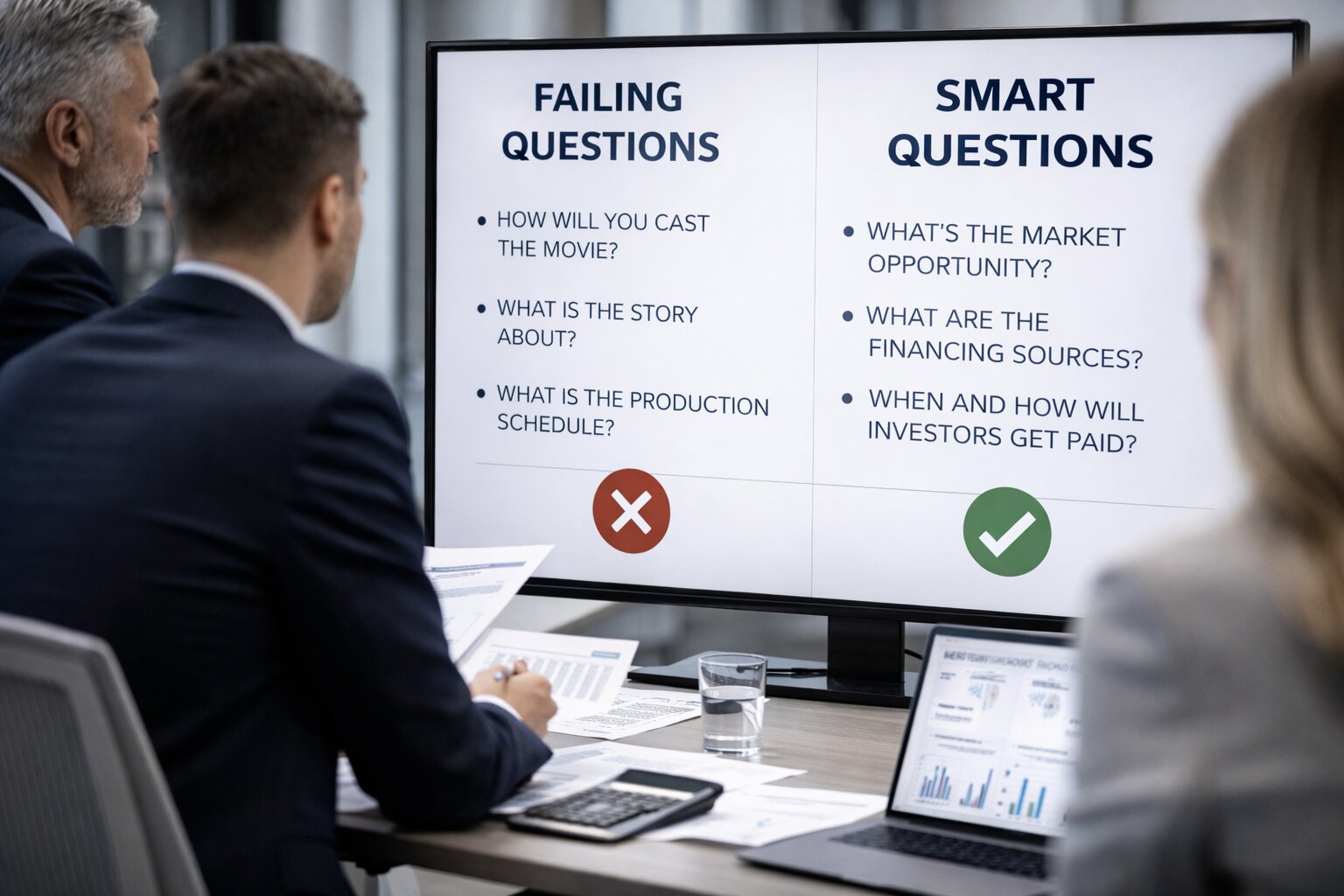
The problem isn’t aesthetic. It’s architectural. The most common film pitch deck mistakes have nothing to do with design quality or writing polish — they come from a fundamental misunderstanding of what these documents are actually for. Filmmakers build decks to inspire. Investors scan them to assess risk. That disconnect kills more deals than weak scripts ever will, and it’s almost entirely fixable once you understand the sequence problem.
Why Beautiful Decks Fail to Close Financing
Walk the producer lounges at the Marché du Film in Cannes or the networking suites at AFM in Santa Monica. You’ll see stunning pitch decks on every screen. Most will never raise a dollar.
The fatal assumption behind most of them: investors want to be moved emotionally before they understand the deal financially. They don’t. An investor doesn’t read your deck cover to cover — they scan it, often in under a minute, looking for specific signals that tell them whether this opportunity merits deeper investigation or immediate dismissal. If those signals are buried on page twelve, they never get there.
This isn’t a character flaw in investors. It’s how capital evaluates opportunity at scale. At any given market, a serious financier may be scanning dozens of packages. They’ve developed rapid filtering systems built around specific questions in a specific sequence. Your deck either answers those questions immediately and clearly, or it fails — regardless of how strong the creative vision behind it actually is.
The Opening Page Problem Most Producers Never Fix
Here’s the most common film pitch deck mistake: leading with story instead of structure.
Almost every deck opens with a logline, followed by a synopsis, a director’s vision statement, thematic framing, and mood boards. From a filmmaker’s perspective, this sequence makes complete sense — it’s how the project lives in your mind and how you’d naturally introduce it in conversation. From an investor’s perspective, it’s completely backwards.
Story matters. But structure comes first. Investors need to understand the deal before they’ll engage with the narrative. What should actually be on page one is a financial snapshot: total budget with clear breakdown, equity requirement and why it’s at the level it is, confirmed financing elements including tax incentives and pre-sales, production timeline, and key attachments framed in terms of their market relevance — not their creative credentials.
Only after establishing that the financial architecture makes sense do you earn permission to discuss creative vision. When you lead with narrative, you force investors to work backwards through the deck to find the information they actually need. They won’t do that work. They’ll move to the next package.
What Investors Actually Scan For in the First 60 Seconds
Experienced capital at EFM, TIFF, or AFM has developed filtering instincts that operate faster than most producers realize. Within the first minute of opening your materials, they’re evaluating a specific set of questions — and if the answers aren’t immediately visible, the evaluation ends.
Does this budget match market reality? If you’re presenting a $6 million romantic comedy with unknown leads, the number signals either inexperience or a fundamental misunderstanding of what the market will support for that package. The conversation ends before it begins.
Is the financing structure coherent? Can they see instantly how much is confirmed versus how much you’re asking for? Is equity exposure at a level that reflects intelligent use of available tools — incentives, pre-sales, gap financing? A financing structure that shows the producer has done the full job is immediately distinguishable from one that hasn’t.
Are the comparables credible? Do you demonstrate a real understanding of what similar films have actually sold for, or are you operating on optimistic assumptions about how your project compares to films with much stronger packages? Investors who know the market spot inflated comps immediately, and it reframes everything else in the deck.
Does this producer understand the business? This is the filter that everything else flows through. Within seconds, experienced investors can sense whether the materials reflect genuine risk literacy or creative enthusiasm that hasn’t engaged with the financial realities of independent film. The deck is the first test of your sophistication as a producer.
The Page Order That Actually Communicates to Capital
The structural sequence that works for investor-facing pitch materials is counterintuitive for filmmakers, but it’s consistent with how investors actually process information.
Lead with a financial overview: budget, equity ask, financing plan, timeline. Everything an investor needs to decide whether the deal warrants deeper attention, in one place, on the first page.
Follow with market positioning: genre, comparable titles with actual sales data, territory estimates from your sales agent, target audience. This section answers whether the market supports the budget you’ve presented.
Then key attachments: cast, director, sales agent — each framed in terms of their market relevance and what they contribute to financing and distribution, not just their creative credentials. An investor needs to understand why this director reduces risk, not just why they’re talented.
Then production strategy: location with incentive justification, shooting schedule, completion bond status. This section demonstrates operational intelligence.
Then distribution plan: sales strategy, territory approach, revenue model. How does the money actually come back?
Only then — pages six through eight — do you present creative vision: logline, synopsis, visual references, thematic elements. By this point, the investor understands the deal. Now they can engage with the story from a position of informed interest rather than unanswered financial uncertainty.
Close with team and track record, emphasizing execution capability over creative passion.
This sequence feels wrong to filmmakers. It’s exactly right for capital.
The Over-Shopped Deck Problem Nobody Talks About
One of the most destructive film pitch deck mistakes is continuing to circulate a deck that’s already been widely seen without closing. At a certain point — and it arrives faster than most producers expect — your materials become known at the markets and in the finance community. Financiers at AFM recognize the project. Sales agents at Cannes have seen the deck before. The quiet assumption forms: still looking for money after all this time.
Once that perception exists, the deck itself becomes a liability rather than an asset. Every new send reinforces the problem. The market has formed a judgment, and sending the same materials to new targets just confirms it for anyone who asks around.
The correct response when a deck has been circulating unsuccessfully for more than six months is a complete rebuild: new design, new positioning, restructured financial presentation. Not because you’re misrepresenting anything — because you’ve incorporated market feedback into a genuinely different structure, and the visual reset signals that something has changed. Investors who passed on the previous version may re-engage with a package that looks and feels materially different.
What Financial Clarity Looks Like Versus What Vagueness Sounds Like
The difference between a deck that passes investor scrutiny and one that doesn’t often comes down to a single quality: specificity.
Clarity looks like this: Budget $2.8M. Equity required $650K at 23%. Tax incentives confirmed $980K representing Georgia’s 35% credit. Pre-sales estimated conservatively at $560K with sales agent attached. Gap financing $610K approved pending final cast confirmation. Production start Q4 2025.
Vagueness sounds like this: we’re exploring various financing structures. Budget is flexible depending on cast. Multiple international opportunities are under discussion. Several investors have expressed strong interest. We believe this film has significant commercial potential.
The first example gives investors everything they need to evaluate the deal in thirty seconds. The second makes them do analytical work they won’t do. Every line of vague language is an invitation to move on to the next package.
The Deck Audit Every Producer Should Run Before the Next Send
If your deck has been circulating for more than three months without meaningful traction, run this diagnostic before sending it again.
Can an investor understand your total budget, equity ask, and financing structure within thirty seconds of opening the deck? If the answer is no, restructure before the next send. Everything else is secondary.
Do you lead with financial logic or creative vision? If creative vision comes first, you’re losing investors before they get to the information that determines whether they engage.
Are your comparables realistic or aspirational? Comparing an unknown-cast drama to films that had A-list stars signals that you don’t understand the market pricing of your own project. Investors who know the market will catch this immediately.
Is your deck longer than twelve pages? If yes, you’re including information investors won’t read. Every page beyond twelve reduces the probability that anyone finishes the document. Cut ruthlessly.
Does your deck answer why now and why this team? If investors can’t quickly understand the urgency of the timeline and the execution capability of the people involved, they’ll default to waiting — which in practice means never.
Three Questions Producers Ask When They Rethink the Deck
Should my deck be more creative-focused or finance-focused? Finance-focused, with creative elements that support the investment thesis. Investors need financial clarity first. Once the deal structure makes sense to them, they’ll engage with the creative vision. Reversing this order means they never get to the creative because they’re stuck on unanswered financial questions — and they won’t ask those questions out loud. They’ll just pass.
How long should the deck actually be? Ten to twelve pages maximum. Investors don’t read thirty-page decks. They scan for key information in a predictable sequence. If you can’t make the complete case in ten pages, that’s a signal that you don’t have sufficient clarity on your own project — not that the investor needs more information. Every additional page reduces the probability of completion.
Can I use the same deck for investors, sales agents, and festivals? No. These are different audiences with fundamentally different needs. Investors need financial structure and risk framing. Sales agents need market positioning and comparable sales data. Festivals need creative vision and thematic depth. A single deck trying to serve all three will fail at all three. Build purpose-specific materials for each audience and treat the investment in doing so as part of the cost of professional packaging.
The Structural Fix That Changes How Investors Respond
Most film pitch deck mistakes can be corrected in a single focused session of restructuring. You don’t need a new designer. You don’t need better mood boards or sharper copy. You need to reorder the information so it answers investor questions in the sequence they’re actually asked.
Financial structure first. Market positioning second. Creative vision third. That reversal feels wrong to filmmakers who’ve spent months developing the story and the visual language. It’s also the difference between decks that circulate endlessly at markets and decks that generate the specific kind of interest that leads to term sheets.
The deck is not the pitch. It’s the filter that determines whether you get the pitch. Build it for the people who have to read it, not for the project you’re trying to make.