



























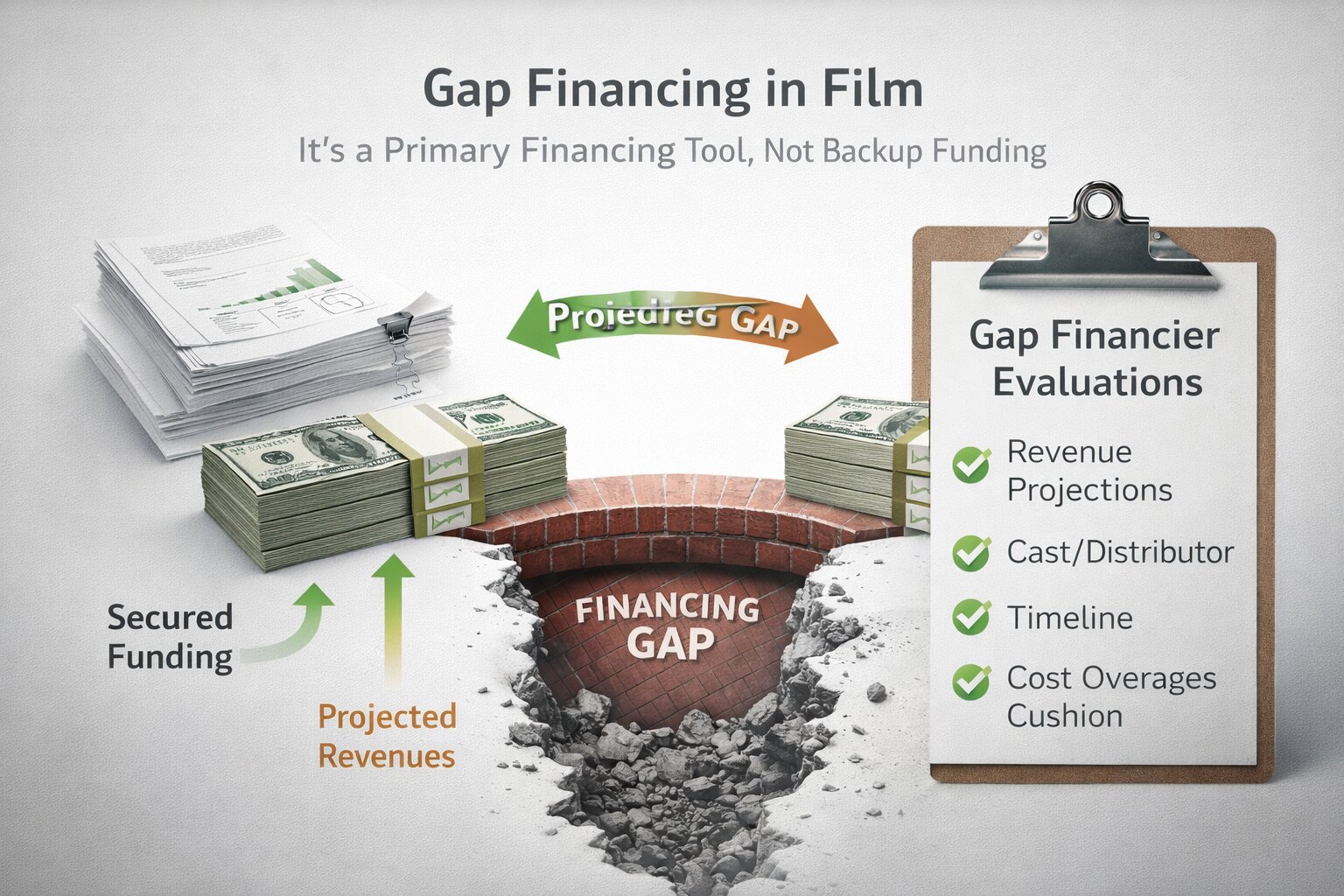
What gap financiers actually evaluate, and why most producers misunderstand the instrument entirely
You’ve secured tax incentives. You have realistic pre-sales estimates. Your equity requirement is reasonable. But there’s still a funding gap between confirmed money and your total budget.
This is where gap financing becomes essential. Yet most producers either don’t understand it, apply too late, or present packages that gap financiers reject immediately. The instrument isn’t mysterious — it’s a specialized form of lending secured against projected revenues. But it requires specific conditions that most producers haven’t created before they come knocking.
Understanding what gap financiers actually evaluate, and structuring your project to meet those criteria, is the difference between films that close and films that stall six inches from the finish line.
What Gap Financing Actually Is — And What It Isn’t
The fundamental concept: gap financing is a loan that bridges the difference between your secured financing and your total budget. It is not equity. It’s debt. Gap financiers get repaid with interest before equity investors see a dollar. They’re secured lenders, not creative partners.
Here’s what the structure looks like in practice. Total budget: $3 million. Tax incentives confirmed: $900K. Pre-sales contracted: $600K. Equity raised: $750K. That leaves $750K unfunded — the gap. The gap financier lends that final amount secured against estimated sales in territories not yet pre-sold.
They charge interest — typically in the range of 3% to 8% annually depending on the package — plus origination fees and sometimes a small backend participation. It’s expensive capital. But it’s non-dilutive. You don’t surrender ownership to close the round.
Who Provides Gap Financing
Gap financing comes from specialized lenders, not from traditional investors. We’re talking about entertainment banking divisions at major institutions, specialized media finance companies, and international lenders active in co-production territories like the UK, Canada, and Australia.
These are not venture capitalists hoping for outsized returns. They evaluate collateral and risk ratios. They think like banks because they are banks, or are structured to operate like them. At markets like Cannes, EFM, or AFM, gap financiers don’t attend pitches. They review completed financing packages brought to them by sales agents or by producers who already have the other pieces in place.
That last point matters more than most producers realize. Gap financing is almost never the first conversation. It’s the final one — and only after everything else has been assembled correctly.
The Coverage Ratio That Determines Approval
Here’s what most producers miss: gap financiers don’t simply look at your total sales estimates. They calculate coverage ratios. The formula is straightforward — total projected sales (confirmed plus estimated unsold territories) divided by the gap loan amount. Most gap financiers require that ratio to come in between 1.2x and 1.5x, meaning projected sales need to exceed the gap loan by 20% to 50%.
An example that works: gap loan requested is $750K. Confirmed pre-sales are $600K. Conservative estimates on remaining unsold territories add $900K. Total projected sales: $1.5 million. Coverage ratio: 2.0x. That gets approved.
An example that fails: gap loan requested is $1.2 million. Confirmed pre-sales are $400K. Estimated remaining sales are $800K. Total projected sales: $1.2 million. Coverage ratio: 1.0x. That gets rejected. The coverage isn’t sufficient to justify the risk.
The lesson: your gap loan request has to be sized to your coverage, not sized to your funding shortfall. Those are two different numbers, and conflating them is one of the most common structural errors I see producers make.
Why Your Sales Agent’s Reputation Is Part of the Application
Here’s something that genuinely surprises many producers the first time they hear it: gap financiers don’t just evaluate your film. They evaluate your sales agent.
Estimates from a top-tier, well-established sales company carry substantially more weight than estimates from an unknown or newly formed one. If your projections come from your own spreadsheet with no sales agent validation, most gap financiers will either reject outright or apply discounts steep enough to make the coverage ratio fail anyway.
This is why attaching a reputable sales agent before approaching gap financiers isn’t optional — it’s structural. The sales agent’s credibility is part of the collateral. Experienced gap financiers maintain working relationships with specific sales companies whose estimates they’ve seen proven out over multiple projects. Projects represented by those companies move through approval faster and on better terms.
What This Capital Actually Costs
Gap financing is not cheap, and producers who treat it as a last resort often get surprised by the true cost. Here’s the honest breakdown.
Interest rates run 3% to 8% annually, lower for strong packages with major sales representation, higher for riskier projects or less established producers. Origination fees typically run 2% to 4% of the loan amount, paid upfront and non-refundable. Some gap financiers also take backend participation — occasionally 5% to 15% of producer profits — particularly on higher-risk projects.
On a $750K gap loan at 6% interest over 18 months with a 3% origination fee, you’re looking at roughly $90K in fixed costs before any backend. That’s real money.
But compare it to equity. $750K in equity at 25% of the film costs you 25% of all revenues indefinitely. If the film generates $3 million, that’s $750K to equity investors. If it generates $6 million, that’s $1.5 million. Gap financing costs are capped. Equity costs compound with success. For films with genuine commercial upside, gap financing is often the cheaper long-term instrument — which is exactly why sophisticated producers use it intentionally, not as a fallback.
Why Applications Get Rejected — And What’s Actually Fixable
Most gap financing rejections aren’t mysterious. They come down to a short list of structural problems, all of which are correctable if you catch them before applying.
Coverage ratio too low is the most common. Your sales estimates don’t exceed the gap loan by the required margin. The fix is either reducing the loan request, increasing pre-sales, or getting more conservative and credible estimates that hold up under scrutiny.
Sales estimates that aren’t credible is the second most common. No reputable sales agent attached, or projections that are obviously inflated relative to comparables in your genre and cast level. Gap financiers see hundreds of packages. They know what a mid-level thriller with unproven international cast actually sells for. Inflated numbers don’t get approved — they get noted as a red flag about the producer’s judgment.
Other financing pieces not actually confirmed shows up more often than it should. Tax incentives that are anticipated but not legally approved, equity that’s “committed” but hasn’t wired, pre-sales that are “expected” but not contracted. Gap financiers require confirmed capital, not projected capital, from the other layers of the stack.
Budget that doesn’t match the package is another common failure. A $4 million budget with an unproven international cast triggers immediate skepticism about whether sales estimates are realistic. The package has to be internally consistent — budget, cast, genre, and territory estimates all need to tell the same story.
Producer track record concerns affect first-time producers most directly. No completion bond, no experienced line producer, no evidence of ability to deliver on budget. These aren’t insurmountable, but they require mitigation — attaching a more experienced producing partner, or an EP with a relevant track record.
Gap percentage too high is the last common failure. Requesting gap financing for 35% or 40% of the budget when the instrument is structured for 20% to 30% signals that the rest of the capital stack hasn’t been properly assembled.
Each of these is fixable. But most producers apply before fixing them, get rejected, and conclude that gap financing “isn’t available” for their project. It is. Their structure just doesn’t qualify yet.
The Completion Bond Requirement Producers Routinely Forget
Most gap financing on projects above roughly $1 to $2 million requires a completion bond. This is the piece that surprises producers who haven’t been through the process before.
A completion bond is insurance that guarantees the film will be delivered on budget and on schedule. If production goes over, the bond company steps in to finish it. Gap financiers require this because they’re lending against future sales — and if the film never gets completed, those sales never materialize and the loan never gets repaid.
Bond companies charge 3% to 6% of budget and conduct their own due diligence: line-item budget review, producer and director track record verification, shooting schedule feasibility analysis. Getting completion bond approval is often harder than getting gap financing approval. The bond company is essentially validating that your entire production plan is realistic, not just your financing structure.
If you’re pursuing gap financing and haven’t started the completion bond process, start it now. It’s not a formality — it’s a prerequisite.
A Few Questions Producers Ask Once They Understand the Instrument
When should I approach gap financiers in my timeline? Only after you have confirmed tax incentives, raised committed equity, and attached a credible sales agent with realistic estimates in hand. Gap financing is the final piece of the stack, not the first. Approaching too early wastes everyone’s time and can quietly damage your project’s reputation with lenders you’ll need later.
Can gap financing work without any pre-sales? Technically yes, but it’s substantially harder and more expensive. Gap financiers prefer to see at least some percentage of the budget covered by contracted pre-sales — it validates that the market has actually responded to the package, not just that a sales agent produced an estimate. Without pre-sales, expect higher rates, lower approval amounts, or outright rejection.
What happens if actual sales fall short of the estimates the gap loan was based on? The gap financier still gets repaid first from whatever sales do materialize. If total revenues don’t cover the loan, equity investors may get nothing, and the producer may carry personal liability depending on loan terms. This is why conservative estimates protect you as much as they protect the lender — there’s no upside to inflating projections when you’re the one on the hook if they don’t materialize.
The Strategic Role of Gap Financing Done Correctly
Gap financing isn’t a backup plan for when equity falls short. Used correctly, it’s a strategic tool that reduces how much ownership you surrender while still closing your budget. The math often favors debt over equity for producers who believe in their film’s commercial performance — you pay a fixed cost now to preserve upside later.
But it only works when the rest of the capital stack is properly built: realistic budget, credible sales estimates from a reputable agent, confirmed incentives, committed equity, and a production plan that can survive completion bond scrutiny.
Get those elements right, and gap financing becomes the clean final instrument that moves your project from financed to greenlit. Get them wrong, and no amount of persistence will make the coverage ratio work.