























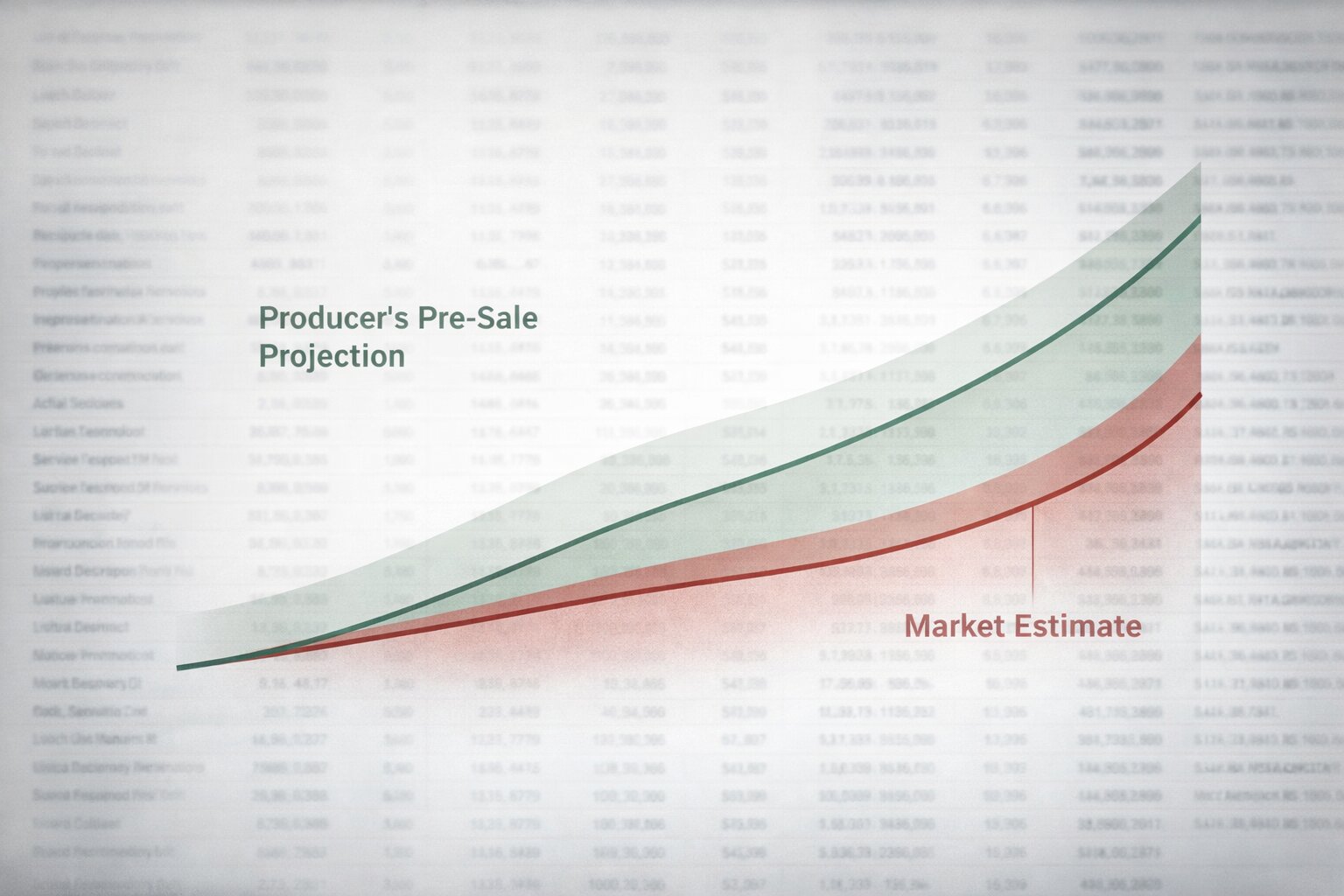
Walk the floor at AFM long enough and you start hearing the same conversation on repeat. A producer has a financing plan. It’s detailed, it’s confident, it has international sales projections that make the budget work. Then a sales agent gets hold of it and quietly, professionally, delivers the number that ends the conversation.
Not the agent’s fault. Not even the producer’s fault, exactly. It’s the gap; and it’s one of the most reliable predictors of whether an independent film gets made or spends the next three years in development purgatory.
I’ve watched this play out enough times to have an opinion about it. Here it is.
The Sequence That Breaks Everything
Most independent producers build their financing plan in the wrong order. They start with a budget — what the film should cost — and then approach sales agents to validate international value. The sales agent gives them a number that’s significantly lower than what their budget requires. And then one of two things happens: they reject the data and go looking for someone who’ll tell them what they want to hear, or the project stalls indefinitely.
The sequence that actually works runs in the opposite direction. You develop your package — script, director, proposed cast. You get sales estimates from agents who know your genre and comparable titles. Then you build a budget that aligns with what the market will actually bear. In that order. Not the reverse.
This isn’t pessimism. It’s math. And the producers who understand this distinction are the ones who actually get their films made.
How Sales Agents Actually Build Estimates
This part matters because most producers misunderstand what a sales estimate actually is. It isn’t a gut feeling or an optimistic projection. It’s a data exercise.
A reputable sales agent pulls comparable titles — films with similar genre, budget range, cast level, and director profile — and analyzes actual transaction data. What did buyers commit to for a mid-level thriller with this cast in Germany? What has this genre commanded in Japan over the last 18 months? What’s the current appetite in South Korea versus what it was three years ago?
They break the estimate down territory by territory: Germany, UK, France, Japan, South Korea, Australia, Latin America, Eastern Europe, Middle East, Scandinavia. Each territory has its own appetite, its own distributors, its own pricing logic. The final global number is the sum of those individual assessments — not a single guess applied everywhere.
Then they apply reality checks. Is this cast actually proven in these territories, or just recognizable domestically? Has this genre recently oversaturated the market? Is the budget proportionate to what the package signals, or inflated past what buyers will accept?
The resulting estimate is deliberately conservative. Sales agents stake their professional credibility on being accurate. Their relationships with buyers and banks depend on it. An agent who consistently inflates estimates loses access to the financing infrastructure that makes their business work. Conservative is structural, not temperamental.
The Romantic Comedy That Couldn’t Exist
Here’s a scenario that plays out constantly, in different genres, at different budget levels.
A producer develops a romantic comedy with two actors who have genuine domestic recognition — solid careers, real audiences in the US — but minimal proven international sales value. The budget is $5 million. The producer’s financing plan assumes international pre-sales will generate somewhere between $3.5 and $4 million, based on a general sense of what romantic comedies have historically sold for.
A sales agent runs actual comparables with this cast level in the current market. The realistic estimate comes back at $1.4 to $1.8 million under optimistic conditions.
Now the math is impossible. The budget is $5 million. Realistic pre-sales are $1.4 million. That leaves $3.6 million — plus finance costs — that has to come from equity. No rational investor takes that position. You’re asking them to risk $3.6 million to participate in a film whose international sales upside is already known to be roughly $1.4 million. That’s not an investment structure. That’s a charitable contribution with paperwork.
The producer’s options at this point are: reduce the budget to align with market reality, attach significantly stronger cast to justify the original budget, or accept that this film won’t get financed in its current form. In my observation, most producers resist all three options and spend years pitching the same broken deal to different rooms.
What Territory Estimates Actually Look Like
To make this concrete: here’s what a territory-by-territory breakdown might look like for a $3 million thriller with a moderate cast — not a star-driven package, but a credible one with a genre-appropriate director.
Germany: $150–180K. UK: $120–150K. France: $100–120K. Japan: $150–200K. South Korea: $80–100K. Australia: $60–80K. Benelux: $50–60K. Scandinavia: $60–70K. Eastern Europe: $70–90K. Latin America: $60–80K. Middle East: $40–50K. Rest of World: $100–120K.
Add it up across every territory and you’re looking at roughly $1 million to $1.3 million in total estimated pre-sales. For a $3 million film. That means the financing plan can’t be built around pre-sales alone — it requires meaningful equity, tax incentives, or both.
If a producer had been operating on an assumption of $2.5 million in international sales, their entire capital structure is fiction. Not aspirational — fiction. And the sooner that fiction is confronted, the better the outcome for everyone involved, including investors who might otherwise be pitched a deal built on numbers that were never real.
Why Your Opinion About Comparables Is Irrelevant
The most consistent objection I hear from producers when they receive conservative sales estimates: “But my film is different. It’s better than those comparables.”
That might be true creatively. It’s financially irrelevant.
Pre-sales estimates are based on what buyers will commit real money to before a film exists. They’re not evaluating artistic merit. They’re evaluating commercial predictability through elements they can verify: genre, cast, director track record, production company reputation. Buyers are underwriting risk. They need signals they can quantify.
Your film might be exceptional. It might win awards. It might outperform every comparable title in its genre. But if the package doesn’t signal commercial value through verifiable elements, distributors won’t risk minimum guarantees. And sales agents who tell you otherwise are doing you a disservice that will cost you years.
This is why Sundance and Toronto are full of extraordinary films that generated minimal pre-sales. Quality and commercial value are not the same variable. Both matter, but they operate on different tracks and get evaluated by different people with different criteria.
Inflated Numbers Don’t Just Fail — They Destroy Credibility
There’s a second-order consequence to presenting inflated pre-sales estimates in investor pitches that doesn’t get discussed enough: it doesn’t just fail to close the deal. It ends your credibility with that investor permanently.
A sophisticated film investor — someone who has financed multiple projects and understands how international sales work — knows roughly what a mid-level thriller with a recognizable but not A-list cast sells for internationally. When your deck claims $4 million in pre-sales for a package that any experienced sales agent would value at $1.5 million, they don’t just pass on the deal. They form a specific opinion about you.
They conclude either that you haven’t done proper due diligence, that you’re operating on hope instead of data, or that you’re deliberately misrepresenting the deal. None of those conclusions leads to a future conversation. Conservative, well-sourced estimates build the kind of trust that gets deals done over multiple projects. Inflated numbers close doors that were open.
The Feedback You Don’t Want Is the Feedback You Need
The most valuable thing a reputable sales agent can do for an independent producer is tell them an uncomfortable truth early. If an experienced sales company tells you your $4 million film might generate $1.6 million in pre-sales, they’re not being discouraging. They’re giving you exactly the information you need to restructure intelligently before you’ve spent two years pitching a deal that was never fundable.
Smart producers hear that feedback and ask the right follow-up question: what would have to change about this package to support a $4 million budget? Different cast? Different genre framing? Lower budget to match what the market will actually bear? That conversation is productive. It leads somewhere.
Producers who reject the data and search for a less experienced agent willing to validate their numbers don’t find a solution. They find a delay. The market doesn’t change because you found someone willing to be optimistic. The buyers in those territories are still working from the same comparable data, making the same risk assessments, committing to the same MG ranges. The only thing that changes is how much time you’ve lost.
Build Backward. Always.
The discipline that separates producers who close financing from producers who are perpetually “in development” is simple to describe and genuinely difficult to practice: build your budget backward from market reality, not forward from what you wish the market would support.
Get real sales estimates from agents who actively work your genre — not generalists, not optimists, not people who need your business. Get estimates from people whose reputation depends on being right. Then believe the numbers. Build your capital structure around the conservative scenario, not the optimistic one. If actual pre-sales come in above estimate, that’s upside for your investors. If you plan around optimistic estimates that don’t materialize, your deal collapses at the worst possible moment.
The films that get made aren’t always the most ambitious or the best written. They’re the ones where someone did the math correctly before asking anyone for money.