























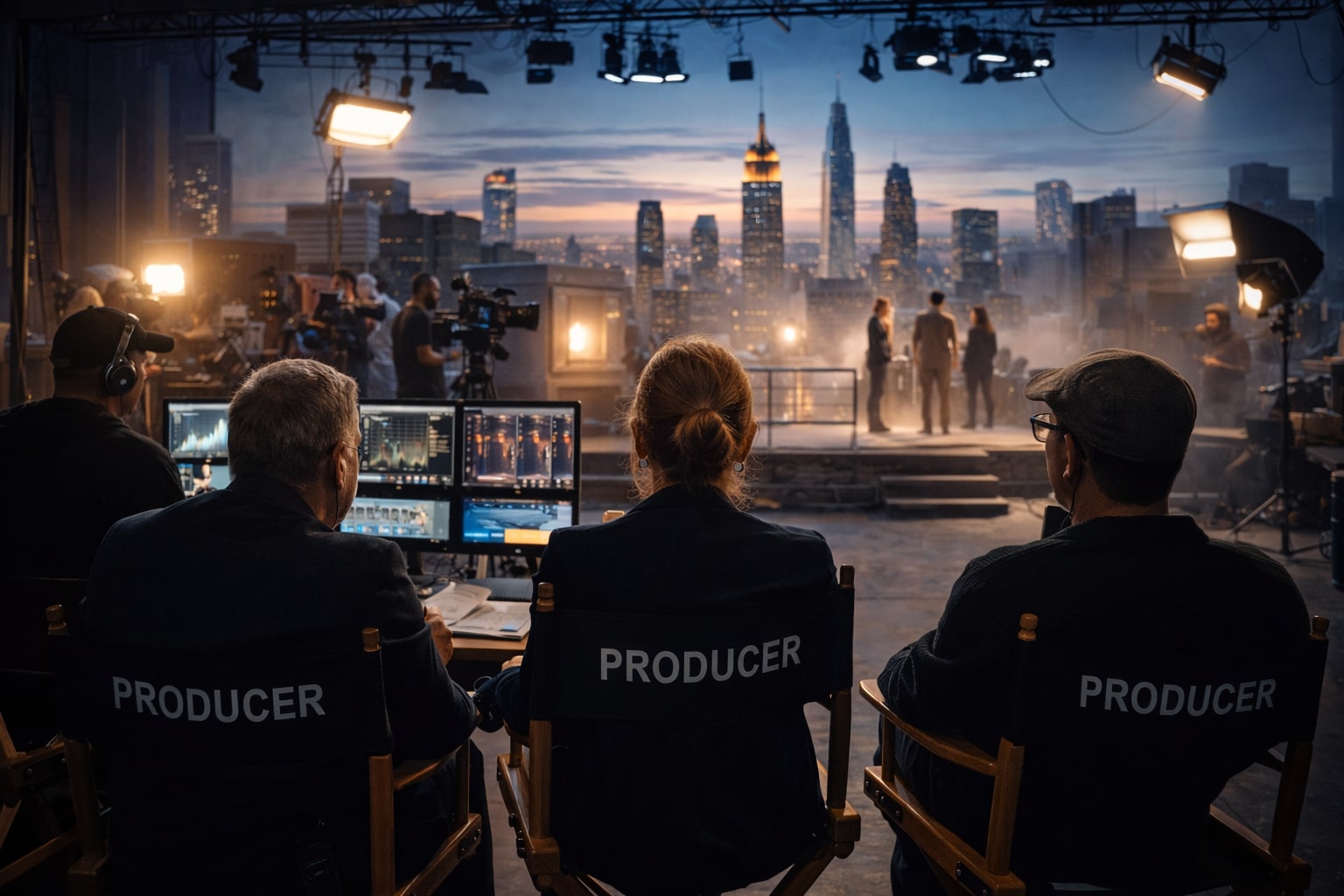
From pre-sales to IP to distribution windows — understanding how movies generate profit in 2026 is the difference between a career and a one-off project.
The quiet shift happening across independent film is not about streaming versus theatrical, or prestige versus commercial. It’s about who in the room understands how money actually moves through a film.
Behind every project that breaks out — whether it premieres in Park City or debuts on the Croisette — is a financial architecture that most audiences never see and that most filmmakers were never taught. In 2026, understanding how movies generate profit isn’t a business school concern separate from creative practice. It’s the difference between building a career and chasing a miracle.
The producers consistently getting films made, financed, and into the marketplace have stopped waiting for the commercial side to work itself out. They design it. Here’s how the revenue architecture actually functions.
The Foundational Shift: Films as Capital Allocation Decisions
The most useful reframe for understanding how movies generate profit is this: a film is not just a product. It is a capital allocation decision designed to produce multiple cash flows over time, across multiple distribution windows, potentially across multiple formats and derivative works.
This doesn’t replace the creative imperative. It clarifies what the creative work needs to support commercially. When producers walk into AFM in Century City, EFM in Berlin, or the Marché du Film in Cannes, the financiers and sales agents in those rooms are evaluating the financial architecture of the package alongside the creative elements. A sizzle reel without a coherent revenue model doesn’t close deals in the current market. A coherent revenue model without compelling creative elements doesn’t either. Both are required.
The shift toward financial literacy among independent filmmakers isn’t a creative concession. It’s how filmmakers protect their creative work by ensuring it actually reaches audiences — which requires getting financed, produced, and distributed, none of which happens without a viable financial structure.
Pre-Sales: Engineering Risk Out of the Budget Before Production Starts
Pre-sales are the revenue mechanism that receives the most discussion in film financing conversations and the least honest assessment. They are foundational to how independent films generate their initial capital recovery — and they are harder to execute well in 2026 than they were five years ago.
A pre-sale is a minimum guarantee contract from a territorial distributor, secured before production begins, in exchange for distribution rights in their market. The distributor commits to pay a specific amount upon delivery of the completed film, and that contract serves as collateral for a production loan from an entertainment bank advancing 70% to 90% of the contract value.
The risk engineering function of pre-sales is precise: confirmed MGs from Tier 1 territories — Germany, Japan, the UK, France, Australia — convert future uncertain revenue into current certain collateral. A film with $1.5 million in executed pre-sale contracts has that portion of its budget covered by instruments that don’t depend on commercial performance. The film has to be delivered per contract specifications, but it doesn’t have to be a hit for those revenues to materialize.
In the current market — post-streaming contraction, post-COVID production boom — pre-sales are smaller and harder to secure than they were in 2019. Action, thriller, and horror genres with internationally recognized cast continue to generate the strongest pre-sale interest. Drama, comedy, and niche-oriented projects depend more heavily on other capital stack components. Understanding this genre-territory dynamic shapes packaging decisions at the script development stage, not after the budget is locked.
Theatrical Release: Validation Signal, Not Primary Profit Center
For most independent films, theatrical release is not the primary profit mechanism. It is a validation signal that affects downstream revenue significantly.
A meaningful theatrical run — even a limited one in key markets — tells streaming platforms, broadcast networks, airlines, and other downstream buyers that the film found an audience and generated press attention. That signal affects licensing negotiations. Films with documented theatrical performance command better terms from streaming platforms than films that went directly to digital. The theatrical run is essentially marketing spend that simultaneously generates some revenue and improves the value of every subsequent licensing conversation.
The cost structure of wide theatrical release — marketing spend, P&A costs, exhibitor revenue splits — means that most independent films don’t generate meaningful net profit from theatrical alone. The break-even math often requires streaming and ancillary revenues to recover total costs. Understanding this means treating theatrical strategy as positioning work rather than profit optimization, which changes the calculation around what kind of release to pursue and in which markets.
In 2026, the festival-to-acquisition model and the festival-to-distribution model both use theatrical validation differently. A Sundance acquisition by a streaming platform may include a limited theatrical commitment primarily for awards positioning and critical attention rather than box office performance. A self-distributed independent film may pursue strategic limited theatrical in major markets specifically to trigger better streaming licensing rates.
Distribution Windows: One Asset, Multiple Revenue Cycles
The distribution window strategy is where understanding how movies generate profit becomes most directly actionable for independent producers.
A completed film flows through a sequence of distribution windows, each generating revenue from a different buyer with different economics. The traditional sequence runs from theatrical to premium VOD to streaming to broadcast to satellite and cable to airlines and hotels to physical media. Each window has a different exclusivity period, a different revenue model, and different timing relative to production completion.
The principle that matters for financial modeling is operating leverage: the underlying asset — the film itself — incurs its primary costs once during production. Each subsequent distribution window generates revenue with minimal incremental cost. A film that licenses to a streaming platform, then to a European broadcaster, then to an airline entertainment network is generating revenue from the same asset three times with primarily administrative costs in each subsequent deal.
The practical implication is that distribution strategy should be modeled as part of the original financial plan, not assembled opportunistically after the film is delivered. Which windows will be pursued, in what sequence, with what exclusivity periods, and in which territories — these decisions affect total revenue potential and the timeline over which that revenue is realized. Producers who treat distribution as a post-completion problem are not modeling their films’ actual revenue potential.
Intellectual Property: Where Long-Term Value Actually Accumulates
The most durable revenue in film doesn’t come from any single release. It comes from intellectual property that generates multiple revenue streams across formats and time.
IP value in film is created when a story, character, world, or concept proves commercially viable enough to support derivative works — sequels, prequels, spin-offs, adaptations to other formats, and licensing applications. The commercial history of the last two decades shows clearly that the projects generating the largest long-term returns are the ones where the original film established the beginning of a revenue system, not the entirety of one.
For independent filmmakers, the IP conversation is more nuanced than the studio franchise model suggests. True franchise-scale IP development is resource-intensive and typically requires studio infrastructure. But the principle scales down meaningfully: a film with a distinctive world, a memorable character, and a story structure that implies continuation is worth more commercially than an equivalent film that resolves completely and offers no extension.
Protecting IP ownership through the deal structure is the practical implication for independent producers. Investors and distributors will seek rights to sequels, remakes, and derivative works as part of deal negotiations. Understanding what you’re giving up, what you’re retaining, and what the market value of those rights might be over time is essential due diligence before signing. A producer who gives away sequel rights to close a financing deal may be trading the most valuable long-term asset in the package for short-term capital.
Ancillary Revenue: High Margin, Often Overlooked
Ancillary revenue — merchandising, music licensing, video games, experiential extensions, and educational licensing — represents a high-margin revenue category that most independent filmmakers underplan.
The economics are straightforward: ancillary licensing agreements generate revenue with minimal additional production cost. A soundtrack album from a film with strong original music, a book adaptation from a film based on existing IP, a limited merchandise line for a film with a culturally engaged audience — these generate revenue from the same creative work that the film required without proportionate incremental investment.
The challenge for independent films is scale. Ancillary revenue typically requires an audience large enough to support consumer products or licensing agreements. Films without significant theatrical or streaming audiences often have limited ancillary potential. But certain genres — family, animation, genre fare with passionate audiences — generate ancillary revenue disproportionate to their theatrical performance, and planning for that potential from the packaging stage affects both development decisions and deal structure.
The Sundance Institute has written usefully about sustainability models in independent film that incorporate ancillary revenue planning, and their resources at sundance.org offer practical frameworks for filmmakers thinking about long-term IP strategy.
What This Means for How You Build a Career
Understanding how movies generate profit in 2026 isn’t a business school concern for producers who’ve already figured out the creative side. It’s the foundation of a sustainable independent filmmaking career.
Filmmakers who understand the revenue architecture of their projects make better packaging decisions — attaching cast and directors who add specific value to specific revenue streams, choosing locations and incentive structures that affect the capital stack, designing distribution strategies that maximize the value of each window rather than treating theatrical as the only metric that matters.
They build better investor relationships because they can speak precisely about how and when their investors will see returns, which windows generate which revenues, and what the realistic risk-adjusted return profile looks like across multiple scenarios. Investors who understand film respond to this fluency — it signals that the producer is operating as a financial architect, not just a creative hoping for a hit.
And they design careers rather than chase them. A producer who understands how a $2 million film generates pre-sales, incentives, streaming licensing, and ancillary revenue can model what a slate of four or five such films over five years produces financially — and use that model to build investor relationships that don’t require starting from zero with every project.
The language of financiers isn’t the enemy of artistic vision. It’s the infrastructure that allows artistic vision to survive contact with the market.
Three Questions Worth Answering Before Your Next Project
Does understanding profit mechanics apply to independent films, or just studio productions? It applies to independent films, but the specific mechanisms scale differently. Pre-sales and IP leverage depend heavily on genre, cast, and budget level. A $1.5 million horror film has a different revenue architecture than a $15 million thriller. The principle — that financial structure should be designed before production, not discovered after — applies at every scale.
Is theatrical release still necessary for independent films in 2026? Not always, but the validation function of meaningful theatrical release continues to affect downstream licensing economics for most films. A film with documented theatrical performance and critical attention commands better terms from streaming platforms, broadcasters, and international buyers than one that bypassed theatrical entirely. The relevant question is not whether to pursue theatrical but what kind of theatrical strategy serves the specific film’s distribution goals.
Does financial thinking constrain creative decision-making? It constrains some decisions and enables others. A producer who understands what cast attached at what budget generates what pre-sales value in what territories has more specific information for creative decisions than one who doesn’t. The constraint is real — not every creative choice is commercially viable at every budget level. But the alternative to understanding this is making creative choices that produce commercially unviable packages, which constrains creative work far more definitively by preventing it from getting made at all.
The Architecture Is the Work
In 2026, how movies generate profit is not a separate conversation from how movies get made and seen. The financial architecture — pre-sales, incentive structures, distribution windows, IP strategy, ancillary planning — is part of the creative work of producing, not a commercial concession that follows it.
The filmmakers building sustainable careers are the ones who learned both languages: the language of storytelling and the language of capital. Not because one serves the other in a subordinate relationship, but because the best films in the current market are ones where both are working simultaneously from the earliest stages of development.
The next generation of great independent films will be creatively ambitious and structurally sound. Those are not competing qualities. In the current market, they’re the same quality.








The IP section alone is worth the read. Painfully true
As a wine collector, I appreciate the long tail metaphor. Some films age better than others
Sundance energy with Wall Street clarity
As a producer, this hurts in the best way. Accurate and mildly terrifying
Film school didn’t teach this. Film markets kinda do
Filmmaking as asset sweating? Brutal. Also, correct
I’ve been to Cannes 12 times and this is the clearest explanation of why half the films there exist
this is the conversation we have quietly, never on stage panels
Reading this with a Negroni and suddenly my budget spreadsheet feels cinematic LOL