





















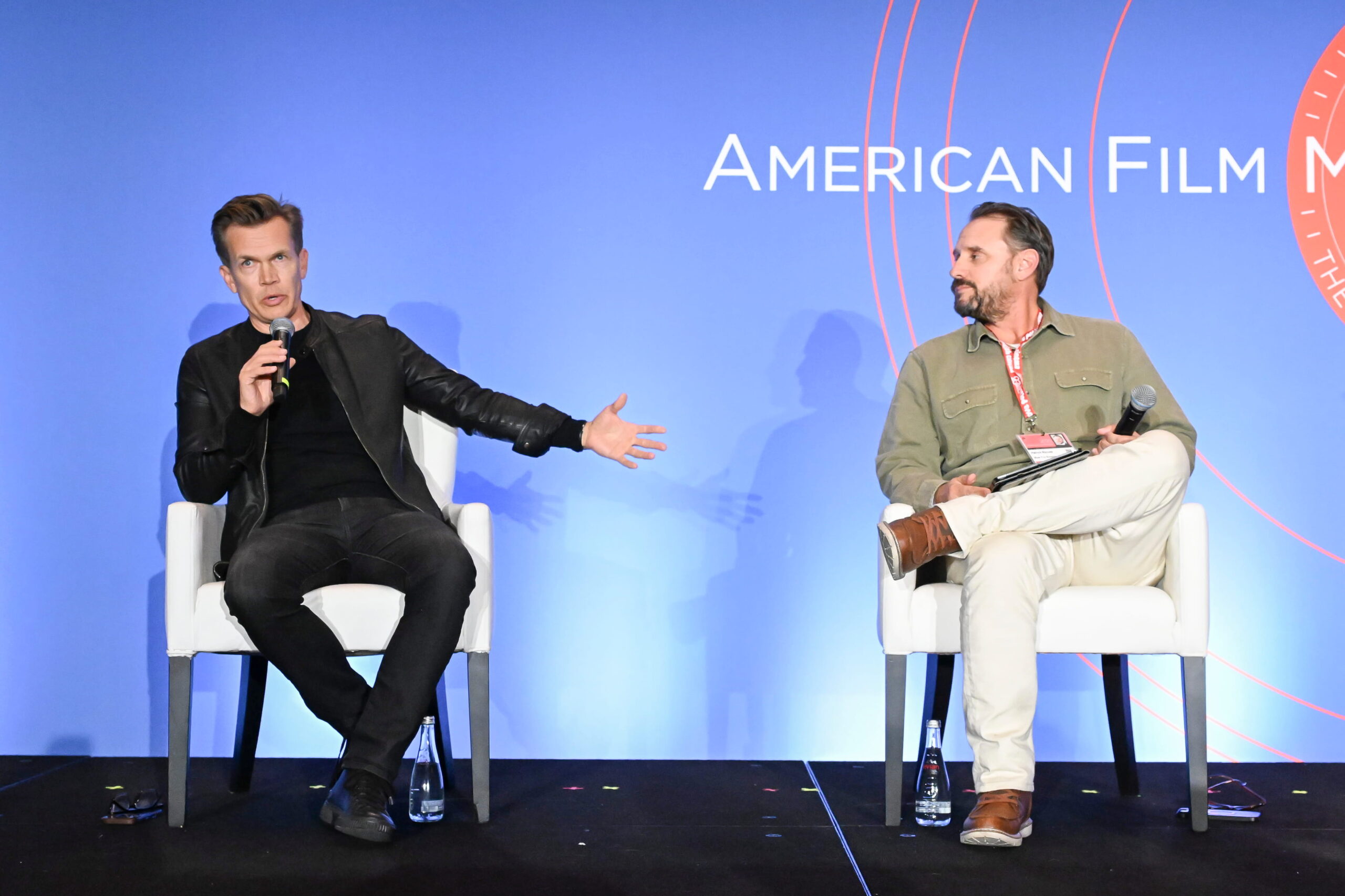
Two top film finance executives, James Huntsman, founder of Blue Fox Entertainment Group, and Patrick Rizzotti, president of Blue Fox Financing, share what works in independent film financing: from tax credits to gap loans, distribution, and what investors actually want.
Every year, thousands of filmmakers descend on markets like the American Film Market in Santa Monica, the European Film Market in Berlin, and Cannes’ Marche du Film chasing the same dream.
They have the script. They have the vision.
What they do not have is a clear map of how independent film financing strategies actually work in the real world, versus how they are portrayed in pitch decks and cocktail conversations.
James Huntsman, founder of Blue Fox Entertainment Group, and Patrick Rizzotti, president of Blue Fox Financing, sat down at AFM 2025 to answer every question the room could throw at them. What came out was one of the most practical, unfiltered conversations about film finance in recent memory.
The Industry Is Rigged Against You (and Here Is How to Fight Back)
Start with a truth nobody advertises. The independent film pipeline, as James Huntsman described it, is structurally broken for producers and investors alike.
“Most movies go down the same path. Most films are financed the same. Most films go to the audience the same way,” Huntsman said.
“But the way the industry is structured, to the detriment of producers and investors, is a la carte. You need someone for A, you need someone for B, you need someone for C, and then you need someone to rip you off at D. And usually all of those happen.”
That quote should be printed above every indie producer’s desk. Because the fragmentation Huntsman is describing is not just inefficient. It is expensive. It eats into margins that were already razor thin before a single frame was shot.
Understanding that structural reality is the first step in building smarter independent film financing strategies. You cannot fix what you cannot see.
Tax Credits Are Not What You Think They Are
Ask ten producers what a tax credit is, and eight of them will get it slightly wrong. The distinction matters enormously.
Rizzotti laid it out cleanly. There are two primary models.
First, transferable tax credits: the state issues you a certificate worth, say, one million dollars. But you cannot simply deposit it. You have to sell it to another entity in that state at a discount, typically around 88 cents on the dollar. Georgia, Louisiana, and California operate this way. Companies like Fallbrook specialize in purchasing these certificates.
Second, direct incentive rebates: the state writes you a check based on qualified spend. No discount. No middleman. For most independent films operating at tight margins, this is the superior option.
“An incentive is better because it just goes directly,”
James Huntsman
“90% of independent films lose money. So if you get a tax credit, and you’re filing that on taxes on an entity that doesn’t ever make any money, that credit, frankly, is worthless.”
This is where a lot of producers miscalculate. They see a state advertising a 30% tax credit and compare it to a state offering a 22% rebate. But after the 10 to 12-point discount on the transferable credit, the math reverses. Net value wins every time.
Buffalo, New York currently offers one of the strongest incentives in the country, around 45%. Mississippi has a low minimum spend threshold of approximately $300,000, making it accessible for micro-budget projects. California recently expanded its program specifically for independent films. Knowing the landscape is not optional. It is foundational to any serious independent film financing strategy. You can explore current state-by-state film incentive data at the Motion Picture Association’s state incentive resource portal.
Gap Financing, Pre-Sales, and the 50 Percent Rule
Here is a framework Rizzotti offered that changes how you think about approaching investors.
“Everybody here already has 25% of your financing in place before you do anything,”
patrick Rizzotti
“Because if you pick the right state and do the right spend, you’re going to get 25%.”
That reframe is powerful. You are not starting from zero. You are starting from a quarter of the way there. The goal then becomes covering the gap between that baseline and 50 to 60% through debt instruments: tax credit loans, minimum guarantees from distributors, international pre-sales where they are available, and gap financing against projected worldwide sales.
Gap financing, as Rizzotti explained it, works like this. You have 80% of your budget locked. A credible international sales company provides territory-by-territory projections. A lender comes in against roughly 25% of the worst-case scenario on those projections. Not the best-case. Worst-case.
“You usually want to lend at around 25% of the worst-case scenario estimates because the estimates are just estimates and they could be a lot lower than what they’re being estimated at,” Rizzotti said.
On pre-sales, both panelists were blunt. The market that financed the great Schwarzenegger and Stallone action films of the 1980s no longer exists. Today, international buyers at markets like AFM, MIFED in Milan, or the Hong Kong Entertainment Expo are inundated. They have three purchasing slots and 60 films competing for them.
“There’s too many of those types of movies. They’re going to spend time on a completed film,” Huntsman said. Pre-sales work today only with a director who travels internationally by reputation, or in a genre with proven demand in the specific target territory. Everything else is wishful thinking.
What Actually Sells and Who Actually Buys It
This is where most producers get religion.
Huntsman has been doing international sales long enough to say it plainly: cast recognition does not travel the way American producers assume it does. An actor with strong name recognition in Los Angeles might move zero units in Taiwan or South Africa.
“Some cast members that are very popular here in the US are not so popular in Germany or Taiwan or South Africa,”
Huntsman
“But directors kind of transcend that because you’re seeing what the director’s doing versus an actor, you’re seeing the performance.”
Genre is the other variable that travels. Horror, thriller, action. Genres that translate through visual language rather than cultural context. And horror in particular has a special economics. Huntsman and Rizzotti both made the case that micro-budget horror under $200,000 can compete commercially, with one condition: deliver the practical effects.
“Do not CGI the blood,” Huntsman said. “Your audience doesn’t care what the budget is, and they’ll never know. If you’re making a horror film […], there’s probably blood, deliver the goods.”
That advice applies at Sundance, at Sitges in Spain, at Fantasia in Montreal. Genre audiences are global and they are loyal. But only when the film earns that loyalty by respecting the genre’s demands.
Mini FAQ: Independent Film Financing Strategies
Q: What is the minimum budget for Blue Fox Financing to consider a tax credit loan?
A: According to Patrick Rizzotti, Blue Fox looks for a minimum tax credit basis of $400,000. Below that threshold, the legal and administrative costs of structuring the loan reduce the net proceeds to the point where the deal becomes unattractive for the borrower.
Q: Should I approach an equity investor or a lender first when building my film’s financing?
A: Rizzotti’s guidance is to build at least 50% of your budget through debt instruments first, including tax credits, minimum guarantees, and pre-sales where viable, before approaching equity investors. Going to a VC or private investor asking for 100% of a $5 million budget is a much harder conversation than presenting a project that already has half its financing structured.
Q: Are pre-sales still a viable way to finance an independent film?
A: Rarely, according to both panelists. The international pre-sales market has been oversaturated for years. It works when you have an internationally recognized director or a genre with strong proven demand in a specific territory. For most independent productions, a completed film has a significantly better chance of attracting buyers than an unfinished one seeking pre-sale commitments.
If You Have a Finished Film, Move Fast and Move Smart
For producers who already have a completed project, the path to market is clear but competitive. You need three entities: a domestic U.S. distributor, an international sales agent, and a Canadian distributor. Most producers do not have direct relationships with all three and will need a producer’s rep or entertainment attorney who will charge 8 to 12% to make those connections.
Rizzotti’s tactical advice was specific: use IMDb Pro, sort sales companies by Star Meter from the top down, and start pitching acquisitions teams on the trailer. Find one entity with wide-reaching relationships rather than cold-calling distributors individually.
And do not write off theatrical. Huntsman was emphatic on this point.
“The theatrical space is not going away anytime soon,” he said. “The theatrical business is a product-driven market. If there’s a good product, box office goes up. If there’s mediocre, it goes down.”
That is a useful corrective for an industry that has spent years declaring theatrical dead every time a streaming platform announces subscriber numbers.
The producers who succeed…
Independent film financing strategies have never been more complex, but they have also never been more mappable. The frameworks Huntsman and Rizzotti laid out at AFM 2025 are not theoretical. They come from people who have been producers, lenders, distributors, and sales agents simultaneously. The producers who succeed are the ones who understand the math, build from a base of debt, and approach equity last. If that’s where you are in your project’s development, the conversation with a financing partner like Blue Fox starts with collateral, not concept.