























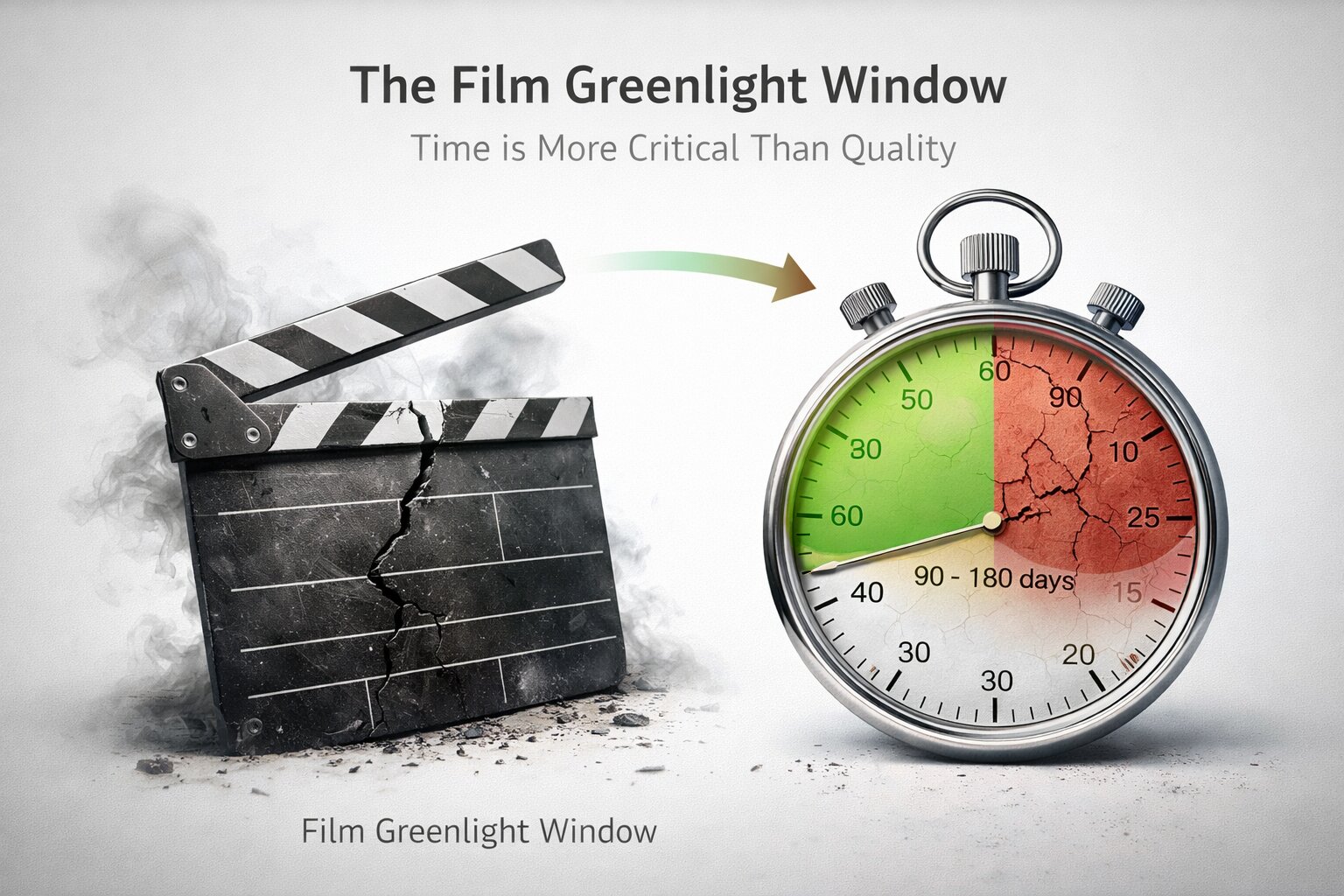
Why the greenlight window matters more than most producers are willing to admit
Your project has been “in development” for two years. You’ve had promising conversations. Multiple investors have expressed interest. Sales agents know about it. You’re convinced momentum is building.
It’s not. You’re dying slowly without realizing it.
Every film has a window — typically 90 to 180 days — when it’s fresh enough to generate real urgency and unknown enough to avoid market fatigue. Once that window closes, the project doesn’t necessarily get worse creatively. It becomes something more dangerous: familiar without commitment. And familiarity in film financing is poison.
Fresh Projects Close Faster Than Better Projects
At film markets from Cannes to AFM, experienced financiers can tell the difference between a new opportunity and a recycled project within seconds. It’s not about the deck. It’s not about the script. It’s about what the project carries with it.
New projects carry urgency. Questions haven’t been answered yet. The market hasn’t formed opinions. Investors worry about missing out if they wait.
Older projects carry baggage. Even if nobody says it directly, the assumption forms: if this has been circulating for 18 months without closing, there must be a reason. That perception, once established, is nearly impossible to reverse.
The greenlight window isn’t about quality. It’s about market psychology. Capital responds to momentum and freshness. It avoids projects that feel stale, regardless of their creative merit. I’ve watched genuinely strong projects die simply because they’d been seen by too many people who hadn’t committed.
The 90 to 180 Day Window Most Producers Ignore
Here’s how it actually plays out in practice.
In the first 90 days, you’re operating at peak opportunity. The project is new to the market. Investors are genuinely curious. No baggage exists yet. Urgency feels natural because the opportunity is real and unresolved.
From day 90 to 180, the window is closing. The project is becoming familiar. Early quiet passes are accumulating. The market is forming opinions. Urgency now has to be actively engineered rather than organically present.
Beyond 180 days, you’re in market burn territory. The project is widely known. Assumptions about why it hasn’t closed are already in circulation. New investors approach with skepticism baked in before you’ve said a word. Each additional pitch reinforces the existing problem rather than solving it.
Most producers don’t recognize when they’ve crossed from window-closing into market burn. They keep pitching with the same energy they had in month two, not understanding that the market around them has fundamentally changed its posture toward the project.
How Good Films Die in Plain Sight
Walk through the producer lounges at TIFF, the terraces at Cannes, the networking spaces at Tribeca. Listen to the conversations. You’ll hear the same projects mentioned repeatedly. “Oh, that one. Still looking for money?” The tone isn’t hostile. It’s dismissive.
Here’s the sequence I’ve watched play out more times than I can count.
Months one through three: the producer pitches initial target investors. Some pass immediately, others say “maybe, keep us posted.” The project feels alive.
Months four through six: the producer expands outreach. Mentions the project to sales agents, other producers, industry contacts. It’s becoming known.
Months seven through nine: the producer continues pitching but hears similar objections repeatedly. Doesn’t recognize the pattern as systemic or address the root cause.
Months ten through twelve: the project has been seen by 40 or more potential investors. None committed. Market perception solidifies: something is wrong here.
Month thirteen and beyond: new investors ask around before the meeting. They discover the project has been circulating. They arrive with caution rather than curiosity. The greenlight window has closed, and the project is now fighting uphill against its own history.
Why More Pitching Makes It Worse
The natural instinct when financing stalls is to pitch more aggressively. More meetings. More emails. More introductions through mutual contacts. More festival networking.
This is exactly wrong.
Volume doesn’t fix structural problems. It amplifies them. Every new pitch where you don’t close reinforces whatever is broken in your financing structure. You’re not building momentum — you’re spreading awareness of a project that doesn’t quite work.
Film finance circles are smaller than most producers realize. People talk. A project that’s been pitched unsuccessfully to 20 investors gets quietly noted by investors 21 through 40 before you even reach them. At markets like EFM or AFM, experienced financiers compare notes. “Have you seen this project?” becomes code for “someone else already passed and I’m wondering if I should too.”
The Strategic Pause That Actually Saves Projects
Here’s the counterintuitive move that works when you’ve missed your greenlight window: stop entirely.
Pull the deck. Pause all outreach. Disappear from the market for 60 to 90 days.
This feels like failure. It’s strategy.
During that pause, you diagnose honestly what’s blocking capital. Is the equity ask too high relative to the risk profile? Does the budget actually match what the market will bear per sales agent data? Is cast inflating the budget without adding proportionate sales value? Is the location creating unnecessary cost that a different jurisdiction would eliminate? Does the pitch deck lead with structure or with story — and which one does this particular investor pool actually respond to?
Then you restructure fundamentally. Adjust the budget based on real sales estimates. Change location to access better incentives. Reconsider cast that doesn’t justify their quotes. Rebuild the pitch deck around investor psychology rather than creative enthusiasm. Create a genuinely different financing structure.
Then you re-enter fresh. New deck design and positioning. Updated financial structure. Different investor targets than before. A compressed timeline with real urgency built into it.
This isn’t cosmetic. You’re not repackaging a broken deal. You’re fixing what wasn’t working and re-entering as a different opportunity. When done correctly, investors who passed six months ago may reconsider because the fundamental equation has actually changed.
What Momentum Sounds Like vs. What Stagnation Sounds Like
Real momentum sounds like this: “We’re closing this round by March 15th with two strategic partners.” “We’ve secured $900K in confirmed incentives and need $650K equity to close.” “We’re in final negotiations with the completion bond and gap financier.” “Production starts Q2, pre-production begins in eight weeks.”
These statements signal movement. They create urgency. They suggest the train is leaving the station whether you’re on it or not.
Stagnation disguised as progress sounds like this: “We’re still exploring various financing structures.” “Several investors have expressed strong interest.” “We’re waiting to hear back from a few key people.” “We’re continuing conversations with potential partners.”
These statements signal drift. They destroy urgency. They suggest the project might never happen — and investors don’t invest in “might.” They invest in “when.”
The Project That Stalled, Reset, and Closed in 60 Days
Here’s a case I’ve seen play out in one form or another multiple times — composite of real situations.
Independent thriller. Budget $2.8 million. Eighteen months of pitching. Dozens of investor meetings. No commitments.
The producer paused completely for 90 days. During that time: consulted a sales agent and discovered realistic sales estimates were $1.8 million, not the $3 million the financing plan assumed. Reduced the budget to $2.2 million to align with market reality. Changed the production location, unlocking $770K in tax incentives. Rebuilt the financing structure so the equity need dropped from $1.2 million to $550K. Completely redesigned the pitch deck to lead with the new structure.
Re-entered the market with a genuine 60-day deadline — closing the round by a specific date, not a vague “soon.” Targeted investors who hadn’t seen the previous version.
Closed $550K in equity in 58 days. Film shot that fall.
Same script. Same director. Same genre. Different structure. Different window. The difference wasn’t quality — it never was. It was timing discipline and structural honesty.
A Few Questions Producers Ask When They Finally Admit the Problem
How do I know if I’ve missed my greenlight window? If you’ve been actively pitching for more than six months without a single term sheet or letter of intent, you’ve likely missed it. If people at markets recognize your project by name before you’ve pitched them, you’ve definitely missed it. The solution isn’t more pitching — it’s a strategic pause and honest restructuring.
Can a project that’s been circulating for years ever get funded? Yes, but it requires fundamental restructuring — not repackaging. Change the budget significantly, add major new elements, or restructure the financing so dramatically that it’s genuinely a different opportunity. You’re not reviving the old project. You’re creating a new one with the same script.
Should I set artificial deadlines to create urgency? Only if they’re real deadlines you’ll actually honor. Fake urgency destroys credibility faster than no urgency. Better approach: structure your fundraising in genuine phases with real constraints attached — “raising $400K equity by March 31st to trigger gap financing and tax incentive approvals.” Real constraints create real urgency. Manufactured ones create skepticism.
Timing Is a Strategic Variable, Not a Detail
Understanding the greenlight window means accepting that timing isn’t incidental to how films get financed. It’s a strategic variable as important as budget, cast, or script quality.
Projects don’t get funded because they’re eventually good enough. They get funded because they’re correctly structured within their moment of market freshness. If your project has been circulating for over a year, you don’t need more investor meetings. You need different structure and a fresh window to put it in front of people.
The market has already told you something isn’t working. The only question is whether you’re listening — or whether you’ll spend another year finding out the hard way that the answer was always the same.