























Getting funded with the wrong waterfall terms can mean earning almost nothing from a successful film. Learn what actually matters in film investor recoupment structure.
Your film could generate $3 million in revenue and you could still walk away with almost nothing — here’s how waterfall structure determines what you actually earn
You just closed $800K in equity financing. You’re funded. Then your lawyer shows you the recoupment waterfall. Gap financier gets paid first. Sales agent commission comes out next. Investor gets 120% of their capital back before you see a dollar. Then profits split 70/30 in the investor’s favor.
Your film could generate $3 million in revenue and you’d still walk away with almost nothing.
Understanding the film investor recoupment waterfall isn’t knowledge you can defer until after you’re funded. It’s essential due diligence that determines whether getting financed is actually worth it. Bad waterfall terms can turn commercially successful films into financial disasters for producers. Smart deal structure protects everyone’s interests fairly — including yours. The two outcomes look identical from the outside. From the inside, they’re completely different careers.
What the Film Investor Recoupment Waterfall Actually Is
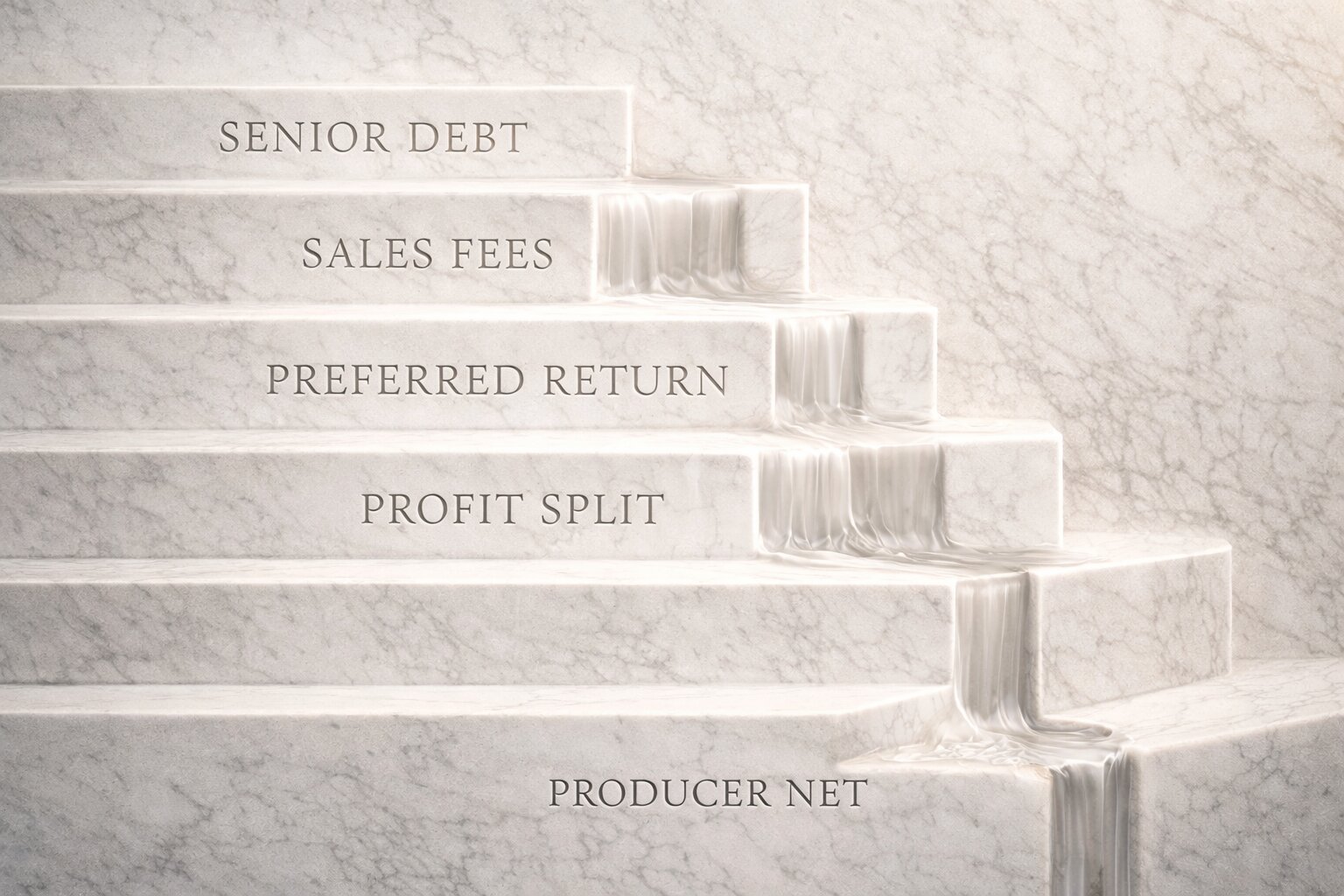
The recoupment waterfall is the legal sequence that determines who gets paid what, and when, from your film’s revenues. Every deal has one. Most producers sign operating agreements without fully understanding how their specific waterfall works until they’re watching revenue flow to everyone else.
Position 1 is senior debt: gap financing loan repayment with interest, any bank loans or production credit facilities. These are secured creditors who get paid first regardless of film performance.
Position 2 is sales agent and distribution costs: sales agent commission running 15% to 25% of gross sales, marketing and distribution expenses, collection fees. This comes off the top of revenues before investors see anything.
Position 3 is investor recoupment: return of investor capital, typically at a premium of 110% to 125%, sometimes with accrued interest layered on top. This is the position most investor conversations focus on.
Position 4 is deferred fees and backend participation: producer deferrals if any were structured into the deal, cast and director backend arrangements, other profit participants.
Position 5 is profit split: whatever revenues remain after Positions 1 through 4 are satisfied, divided between investors and producers according to the agreed ratio.
The practical reality of most independent film deals is that a large percentage of films never generate enough revenue to reach Position 5. Positions 1 through 3 absorb the available revenues entirely. Understanding which position you occupy and what the deductions above you actually total determines whether you’ll see meaningful returns from commercially successful films — not just the ones that perform at the top of projections.
Why Waterfall Position Matters More Than Percentage Points
The most instructive way to understand waterfall impact is to run the same revenue figure through two different deal structures.
In the first scenario, a producer accepted standard terms without negotiation. Total revenues of $2.5 million. Gap loan plus interest in Position 1 takes $800K. Sales commission and expenses in Position 2 take $500K. Investor recoupment at 120% in Position 3 takes $960K. Deferred producer fees in Position 4 take $150K. Remaining for profit split: $90K. Producer’s 50% share: $45K. The producer raised $800K in equity, delivered $2.5 million in revenue, and received $45K.
In the second scenario, the same producer negotiated more carefully on the same project. Total revenues still $2.5 million. Lower gap financing need reduces Position 1 to $600K. Negotiated sales commission reduces Position 2 to $450K. Investor recoupment at 110% instead of 120% reduces Position 3 to $880K. Producer fee moved from deferral to a priority position alongside investor recoupment adds $150K directly to the producer. Remaining for profit split: $320K. Producer’s 50% share: $160K plus the $150K fee equals $310K.
Same revenues. Better structure. Producer earns roughly seven times more. The negotiation that produced this result happened before signing, not after. Deal structure often determines producer returns more decisively than the film’s commercial performance.
The Investor Premium That Quietly Destroys Producer Returns
Most investors don’t just want their capital back. They want a premium before profit-sharing begins, reflecting the risk they accepted. The premium percentage matters significantly, and so does whether interest accrues on top of it.
A 110% recoupment requirement — the investor gets $1.10 back for every $1.00 invested before the profit split activates — is relatively producer-friendly and common with experienced investors comfortable with film risk. A 120% recoupment is the standard market rate for independent film equity. A 125% to 150% recoupment is typical for high-risk deals or first-time producers without track records, often combined with unfavorable profit splits.
The most expensive structure replaces a flat premium with 100% return plus annual interest accrual — essentially treating equity like expensive debt. At 10% annual interest on $800K over an 18-month production and distribution timeline, the interest alone adds $120K to what must be paid before the producer participates in profits.
At markets like AFM in Century City, Cannes, and TIFF, the most predatory deals consistently target first-time producers who haven’t modeled how premium structures compound. A 125% premium combined with a 70/30 profit split in the investor’s favor means a film needs to substantially outperform its break-even point for the producer to see meaningful returns — and most independent films don’t outperform projections.
How Sales Agent Position in the Waterfall Changes the Math
Sales agents typically sit in Position 2, before investor recoupment, with their commission calculated on gross revenues. This is industry standard. But the specific commission rate and what expenses count as deductible significantly affect how much reaches Position 3 and below.
On $2 million in sales revenue with a 20% sales agent commission, the agent receives $400K and $1.6 million flows down the waterfall. Negotiating that commission to 15% saves $100K that benefits every participant downstream — including the investor. Understanding that sales agent economics affect investor returns gives producers a legitimate negotiating point: lower commission rates can be presented as investor-protective, not just producer-favorable.
What qualifies as reimbursable sales expenses — market attendance costs, marketing materials, screening expenses, travel — is a negotiation point that receives less attention than commission rates but can matter significantly on films with long sales cycles. Loosely defined expense reimbursement clauses create the conditions for position inflation that erodes downstream participants’ returns.
[Insert Internal Link: How to Structure Film Financing to Reduce Investor Risk]
The Producer Fee Versus Backend Participation Trade-Off
Producers typically get paid in two ways: a production fee paid during the shoot as an operating expense, and backend participation in the waterfall. How these are structured determines whether you get paid regardless of commercial outcome or only if the film performs.
A producer fee of 3% to 5% of budget, paid during production, compensates you for the work of making the film independently of whether it generates profit. It’s not dependent on the waterfall. It’s compensation for services rendered.
Backend participation is meaningful only if the film generates revenues beyond the senior obligations in Positions 1 through 3. On many independent films, it pays nothing. On successful ones, it can be substantial.
The risky approach is deferring all producer compensation to the backend, making the argument to investors that the lower production costs demonstrate alignment. The problem is that most independent films never generate backend profits, which means most producers who take this approach earn nothing for their work on those projects.
The balanced approach is taking a reasonable production fee — ensuring you’re compensated for your work regardless of commercial performance — while maintaining meaningful backend participation. This is the structure that allows producing careers to be financially sustainable.
The negotiating mistake many first-time producers make is believing that waiving their fee makes them more attractive to investors. Investors who understand film respect producers who value their own work appropriately. A producer who waives all compensation signals either inexperience or desperation, neither of which inspires confidence.
The Profit Split That Comes After Everyone Else Gets Paid
A 50/50 split is standard for experienced producers with established track records. A 60/40 split favoring investors is common when investors perceive higher-than-standard risk. A 70/30 split heavily favoring investors is typical for first-time producers or packages with structural weaknesses. Escalating splits — starting at 60/40 and improving to 50/50 once investors reach 150% return — align incentives for long-term performance and are a more sophisticated structure that experienced investors often prefer.
The key insight, visible once you’ve run the waterfall math, is that a 50/50 split in Position 5 after large deductions in Positions 1 through 3 can produce less producer income than a 70/30 split with a more favorable overall waterfall structure. Position and premium matter more than the split ratio. Negotiate the waterfall top-down, not bottom-up.
The Negotiation Points That Actually Move the Needle
Reducing the investor premium is the highest-impact negotiation. Moving from 125% to 120% to 115% recoupment meaningfully increases the revenue available for all downstream participants. Every five percentage points of premium reduction on an $800K equity raise represents $40K in additional capital that flows through to later waterfall positions.
Moving producer fees into an earlier priority position — alongside or before investor recoupment rather than as a pure deferral — ensures you’re compensated for your work regardless of whether the film generates profit beyond investor recoupment. This is the structural change with the most direct impact on career sustainability.
Reducing gap financing costs through negotiation with lenders improves Position 1 outcomes and benefits everyone downstream. Tightening the definition of allowable sales expenses prevents Position 2 inflation — the definition of what qualifies for reimbursement should be specific and limited, with caps where possible.
The profit split ratio and audit rights matter but have less immediate impact than the four points above. Audit rights are standard in professional deals and should be included as a matter of course. The profit split negotiation is worth having but should not be the primary focus of waterfall negotiation.
Three Questions Producers Ask When They Finally Read the Waterfall Closely
Can investors change the waterfall terms after we’ve agreed? Not without your consent. The waterfall structure is legally documented in operating agreements and LLC agreements. Once signed, changes require all parties to agree. This is why careful review before signing is essential and why working with entertainment counsel on document review is not optional. Many producers sign without fully understanding the waterfall terms and discover unfavorable structures only when revenue starts flowing.
What’s a fair investor recoupment premium for independent film? Industry standard is 110% to 120% for experienced producers with solid packages. First-time producers or higher-risk projects commonly see 120% to 125%. Anything above 130% should trigger careful evaluation of whether the deal is worth accepting. Combined with profit splits, high premiums can make it structurally impossible for producers to earn meaningful returns even from films that perform above projections.
Should I accept investor-favorable terms just to get funded? It depends on your alternatives and career stage. If this is your first film and you have no other financing options, investor-favorable terms may be acceptable to build track record. But if you have leverage or other potential investors, negotiate. A film that generates revenue but leaves you with almost nothing doesn’t build a sustainable career — it builds a resume. Sometimes walking away from structurally punishing terms is smarter than accepting financing that benefits everyone except you.
The Long-Term Career Impact of Deal Terms
Producers who consistently accept poorly structured terms get films made but never build capital for subsequent projects. They remain perpetually dependent on outside financing because they never generate meaningful returns from their work.
Producers who negotiate balanced waterfall terms — reasonable premiums, producer fees in priority positions, tightly defined expense deductions — create the possibility of generating returns that reduce dependence on outside capital over time.
The waterfall conversation happens before the deal closes. It cannot be renegotiated after you’ve signed and the film is in production. The time to understand exactly where you sit in the sequence, what the deductions above you will total under realistic revenue scenarios, and whether the structure is worth accepting is before any document gets signed.