




















Saudi Arabia is rewriting the luxury investment playbook. Here’s how HNI and UHNWI lifestyle investors can get a seat at the table.
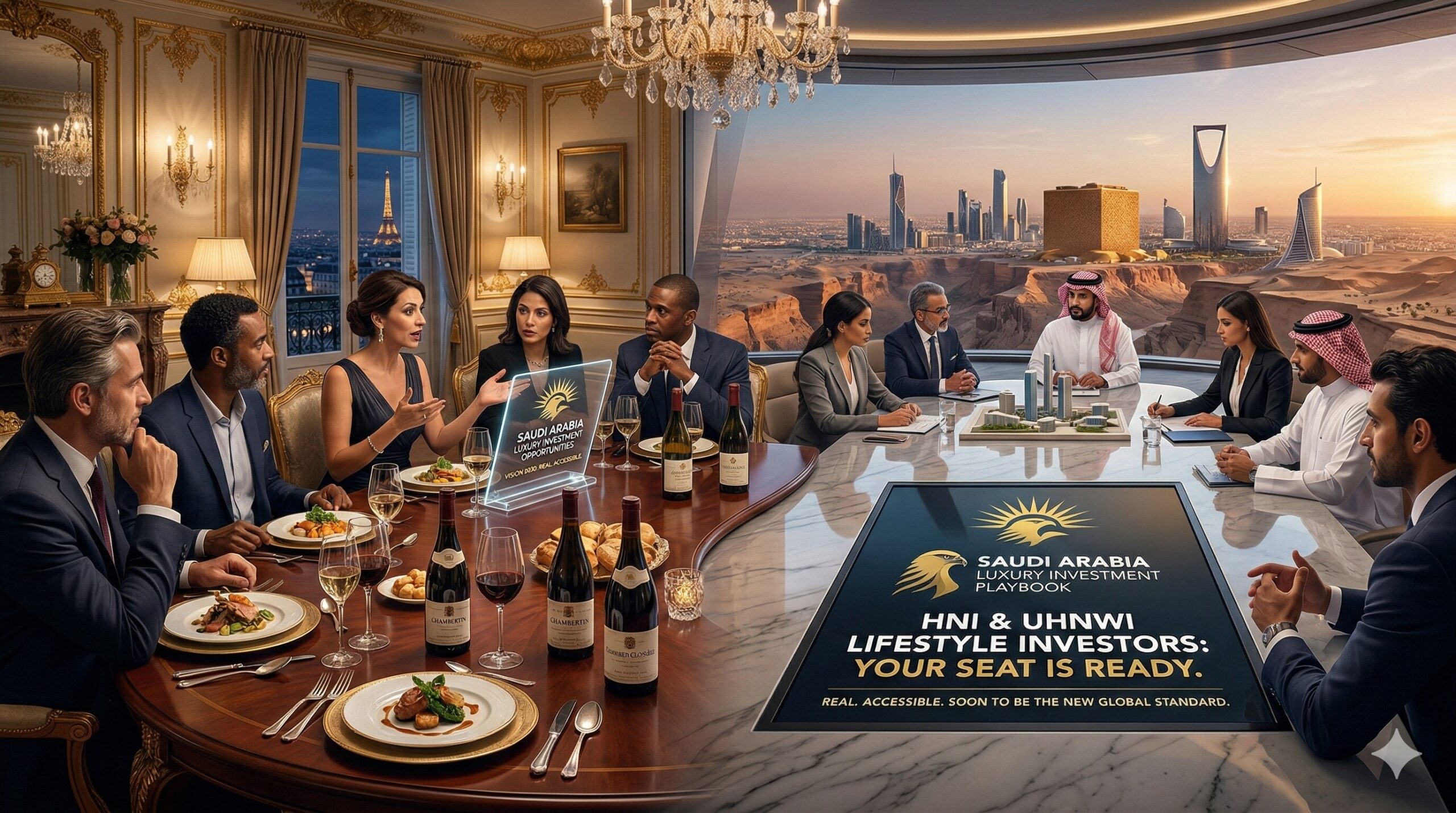
Picture this. You’re at a private dinner in the 16th arrondissement, somewhere between the second pour of a gorgeous Burgundy and a plate of food that has no business being that good. The conversation turns, as it always does among people who investment resources, to where the interesting opportunities are right now.
Someone mentions Saudi Arabia.
The table gets quiet in that particular way it does when everyone is pretending they already knew something.
Luxury investment in Saudi Arabia has moved well past the rumor stage. It is real, it is accessible, and if you are the kind of person who treats your lifestyle and your portfolio as two expressions of the same taste level, you need to understand what is being built in the Kingdom right now.
The Kingdom Is Pouring Something Worth Tasting
In late January 2026, more than 1,000 of the world’s most sophisticated investors flew to Riyadh for the second edition of SuperReturn Saudi Arabia. Not because the airline miles were tempting. Because the capital story in Saudi Arabia has reached the kind of inflection point that serious money does not ignore.
The conference was held January 26 to 27 at the Fairmont Hotel in Riyadh; a venue that, for the record, does not disappoint on the hospitality front. The strategic partner was Jada Fund of Funds, established by Saudi Arabia’s Public Investment Fund (PIF).
Jada’s job is to build the Kingdom’s private equity and venture capital ecosystem from the inside out. It has deployed more than SAR 3.5 billion across over 47 funds in venture capital, private equity, and private credit.
In 2025 alone, SAR 440 million went to work.
For context, PIF is the same sovereign wealth fund behind LIV Golf, the Newcastle United acquisition, and a growing list of global luxury, hospitality, and entertainment assets. When PIF moves, it moves with intention and scale. Jada is the domestic engine powering that same ambition from within the Kingdom.
What HNI and UHNWI Investors Are Actually Looking At
Here is the part that often gets lost in the institutional finance coverage of Saudi Arabia. The story is not just about sovereign wealth and mega-funds. It is about an entire ecosystem being built beneath that canopy; one with very real entry points for sophisticated private investors who know how to identify a market before it becomes obvious.
Think about what Vision 2030 actually means on the ground.
It means a country of 35 million people with significant disposable income rapidly developing its appetite for luxury travel, world-class dining, premium spirits education, boutique hospitality, and curated entertainment.
The infrastructure that supports those experiences: the hotels, the restaurants, the content platforms, the venues, requires capital. Private capital.
The kind that family offices and high-net-worth investors deploy when they see both a lifestyle alignment and a return opportunity.
This is not speculation.
International hotel groups are actively expanding in the Kingdom.
The Red Sea coast is being developed into one of the world’s most ambitious luxury travel destinations. NEOM’s Sindalah island is being positioned as a superyacht and ultra-luxury hub.
These are not concepts. They are funded, actively developing, and backed by sovereign capital with a long-term runway.
Luxury Investment in Saudi Arabia — The Sectors Worth a Second Glass
Let’s get specific, because vague optimism about emerging markets is the financial equivalent of a wine described as having notes of fruit and earth. Technically true. Completely useless.
Hospitality and luxury travel represent perhaps the most intuitive entry point for lifestyle investors. Saudi Arabia’s giga-projects: NEOM, The Line, Diriyah, Amaala, are creating demand for premium hospitality brands, F&B concepts, and curated experience design at a scale that does not exist anywhere else on earth right now. Investors with backgrounds in boutique hotel development, restaurant groups, or experiential luxury have genuine relevance here.
Food and dining culture in Saudi Arabia is undergoing a transformation that would make any serious epicurean take notice. Riyadh and Jeddah are developing genuine fine dining scenes, with internationally trained Saudi chefs returning home, global restaurant groups opening regional flagship locations, and a young professional class with serious culinary curiosity.
The investment opportunity in premium F&B and hospitality concepts is not five years away. It is now.
On the spirits and beverage side: and yes, this requires some nuance, the non-alcoholic premium beverage market in Saudi Arabia is experiencing remarkable sophistication.
Premium mocktail culture, artisan coffee, rare teas, and high-end juice and wellness concepts are filling the experiential space that wine and cocktail culture occupies in other luxury markets.
For investors and brands in the premium beverage space, that is a genuinely underserved market with enormous appetite.
And for those with wine cellar ambitions, international wine investment portfolios remain entirely viable for private investors globally, even as the Kingdom develops its own hospitality norms.
Luxury investment in Saudi Arabia does not require abandoning your relationship with a great Barolo.
How to Actually Get a Seat at the Table
The honest answer is that access to Saudi Arabia’s private capital ecosystem requires the same thing access to any great investment opportunity requires: the right relationships, the right timing, and a willingness to do the work before the crowd arrives.
For HNI and UHNWI investors, the practical pathways include co-investment structures through family office networks already active in the GCC, direct engagement with the fund managers in Jada’s portfolio, attendance at events like SuperReturn Saudi Arabia and the Red Sea International Film Festival where capital and creativity intersect, and relationships with international law and advisory firms with active Saudi practices.
The attendee list at SuperReturn Saudi Arabia 2026 gives you a useful map. Mubadala, PIF, Apollo, Brookfield, Warburg Pincus — these are not organizations that share their deal flow publicly. But they do share it with people in the room.
Getting in the room is the first move.
For a starting point on understanding Jada’s investment ecosystem, visit jada.com.sa. For luxury travel planning in the Kingdom, the Visit Saudi official portal is a surprisingly good resource.
FAQ: Luxury Investment in Saudi Arabia for Lifestyle-Minded Investors
Q: Is Saudi Arabia actually open to international private investors right now?
A: Yes, and increasingly so. Saudi Arabia’s Vision 2030 reforms have systematically opened the Kingdom to foreign investment across hospitality, entertainment, finance, and real estate. The government has introduced new visa categories, foreign ownership structures, and regulatory frameworks specifically designed to attract international capital and talent. The presence of global firms like Apollo, Brookfield, and Warburg Pincus at SuperReturn Saudi Arabia 2026 reflects that this opening is real and being taken seriously at the institutional level.
Q: What luxury and lifestyle sectors offer the most interesting opportunities in Saudi Arabia right now?
A: Hospitality, premium F&B, curated entertainment, wellness, and experiential luxury are all sectors experiencing significant investment and demand growth. The giga-projects — NEOM, Amaala, Diriyah, and the Red Sea Project — are creating concentrated demand for world-class lifestyle brands and concepts. Premium non-alcoholic beverage concepts and specialty dining are particularly underserved relative to the appetite that exists among Saudi Arabia’s young, affluent, and globally-traveled population.
Q: How does Saudi Arabia’s luxury market compare to established markets like Dubai or Singapore?
A: Dubai had a 20-year head start, and Singapore has the advantage of deeply embedded global financial infrastructure. What Saudi Arabia has that neither of those markets can replicate is sheer domestic scale — a population of 35 million, enormous domestic wealth, and a government with both the capital and the political will to build at speed. For investors who caught Dubai early, the Saudi opportunity will feel familiar. For those who did not, this is the version of that story still in its opening chapters.
The Vintage Everyone Will Wish They Bought Earlier
The best investments, like the best bottles, tend to be obvious only in retrospect.
Saudi Arabia’s transformation is not a secret. But the gap between knowing something is happening and actually positioning yourself to benefit from it is where most people lose the opportunity. The capital infrastructure is being built. The luxury market is developing real depth. The international money has already arrived. The question is whether you are reading about this moment five years from now and wishing you had moved, or whether you are someone who was paying attention when it mattered.
Fact-check notes: All financial figures sourced from the official Saudi Press Agency (SPA) press release dated January 29, 2026, verified against Jada.com.sa and Informa Connect conference records. PIF portfolio references verified via pif.gov.sa. NEOM and Red Sea Project details sourced from respective official project sites. SAR 3.5B Jada deployment figure cross-referenced against March 2024 public reporting; 47+ fund count reflects updated January 2026 conference data.







I’ve been following the premium NA spirits category for two years and the Saudi market keeps coming up in industry conversations.
The GCC family office co-investment angle in this piece is the most actionable insight. Those networks have been working the Saudi market for years and they’re not broadcasting their access.
You’re investing in luxury infrastructure, not in a local wine market. Different thesis entirely.
What the article gets right is the sequencing. Sovereign capital de-risks the infrastructure build, private capital comes in on the hospitality and experiential layer, and the exit is either a strategic trade sale or a very compelling REIT structure as the assets mature. It’s not a complicated thesis.
A market of 35 million sophisticated consumers developing that culture is not trivial.
Think about the flavor profile opportunities in a market built on incredible indigenous botanicals; rose water, tamarind, cardamom, dried lemon
The Jada numbers are real and they’re not small. SAR 440M deployed in a single year through 47+ fund relationships is a serious co-investment ecosystem. Anyone in private credit or mid-market PE should have had this on their radar already.
The premium NA beverage angle genuinely excites me as a cocktail person. The craft and technique that goes into a great zero-proof cocktail is real, and a market hungry for sophisticated non-alcoholic experiences
The part about Riyadh’s fine dining scene is real. Was there last spring and had a tasting menu that genuinely surprised me. Saudi chefs coming home with serious European training — the food culture is shifting fast.
The article barely scratches the surface on the Saudi food story. The regional cuisine alone: the kabsa, the saleeg, the coastal fish dishes
What’s interesting from a pure allocation perspective is that the luxury hospitality boom in Saudi Arabia actually creates secondary demand for serious wine collections among the international clientele staying at these properties.
The article handles the wine angle with more sophistication than I expected. My cellar doesn’t care about Saudi regulatory norms, fine wine investment is a portfolio play, full stop.
Jeddah’s restaurant scene doesn’t get nearly enough coverage. Some of the freshest seafood preparations I’ve had anywhere, and the spice literacy is on another level.
I’ve allocated to wine funds that performed on the back of Asian luxury hospitality booms before. The parallel here isn’t perfect but it’s not nothing.
there’s a whole global export opportunity in authentic Saudi fine dining that nobody is talking about yet.
The comp to Dubai early days is overused but not inaccurate. The difference is that Saudi has domestic scale Dubai never had. You don’t need tourism to carry the whole return
The non-alcoholic premium beverage angle is actually worth taking seriously as a collector adjacent play. We’ve seen what happened when premium NA spirits started pulling serious drinkers.