
























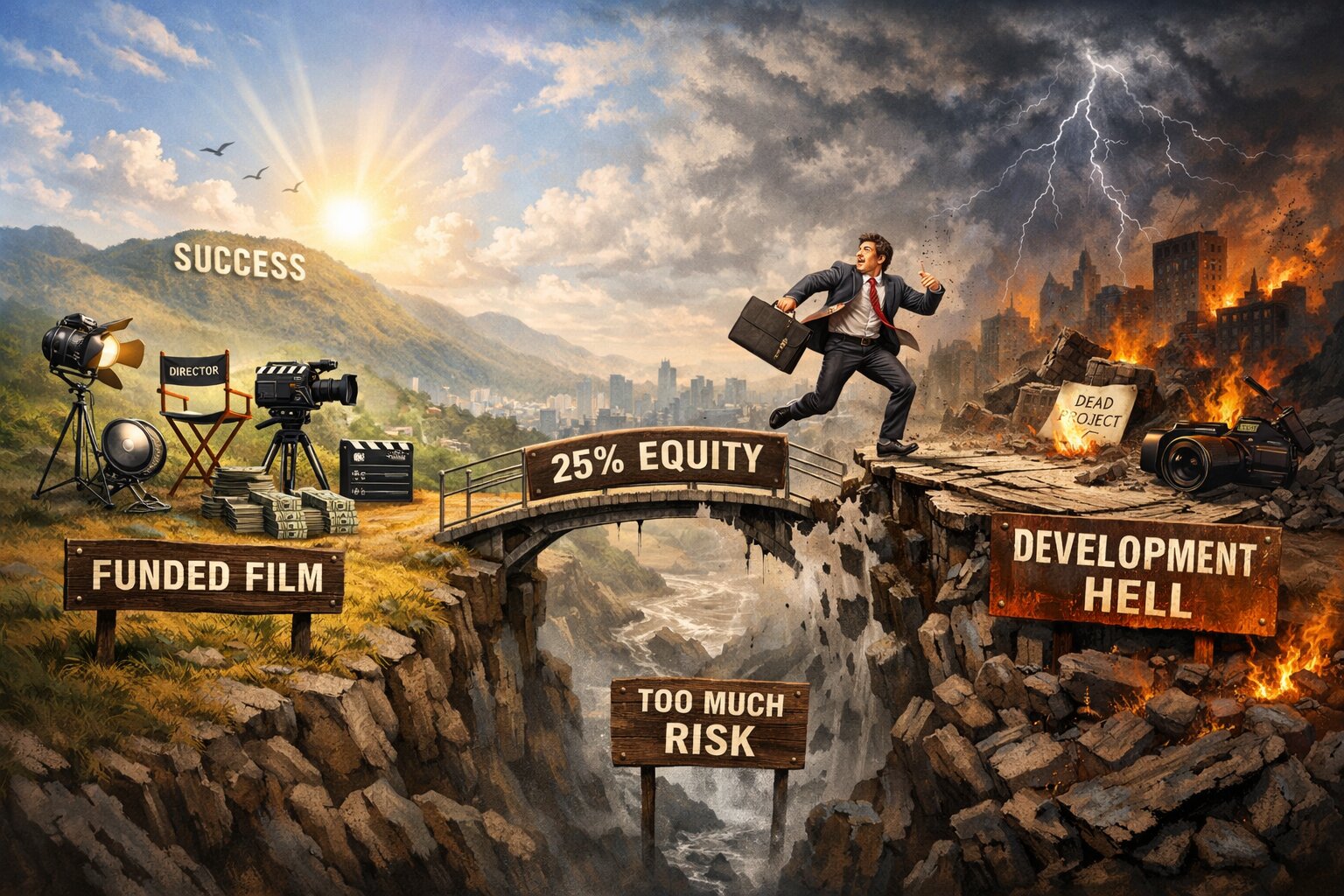
Most indie films fail because producers ask investors to absorb too much risk within their film equity financing. Learn the 25% equity rule that separates funded films from development hell.
You have a great script. Your director has festival credentials. The cast makes sense. Yet every pitch ends the same way: polite interest, followed by silence.
The problem isn’t your film. It’s your film equity financing structure. Specifically, you’re asking investors to take on far more risk than they’re comfortable with. And there’s a threshold where even excellent projects become uninvestable.
That threshold is roughly 25% of your total budget.
Why Equity Over 25% Triggers Investor Flight
Walk into any film market—whether it’s the Marché du Film in Cannes, the American Film Market in Santa Monica, or the European Film Market in Berlin—and listen to what financiers actually discuss behind closed doors. It’s rarely about artistic merit.
They’re calculating exposure.
When an investor is asked to provide equity (cash with no guaranteed return), they’re absorbing pure risk. Unlike tax incentives that arrive automatically, or pre-sales backed by contracts, equity disappears entirely if the film underperforms.
Most films don’t fail because they’re bad. They fail because they make no financial sense to the people being asked to fund them.
That disconnect often starts with an equity gap that exceeds what rational capital can justify.
The Psychology Behind the 25% Threshold
Here’s what most producers miss: film equity financing isn’t evaluated in absolute dollars. It’s evaluated as a percentage of total risk.
A $1 million equity ask in a $4 million film feels completely different from a $1 million ask in a $2 million film.
Same money. Radically different risk profile.
In the first scenario, the investor is exposed to 25% of the budget. That’s the edge of what serious money considers reasonable. In the second, they’re carrying 50% of the risk—and that’s when conversations die quietly.
Beyond 25%, investors start asking themselves: “Why am I taking on this much exposure when the producer has clearly not done the work to reduce it?”
The Producers Guild of America notes that successful independent films typically blend multiple financing sources. The projects that close fastest are those where equity represents the smallest slice of a well-structured pie.
How Smart Producers Replace Equity With Structure
The solution isn’t to find braver investors. It’s to redesign your financing architecture so less equity is needed.
Consider a $3 million independent drama. The traditional approach looks like this:
- Total Budget: $3M
- Equity Required: $3M (100%)
Good luck raising that. Now watch what happens when you apply the 25% rule backwards:
- Total Budget: $3M
- Tax Incentives (Georgia, Canada, or Eastern Europe): $900K (30%)
- Pre-Sales (based on realistic sales estimates): $600K (20%)
- Gap Financing (secured against the above): $750K (25%)
- Equity Required: $750K (25%)
Same film. Same budget. But you’ve transformed an impossible ask into a plausible one.
This is why location matters more than most filmmakers realize. Shooting in Prague instead of Los Angeles, or in Montreal instead of New York, isn’t just about production value. It’s about accessing incentive programs that replace investor capital with government rebates.
The $1 Million Equity Paradox
Here’s where it gets interesting. That same $1 million can be easy money or impossible money depending entirely on context.
Scenario A: $1M equity in a $4M film (25% exposure)
- Remaining $3M covered by incentives, pre-sales, and gap financing
- Investor risk feels proportionate
- Deal closes in 90–120 days
Scenario B: $1M equity in a $2M film (50% exposure)
- Remaining $1M covered by… hope?
- Investor carries half the risk with no safety net
- Deal stalls indefinitely
The difference isn’t the quality of the project. It’s the structure of the deal.
What This Looks Like at Sundance vs. Your Living Room
If you’ve ever wondered why some films get financed at markets while others languish for years, this is often the invisible dividing line.
The projects moving forward at Sundance, SXSW, or Tribeca aren’t necessarily better written. They’re better structured. Their producers understand that film equity financing is the most expensive form of capital because it absorbs the most risk.
Every dollar you can replace with non-recourse funding (tax credits, soft money, grants) or secured financing (pre-sales, gap loans) makes the remaining equity ask exponentially easier to close.
When 25% Still Feels Like Too Much
Sometimes even 25% equity won’t close if the overall budget doesn’t match market reality.
A $5 million romantic comedy with unknown leads won’t find equity at any percentage if sales agents estimate it’s worth $2.5 million globally. The problem isn’t the equity ratio. It’s that the entire budget is divorced from what the market will support.
This is why conversations with international sales agents need to happen before budgets are locked, not after. They can tell you what comparable films have sold for in which territories. That data should shape your budget, which then determines your equity need.
FAQ: Understanding Film Equity Financing
Q: Why do investors care more about percentage than absolute dollars?
A: Because percentage represents their risk exposure relative to total project value. A 50% equity position means if anything goes wrong, they lose half the budget. At 25%, their exposure is capped at one quarter—making the bet feel safer even if the dollar amount is identical.
Q: Can I ever go above 25% equity and still get funded?
A: Yes, but you’ll need to compensate elsewhere—usually with extremely strong pre-sales, completion bond approval, or cast that significantly de-risks the project. Or you need to find specialized equity funds that understand your specific niche (faith-based films, horror franchises, etc.). Generally, going above 25% slows everything down.
Q: What if my film genuinely requires the budget I’ve set?
A: Then your job is to find the financing tools that support that budget at a reasonable equity level. Change locations to access better incentives. Restructure the shooting schedule. Pursue co-production treaties. The budget may be justified—but that doesn’t mean investors should carry all the risk.
The Path Forward
Most independent films aren’t rejected because they lack merit. They’re rejected because their film equity financing structure asks too much of the people being asked to fund them.
The 25% rule isn’t arbitrary. It’s the distilled wisdom of thousands of transactions across markets worldwide. It’s where investor psychology shifts from “this could work” to “this feels too exposed.”
If your project is stalled, pull your deck. Look at your equity percentage. If it’s above 25%, you don’t have a quality problem. You have a structure problem.
And structure problems have solutions.