























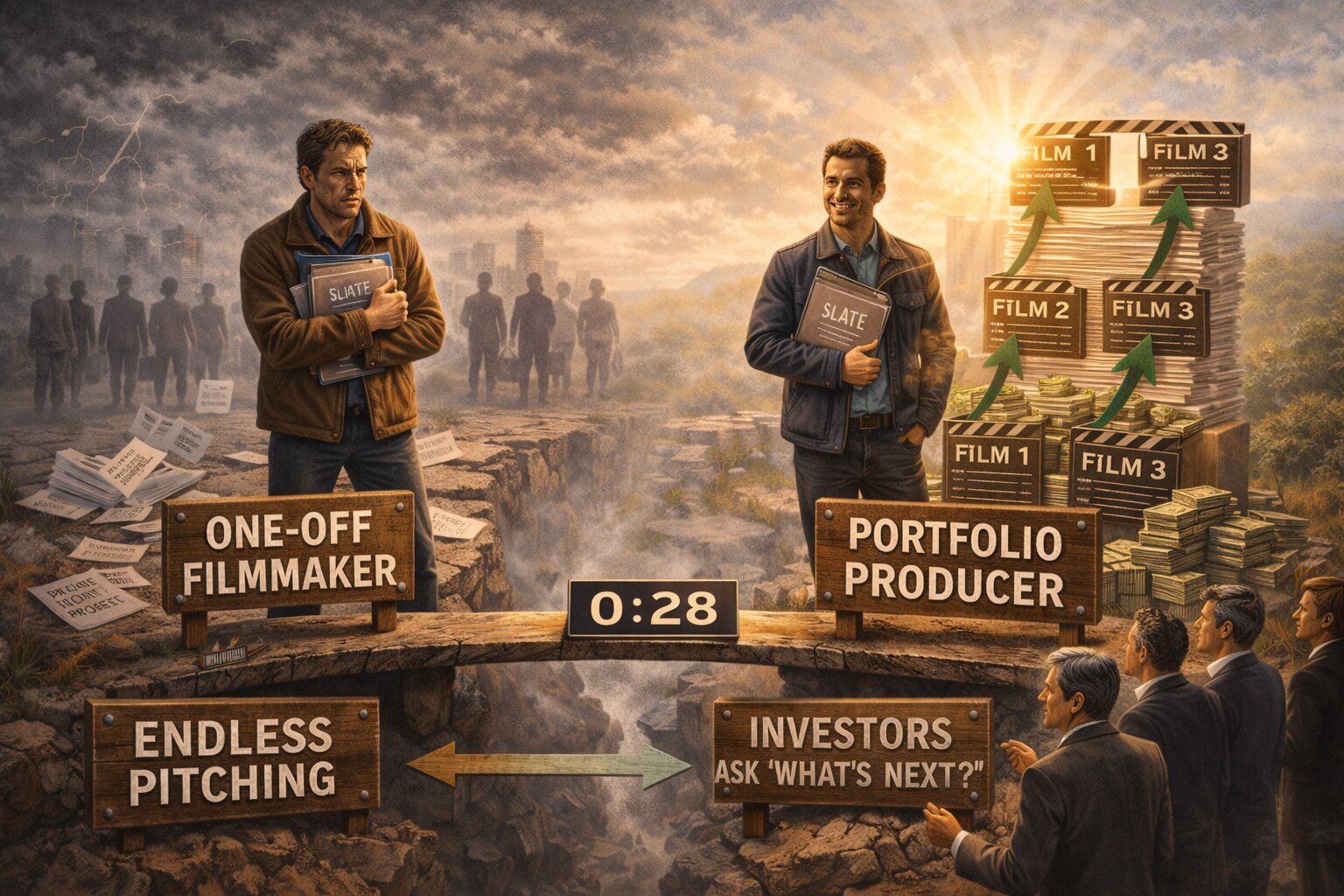
One-off filmmakers chase funding endlessly. Portfolio producers using film slate financing have investors asking what’s next. Here’s the shift.
You’re on your third year trying to fund a single film. You’ve had dozens of meetings. Multiple investors have shown interest. Nothing has closed.
Meanwhile, another producer you met at Sundance just closed their second film in 18 months. Same budget range. Similar genre. They’re already in pre-production on film three.
The difference isn’t talent. It’s thinking. They understand film slate financing while you’re still treating each project as an isolated event. That shift in perspective changes everything about how capital responds to you.
Why One-Off Thinking Keeps Producers Struggling
When you approach each film as a standalone bet, you reset to zero every single time.
You rebuild investor trust from scratch. You re-explain your process. You re-justify why anyone should believe you can execute. You negotiate terms as if you’ve never done this before.
This is exhausting. And expensive.
More importantly, it signals to capital that you’re not a system. You’re a single transaction. And single transactions carry more risk than repeatable systems.
Investors who focus on independent film don’t want to fund your movie. They want to back a producer who generates predictable returns across multiple projects.
One film can disappoint. A portfolio absorbs variance.
What Investors Actually Want Long-Term
At film markets in Cannes, Berlin, or Toronto, the producers who command real attention aren’t the ones pitching a great script. They’re the ones presenting a slate.
Sophisticated capital looks for:
Repeatability: Can you deliver projects consistently, not just once?
Risk distribution: Are you balancing safer commercial projects with riskier artistic ones?
Strategic growth: Does each film strengthen relationships that benefit the next?
Producer discipline: Do you know when to say no to projects that don’t fit your portfolio thesis?
This is why producers who think in terms of film slate financing close faster, raise larger rounds, retain investors across projects, and command better terms.
They’re no longer selling hope. They’re offering participation in a proven system.
The Producers Guild Model for Portfolio Thinking
The Producers Guild of America regularly emphasizes that professional producing is about building sustainable careers, not chasing individual projects.
The producers who last decades understand something critical: your second film should be easier to finance than your first. Your third easier than your second.
If that’s not happening, you’re doing something structurally wrong.
Portfolio thinking means each project creates infrastructure for the next:
- Relationships with the same gap financiers who now trust your execution
- Returning investors who saw returns on film one
- Sales agents who know you deliver on time and on budget
- Crews and service companies in territories where you’ve proven yourself
Momentum compounds. But only if you’re intentional about it.
Designing Your Film Slate Financing Strategy Backwards
A film slate isn’t a random collection of scripts you like. It’s designed with intentional balance.
That means thinking about:
Budget diversity: Mixing $1M, $3M, and $5M projects so you’re not always chasing the same capital
Genre balance: Pairing commercially safer films (thriller, horror) with riskier artistic projects (character drama, experimental)
Territory leverage: Shooting multiple films in the same region to maximize relationships and incentive efficiency
Investor appeal: Creating entry points for different types of capital (some want safer returns, others want prestige)
When done correctly, your $1M horror film funds your $3M drama. The drama builds credibility that unlocks the $5M thriller. Each success makes the next easier.
This is how production companies like A24, Blumhouse, and Neon operate. They think in systems, not singles.
Why Location Becomes a Strategic Portfolio Advantage
One of the most underutilized strategies in film slate financing is geographic consistency.
Producers who understand incentives don’t treat location as a per-project creative decision. They build relationships in specific territories and return repeatedly.
Shooting in Montreal, Prague, or Bucharest isn’t just about tax credits on one film. It’s about:
- Developing trusted relationships with local service companies
- Understanding exactly how to maximize incentives in that jurisdiction
- Building crew familiarity that increases efficiency
- Reducing unknowns that typically inflate budgets
When you shoot your second film in the same region, everything gets faster and cheaper. Investors notice.
By film three, you’re no longer explaining why Montreal makes sense. You’re known as the producer who executes efficiently in Montreal. That reputation has value.
The Canadian Film or Video Production Tax Credit and similar programs in Eastern Europe become infrastructure, not variables.
From Selling Films to Managing Capital
At a certain level, the role fundamentally shifts.
You stop being someone who asks for money. You become someone who allocates capital on behalf of investors.
This is when:
- Investors approach you asking what you’re developing next
- Sales agents bring opportunities to you instead of the reverse
- Talent takes your calls faster because they know you close deals
- Your track record precedes your pitch deck
This doesn’t happen after one successful film. It happens after demonstrating you can repeat the process with discipline.
One film proves you got lucky. Three films prove you have a system.
The $10 Million Slate vs. Three $3.3 Million Singles
Here’s where portfolio thinking reveals its power.
Approach A: Three separate $3.3M films
- Raise equity three times (maximum friction)
- Renegotiate with gap financiers three times
- Build trust with investors from zero three times
- Total time to finance all three: 4-6 years
Approach B: One $10M slate
- Raise equity once for three films (shared risk)
- Negotiate gap financing once with volume leverage
- Investors participate in a portfolio, not single bets
- Total time to finance all three: 12-18 months
Same total budget. Radically different execution timeline.
Slate financing reduces transaction costs, increases investor confidence through diversification, and creates momentum that accelerates everything.
This is why experienced producers pitch slates, not projects.
What Portfolio Discipline Actually Looks Like
Thinking in terms of film slate financing requires something most filmmakers struggle with: saying no.
Every project you add should strengthen your strategic position, not dilute it.
Questions to ask before adding a film to your slate:
- Does this budget level align with the others, or does it create financing complexity?
- Does this genre balance commercial risk across the portfolio?
- Can this shoot in a territory where we already have relationships?
- Does this timeline work sequentially with other projects?
- Will this attract the same investor base or require starting over?
If the answer to multiple questions is no, the project doesn’t belong in this slate. Save it for later or let it go.
Strategic restraint is how you build a fundable portfolio instead of a random collection.
FAQ: Building a Film Slate Financing Strategy
Q: Do I need multiple finished scripts before pitching a slate?
A: Not necessarily. You need clear project summaries, realistic budgets, and a coherent strategic thesis. Some investors prefer optioned IP or completed scripts, but the key is demonstrating that you’ve thought through how the projects work together, not just individually.
Q: Can first-time producers use slate financing or is this only for established companies?
A: First-timers can absolutely use this approach, but you’ll likely start with a two-film slate rather than five. The key is showing that you understand portfolio logic and have structured projects that balance risk. Even with no track record, demonstrating systems thinking separates you from hobby filmmakers.
Q: Should all films in my slate be the same genre?
A: Not necessarily. Many successful slates balance genres to appeal to different investor appetites and spread commercial risk. A slate of three horror films might appeal to genre specialists, while mixing horror, thriller, and drama creates broader investor appeal. The key is coherent strategic logic, not genre uniformity.
The Career Shift That Changes Everything
Moving from project thinking to portfolio thinking isn’t just a financing strategy. It’s a career strategy.
Producers who master film slate financing stop grinding endlessly on single projects. They build infrastructure that generates consistent output.
The goal isn’t to make one film. The goal is to never start from zero again.
When you present yourself as a portfolio producer with a clear slate strategy, capital responds differently. You’re no longer a filmmaker asking for help. You’re a business offering returns.
That shift transforms every conversation you have.